You reduce patient call hold times by attacking their cause: more calls arrive than staff can answer at once, concentrated at daily peaks and driven by routine requests. There is no single fix, but four levers work together. First, deflect and resolve routine calls, scheduling, refills, and coverage questions, with automation so they never enter the human queue. Second, staff to the actual arrival pattern rather than a flat headcount, because volume spikes at the morning open and after results go out. Third, cut average handle time so each call clears faster. Fourth, offer a callback instead of an open-ended hold. The largest gains come from removing routine volume, because that is what fills the queue.
Why are patient hold times so long?
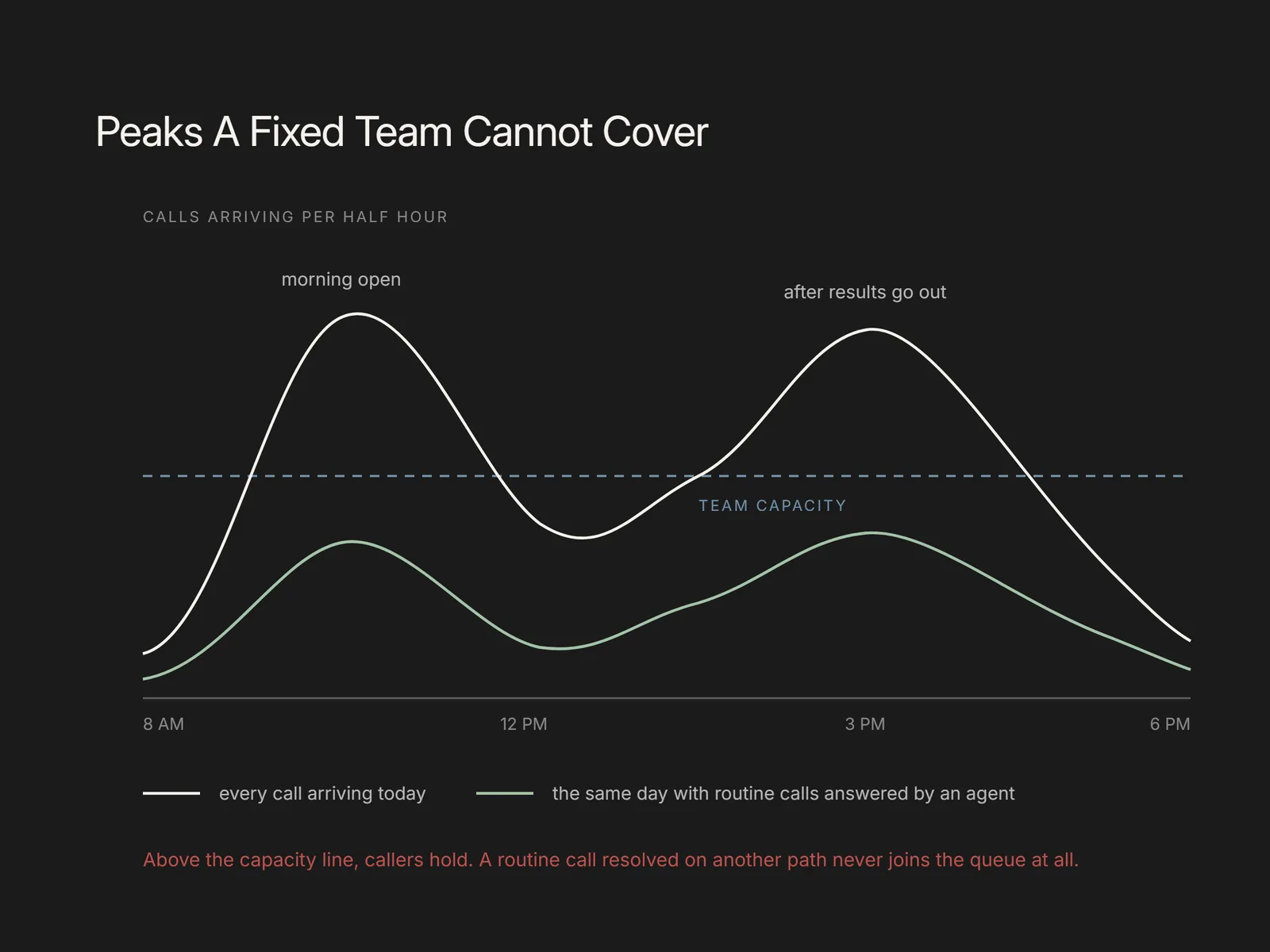
Hold time is a queue, and a queue forms whenever calls arrive faster than agents can clear them. In a medical practice this is not spread evenly across the day. Calls surge at the morning open, again after lunch, and in waves after appointment reminders, lab results, or billing statements go out. A fixed number of front-desk staff cannot expand to meet those peaks, so callers wait. The composition of the calls matters as much as the timing: a large share of the phone load is routine and repeatable, such as scheduling, refills, eligibility questions, and requests for records. An MGMA Stat poll found that phones remain a backlog costing medical practices time, with eligibility and authorization work and scheduling consuming most of it. When routine and clinical calls compete for the same lines, everyone waits.
Want this mapped against your own call and claim volume? Book a 30-minute audit
What is a good hold time or service level?
There is no universal target, but contact centers measure the same things. Service level is the share of calls answered within a threshold, often stated as a goal like answering 80 percent of calls within 20 to 30 seconds. Average speed of answer is the mean wait before an agent picks up. The abandonment rate is the share of callers who hang up before reaching anyone, and it is the metric that most directly reflects patient experience, because an abandoned call is a patient who gave up. Read these three together, because a good average speed of answer can hide a peak-hour spike where abandonment climbs. The right threshold depends on your patient population and the mix of urgent versus routine calls, so set a target you can staff to and that holds up during your busiest hour, not just on average.
See what AI can run at your facility. In a 30-minute audit we map the calls, eligibility, and follow-ups Flexbone can take off your team first.
Book an auditHow do AI voice agents cut hold times?
An AI voice agent changes the math of the queue. A human agent handles one call at a time, so when calls arrive faster than agents are free, callers stack up on hold. An AI voice agent answers every incoming line the moment it rings, so callers are not queued behind one another. It then resolves routine requests end to end: within the scope a practice defines, it can book or reschedule a visit, take a refill request, or verify coverage, and write the result back to the system of record. Calls it should not handle, a clinical question or an upset caller, it escalates to staff with the transcript attached. Because the agent answers many calls at once and finishes the routine ones itself, it removes the peak-load problem that a fixed number of human agents cannot absorb. Payer calls are a clear case: eligibility checks and claim-status calls, the work behind the HIPAA 270/271 and 276/277 transactions, can move off the human queue entirely, since an agent places them to the payer or a connection like Availity and reads back the result. This is the model behind Flexbone's healthcare calls and its AI patient coordinator.
What is call deflection, and how does it help?
Call deflection is resolving a caller's request without adding it to the queue a human agent has to work. The word is often misused to mean pushing callers to voicemail or an IVR menu, but that is not real deflection, because the request is not finished and the patient calls back. True deflection means the request is completed on another path: a self-service channel the patient actually uses, such as online scheduling, or an AI voice agent that finishes the task on the call. It helps hold times because it removes volume at the source. Every routine call an automated path resolves never joins the line, which shortens the wait for calls that genuinely need a person, such as clinical triage. The highest-value calls to deflect are the high-volume, repeatable ones: appointment booking, refill requests, and coverage checks. Insurance work is a strong candidate, because eligibility and status calls are structured and payer-specific: a Medicare or Medicaid check follows a defined transaction rather than a free-form conversation. See insurance eligibility verification for how that workflow moves off the phone queue.
How do you staff a call center to demand, and where does callback fit?
You staff to the arrival pattern, not to a flat daily headcount. Measure call volume by half-hour across a representative week so you can see where the peaks actually fall, then align coverage to that shape rather than spreading staff evenly. The limit of pure human staffing is that peaks are expensive to cover, because you either overstaff the quiet hours or accept longer holds during the surge. A callback option is the relief valve for those surges. Instead of holding, the caller keeps their place in the virtual line and hangs up, and the system rings back when an agent is free, which lowers the abandonment rate because a patient is more willing to wait off the phone. A callback does not add capacity, though, so pair it with automation: an AI voice agent absorbs routine volume during the peak, flattening the spike so the team you have can hold the service level steady.
AI voice agents reduce hold times by answering every line at once so callers are never queued, resolving routine scheduling, refill, and coverage requests end to end, and moving payer calls off the human queue entirely, which flattens the daily peaks a fixed headcount cannot cover. To see where this fits your phones, book a call with Flexbone and we will run a quick audit of what an AI voice agent can take off your queue.