
Humana prior authorization is a coverage review that Humana requires before it will pay for certain services, drugs, or equipment. The ordering provider submits clinical information to show the request meets Humana's medical-necessity and coverage rules for that member's plan, and Humana approves, denies, or asks for more. Categories that commonly require it include advanced imaging such as MRI, CT, and PET, many specialty and injectable drugs, some outpatient procedures and surgeries, durable medical equipment (DME), and post-acute and home health services. Humana is a large Medicare Advantage payer, so many of its rules follow CMS Medicare Advantage requirements. Requirements vary by plan and change over time, so the reliable step is to check each service against Humana's current list for the specific plan before scheduling.
What requires Humana prior authorization?
Humana groups its prior authorization requirements by service type, and the categories that most often need review are consistent across payers even though the exact codes differ. Advanced imaging (MRI, CT, PET, nuclear cardiology) is a frequent trigger. Many specialty and injectable drugs, including infused biologics and some high-cost oral therapies, require review, and Humana often routes these through a pharmacy or medical-benefit pathway depending on how the drug is administered. Some outpatient procedures and surgeries, durable medical equipment, and post-acute and home health services (skilled nursing, home health visits, inpatient rehabilitation) also commonly require authorization. Because Humana offers Medicare Advantage, commercial, and other plan types, the precise list depends on the member's plan and can change quarter to quarter. The dependable habit is to verify each service against Humana's current requirement for that plan rather than relying on last year's list.
Want this mapped against your own call and claim volume? Book a 30-minute audit
How do you submit a Humana prior authorization?
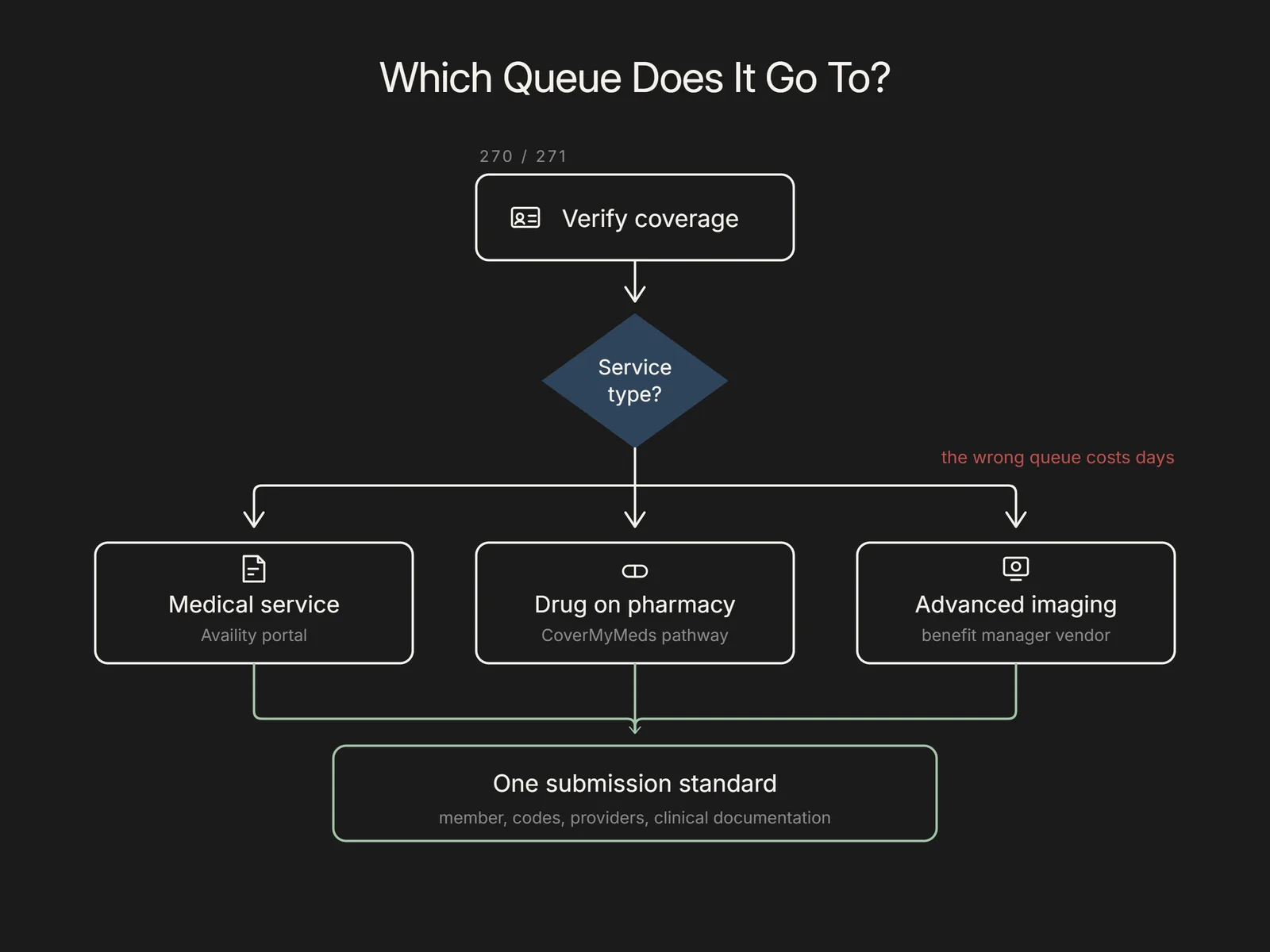
For most medical services, Humana accepts electronic prior authorization requests through the Availity provider portal, which is Humana's primary channel for submitting requests and checking status. A submission generally includes the member's information, the requested service or item with its codes, the ordering and servicing providers, and the clinical documentation that supports medical necessity, such as chart notes, prior treatment history, and relevant test results. Medication requests are often handled through CoverMyMeds or a pharmacy benefit pathway rather than the medical portal. Humana also uses benefit managers for some imaging, so an advanced-imaging request may route to a specialty vendor instead of the general medical queue. Before you submit, confirm the member's eligibility and active coverage, since an eligibility mismatch is a common and avoidable reason a request stalls. Standardized eligibility checks use the 270/271 electronic transaction that CMS maintains under Administrative Simplification.
See what AI can run at your facility. In a 30-minute audit we map the calls, eligibility, and follow-ups Flexbone can take off your team first.
Book an auditHow long does Humana prior authorization take?
Decision timeframes vary by plan and by whether the request is standard or expedited. Because Humana is one of the larger Medicare Advantage payers, many of its plans operate under CMS Medicare Advantage rules, which set a standard organization determination within a defined timeframe and a faster expedited determination when waiting could seriously jeopardize the patient's health. When a case is urgent, request an expedited review and document why the standard timeline would be harmful, because that is what supports the faster track. Commercial and other Humana plans may follow different timelines, so the practical step is to confirm the applicable timeframe for the specific plan at submission and to note the date and reference number. Electronic submission through Availity typically returns status faster than paper or phone follow-up, and checking status through the portal avoids hold time on requests that are simply pending.
Why do Humana prior authorizations get denied?
Most denials fall into a few patterns, and many of them are about documentation rather than the underlying clinical decision. The frequent causes are missing or incomplete clinical records, a service that does not meet the plan's medical-necessity criteria as written, a coding mismatch between the request and the documentation, a member-eligibility or coverage error, and a request sent to the wrong pathway (for example, a drug submitted on the medical benefit when it belongs on the pharmacy benefit). A specific denial reason is useful precisely because it tells you what to fix: an incomplete-documentation denial usually calls for a corrected resubmission with the missing notes, while a medical-necessity denial may need a peer-to-peer review or a formal appeal that cites the payer's own policy. Reading the denial reason carefully, rather than resubmitting the same packet, is what shortens the path to approval.
How can a practice reduce Humana prior authorization delays?
The prior authorization workload is heavy across payers, not only Humana. The American Medical Association reports that practices handle about 39 prior authorizations per physician per week and spend roughly 13 hours on them, so small process gains compound quickly. A few steps help with Humana specifically. Verify eligibility and coverage before you submit so an avoidable mismatch does not bounce the request. Confirm whether the service routes to Availity, to CoverMyMeds, or to an imaging benefit manager, since sending it to the wrong queue costs days. Build a service-level checklist of what documentation Humana commonly asks for so the first submission is complete. Track status proactively instead of waiting, and when a denial arrives, act on the stated reason rather than resubmitting blindly. Practices we work with also automate the repetitive parts of this flow: our prior authorization automation submits requests and checks status, insurance eligibility verification confirms coverage before a request goes out, and AI denials management reads the denial reason and drafts the corrected resubmission or appeal for a person to review.
If your team spends its week on Humana prior authorization, we can map which parts of that workload AI can take off your staff and which stay with clinical reviewers, starting from a sample of your own requests. To scope it, book a call with Flexbone.