
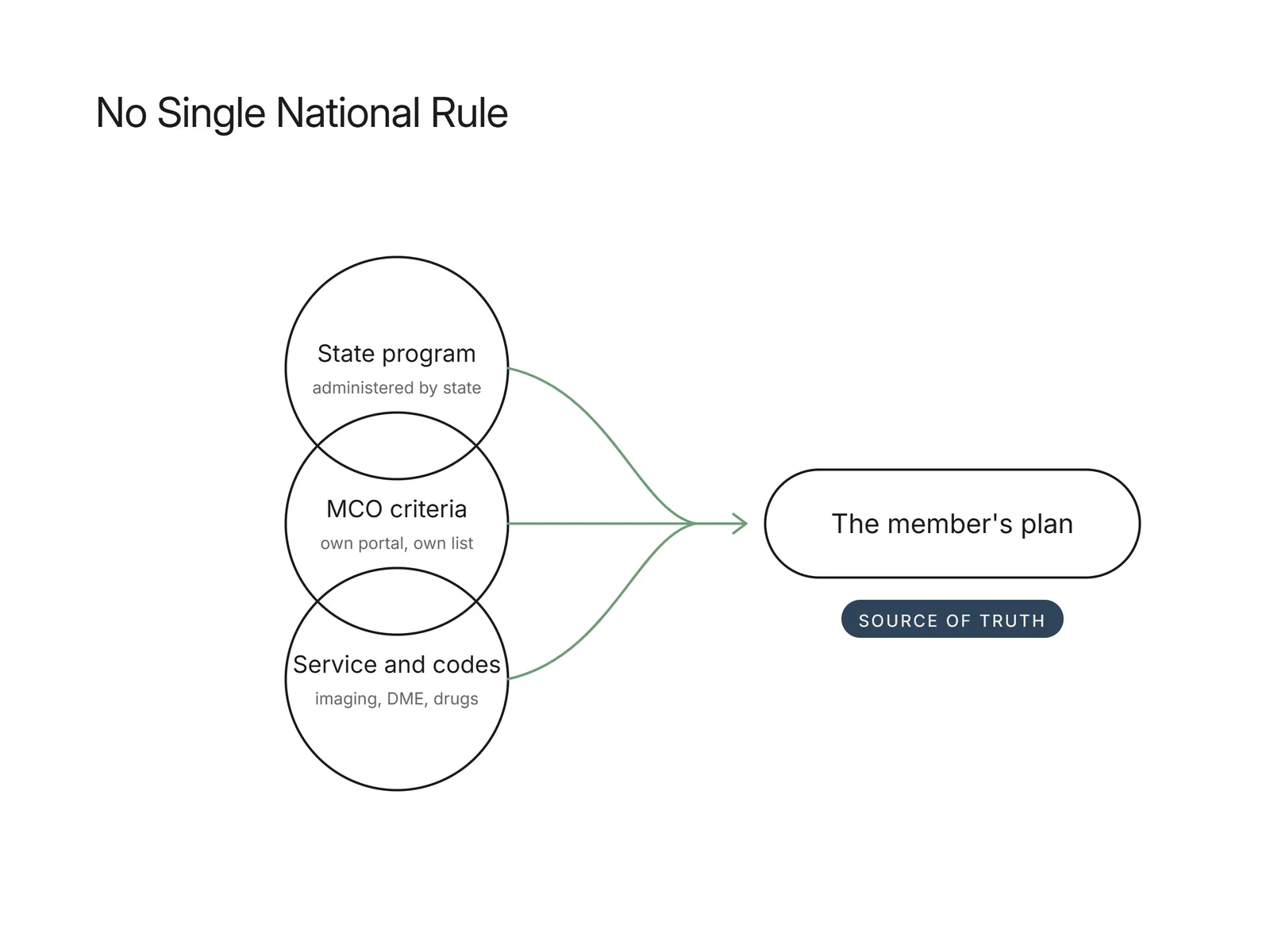
Medicaid prior authorization is the approval a state Medicaid program or its contracted health plan requires before it will cover certain services, drugs, or equipment. The defining nuance is that Medicaid is administered by each state, and most states contract managed-care organizations (MCOs) to run their programs, so the rules, portals, covered services, and decision timelines vary by state and by the member's specific plan. There is no single national Medicaid prior authorization process. The member's exact state program or MCO is the source of truth. In practice, a provider confirms the member's plan, checks whether the specific service needs approval, submits documentation and codes through the plan's channel, and tracks the request to a decision before delivering the service.
Does Medicaid require prior authorization?
Medicaid often requires prior authorization, but not for every service, and the answer depends on the state and the specific plan. Because Medicaid is run by each state, and most states delegate day-to-day coverage decisions to contracted managed-care organizations, each program publishes its own list of services that need approval before they are delivered. A service that needs prior authorization in one state or plan may not need it in another. Routine, low-cost, and emergency care generally does not require approval, while higher-cost, elective, and specialty services commonly do. The reliable way to answer the question for a given patient is to identify the member's specific Medicaid program or MCO and check that plan's current requirements rather than assume a blanket rule.
Want this mapped against your own call and claim volume? Book a 30-minute audit
What does Medicaid require prior authorization for?
The categories that commonly require prior authorization across many state Medicaid programs include advanced imaging (such as MRI, CT, and PET), many specialty and high-cost drugs, certain surgical and elective procedures, non-emergency medical transport, durable medical equipment (DME), and inpatient hospital stays. Some programs also require approval for extended therapy courses, select outpatient services, and out-of-network care. The specific list, the codes that trigger a review, and the clinical criteria all vary by state and plan, so a service that is on one program's list may be excluded from another's. Before scheduling, verify the exact service against the member's plan. The same discipline that supports insurance eligibility verification applies here: confirm coverage and requirements up front, because catching a missing authorization after the service is delivered is far harder to correct.
How do you submit a Medicaid prior authorization?
Submitting a Medicaid prior authorization starts with identifying the member's exact plan, because the channel and requirements belong to that plan rather than to Medicaid as a whole. Once you know whether the member is in fee-for-service Medicaid or a specific MCO, use that plan's stated submission channel, which is commonly an online provider portal, and in some cases a fax line or phone intake. A complete request generally includes the member's identifiers, the procedure or drug codes, the ordering and servicing provider details, supporting clinical documentation, and a medical-necessity justification that maps to the plan's criteria. After submitting, record the reference or tracking number and follow up until the plan returns a decision. The volume of these requests is significant across a practice: the American Medical Association reports physicians handle about 39 prior authorizations per week, taking roughly 13 hours of physician and staff time, which is why the confirmation and submission steps benefit from consistent, repeatable handling.
See what AI can run at your facility. In a 30-minute audit we map the calls, eligibility, and follow-ups Flexbone can take off your team first.
Book an auditWhy do Medicaid prior authorizations get denied?
Medicaid prior authorizations commonly get denied for a small set of reasons that are usually identifiable and often correctable. The frequent causes include missing or incomplete clinical documentation, a medical-necessity criterion that the submission did not directly address, submitting to the wrong plan or program for that member, using codes that do not match the requested service, or requesting a service that is simply not covered under that specific state program. Because rules vary by state and plan, a request built against one plan's criteria can fail under another's even for the same procedure. When a denial arrives, the practical response is to read the stated reason, close the specific gap, and resubmit or appeal with the requested information attached. Many denials that stem from documentation or criteria gaps can be resolved this way. A disciplined, tracked path from denial to resubmission is the core of effective AI denials management, which turns a denial into a corrected request rather than lost revenue.
How do fee-for-service and managed Medicaid differ?
Fee-for-service (FFS) Medicaid and managed Medicaid differ in who reviews the request and under which rules. In FFS Medicaid, the state agency or a contractor it designates reviews prior authorization requests directly under the state's own criteria and through the state's channel. In managed Medicaid, the member is enrolled in a managed-care organization that operates within the state's framework but applies its own coverage criteria, its own portal, and sometimes its own list of services that require approval. For a provider, the first step is to determine which model covers the member, because the submission channel, the documentation format, and the specific requirements can differ between the state program and the MCO. Many states run both models for different populations, so two patients in the same state can follow different prior authorization paths.
How does electronic exchange fit into Medicaid prior authorization?
Electronic data exchange reduces some of the manual work around Medicaid prior authorization, though the degree of automation varies by state and plan. Standardized transactions support the eligibility and coverage checks that precede an authorization request: the CMS eligibility inquiry and response standard (270/271) lets a provider system ask a plan about a member's coverage and receive a structured answer, which helps confirm the right plan before a request is built. For prior authorization itself, adoption of electronic submission differs across programs and MCOs, so many practices still work through a mix of portals, and in some cases fax or phone, plan by plan. Mapping which of your Medicaid payers accept which channels, and standardizing how requests are prepared and tracked, is the difference between authorization work that scales and work that absorbs staff time unevenly. For a broader view across public programs, see our guide to Medicare and Medicaid prior authorization.
Flexbone deploys AI voice and browser agents that handle the repeatable parts of this workload: confirming the member's plan, checking whether a specific service needs approval, preparing and submitting requests through each plan's channel, and following up until a decision is recorded, with a person reviewing clinical and medical-necessity judgments. To map what an agent can take off your team's Medicaid prior authorization workload, book a call with Flexbone.