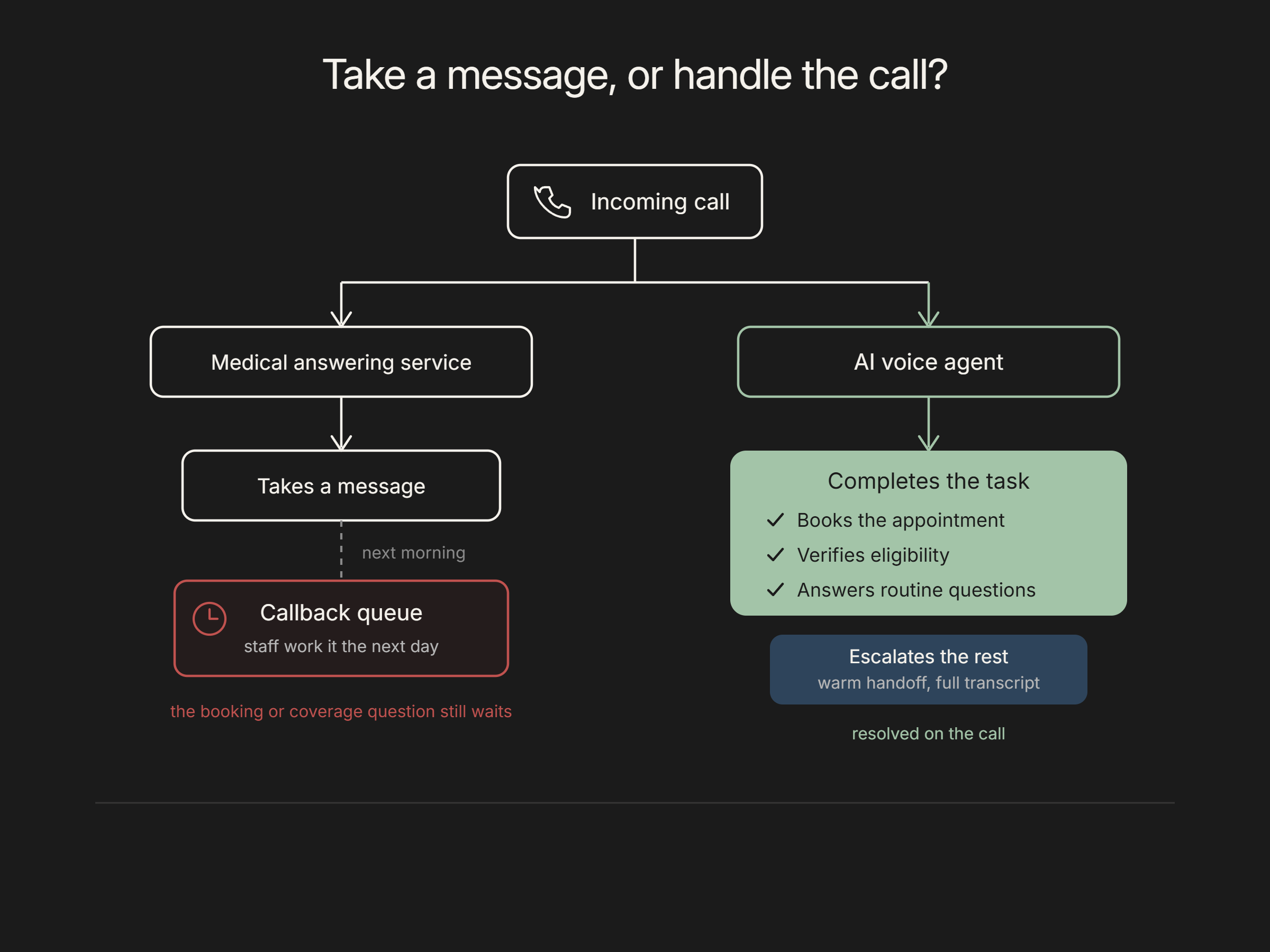
A medical answering service uses human operators to answer calls after hours and take messages that staff return later, while an AI voice agent answers calls at any hour and completes the request in the moment: it schedules appointments, verifies insurance coverage, answers common questions, and escalates urgent or clinical calls to a person. The practical difference is what the caller gets. A traditional medical answering service records who called and why, then hands your team a queue of callbacks the next morning. An AI answering service resolves the routine work itself and passes only the calls that need a human, with a full transcript. Both can be HIPAA compliant under a business associate agreement, and both matter because phone work is a documented front-desk load: in one MGMA poll, practice staff spent the most phone time on eligibility and prior authorization (45%) and scheduling (31%).
What does a medical answering service do?
A medical answering service answers calls that the front desk cannot reach, usually after hours, on weekends, or during overflow, and relays a message to the practice. Human operators pick up under the practice's script, collect the caller's name, reason, and callback number, and either page the on-call clinician for anything urgent or hold the message for the next business day. The value is coverage and a live voice when the office is closed, which keeps patients from reaching a dead line. The limit is that the operator takes a message rather than completing the task, so scheduling, refill requests, and coverage questions still land back on staff. That backlog carries a real cost: MGMA notes that no-shows and missed appointments are estimated to cost the healthcare industry around $150 billion annually, and a message queue does nothing to book the slot that prevents them. For a fuller picture of what these services cover, see our overview of the medical answering service.
Want this mapped against your own call and claim volume? Book a 30-minute audit
What does an AI voice agent do differently?
An AI voice agent answers the same calls but finishes the work instead of recording it. It books, moves, and cancels appointments against the practice's calendar rules, runs an insurance eligibility check before confirming a visit, answers routine questions from the practice's own knowledge base, and escalates clinical or edge-case calls to a person with the full transcript attached. Because it is software, it takes many calls at once, so a spike in volume does not create a hold queue. It works the same way at 2 a.m. as it does at 2 p.m., which is where it overlaps with an automated healthcare receptionist that handles the daytime front desk. The table below sets the two side by side.
The practical difference is that an agent completes the transaction rather than taking a message: it books into the EHR, confirms, and closes the call. Flexbone builds agents that way and keeps a person on clinical and urgent calls, based on the practice's own recordings. See healthcare call automation.
| Capability | Traditional medical answering service | AI voice agent |
|---|---|---|
| Core action | Takes a message for staff to act on | Completes the task (schedule, verify, answer) |
| Hours | 24/7 human operators | 24/7, many concurrent calls at once |
| Cost model | Per-minute operator time plus add-on fees | Volume or capability tiers |
| HIPAA | Business associate agreement required | Business associate agreement required |
| Escalation | Message relayed or on-call clinician paged | Rules-based warm handoff with transcript |
See what AI can run at your facility. In a 30-minute audit we map the calls, eligibility, and follow-ups Flexbone can take off your team first.
Book an auditHow much does a medical answering service cost compared with an AI voice agent?
The two price on different meters. A traditional medical answering service usually bills by operator time, so the monthly cost scales with call minutes, and many providers add fees for HIPAA-compliant handling and after-hours or holiday coverage. That means a busy line gets more expensive exactly as call volume grows. An AI answering service does not run a per-minute operator meter, so its pricing tends to track capability and volume tiers rather than raw minutes, and it can take concurrent calls without adding staff. The number that matters for a practice is not the invoice alone but the cost per task completed. A human operator's per-minute charge buys a message; the same spend on an AI agent can buy a booked appointment, a verified eligibility result, and a logged call. Given that phone work already concentrates on eligibility and scheduling, the tasks an AI agent can finish are the ones consuming the most staff time in the first place.
Is a medical answering service HIPAA compliant, and how are messages handled?
A medical answering service can be HIPAA compliant, and for patient calls it must be, because it creates and handles protected health information on the practice's behalf. Under HIPAA, a service that takes patient calls is a business associate, so the practice needs a signed business associate agreement and the vendor is directly responsible for safeguarding that information. HHS describes these obligations in its guidance on business associates, which requires the vendor to limit uses and disclosures, apply appropriate safeguards, and report any use not permitted by the contract. This applies equally to a human answering service and an AI voice agent: both handle call content, recordings, and transcripts, so both need the BAA, encrypted storage, access controls, and activity logging. When you evaluate either option, confirm the vendor will sign a BAA, ask how recordings and transcripts are stored and for how long, and check whether it supports additional standards such as SOC 2. A vendor that will not commit to a BAA should not handle patient calls.
How Flexbone runs an AI answering service
Most answering services stop at taking a message, which leaves your staff every callback, booking, and verification the next morning. Flexbone runs a set of coordinated agents instead: a voice agent answers the call, a browser agent works inside your scheduling and payer systems, and a document agent reads and writes structured notes. Together they answer each call, book or reschedule appointments, verify eligibility with the payer, and write the result back to the EHR, whether that is athenahealth, eClinicalWorks, NextGen, or Epic. The approach is audit-first, meaning every action is logged and reviewable, and the platform is HIPAA compliant and SOC 2 aligned. When a call falls outside the rules you set, the agent hands it to a staff member with the full transcript so the person picks up in context rather than starting over. This is the same mechanism behind our AI patient coordinator, applied to inbound and after-hours calls. For how Flexbone deploys voice agents on both the inbound and outbound side, see AI voice agents for healthcare.
Which should a practice choose, a medical answering service or an AI voice agent?
Choose based on what you need the calls to accomplish rather than on the label. If your only gap is after-hours message-taking and a live human voice for a low volume of calls, a traditional medical answering service covers that at a predictable cost. If the problem is unanswered calls, callback backlogs, long hold times, or scheduling and eligibility volume that ties up the front desk, an AI voice agent that completes those tasks and escalates the rest will remove more work per dollar. Many practices run a hybrid: the AI agent resolves routine scheduling, refill, and coverage calls and routes anything clinical or unusual to staff or an on-call clinician. The deciding question is simple. Do you need someone to take a message, or do you need the call handled? If it is the latter, hear the agent run your own call types: book a demo.