A medical necessity denial is a payer's decision that a service was not reasonable and necessary for the patient's condition under the plan's coverage criteria, so it is not covered. It is a clinical coverage judgment, distinct from a coding error or an eligibility problem. The payer measures the claim, its diagnosis, and its documentation against a written standard, such as a Medicare coverage determination or the plan's own medical policy, and decides the care did not meet that bar. Prevention depends on documentation and, for many services, prior authorization: confirm the coverage rules and any authorization requirement before care, and record the clinical rationale clearly. When a claim is denied anyway, the fix is a documented appeal that shows the service met the criteria, often supported by a peer-to-peer review with the payer's medical director.
What is a medical necessity denial?
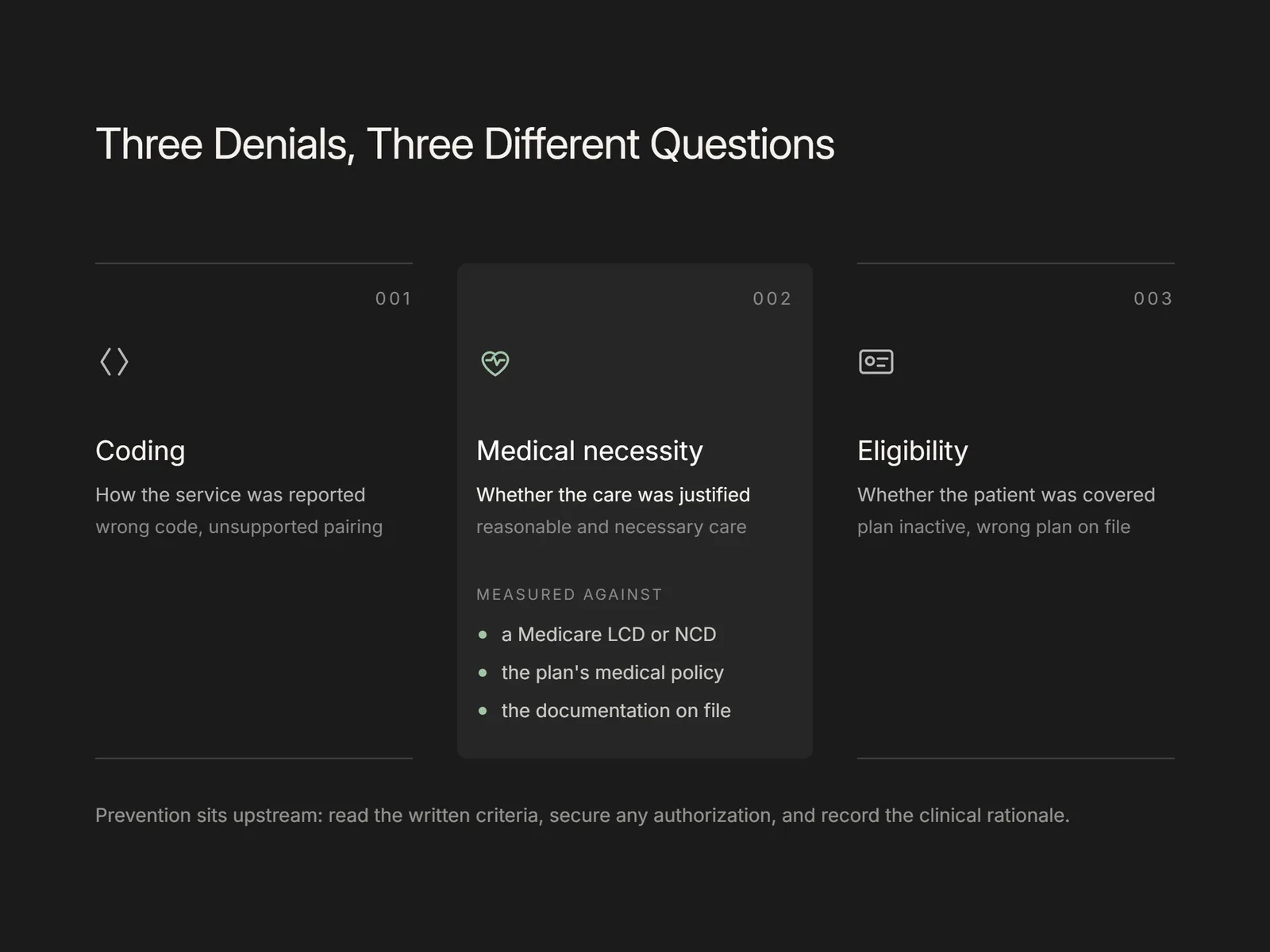
A medical necessity denial is a payer decision that a billed service does not meet the plan's definition of reasonable and necessary care for the patient's condition, so the plan will not pay for it. Every payer maintains coverage criteria, written rules describing when a service is appropriate: the qualifying diagnoses, the clinical circumstances, and sometimes the treatments that must be tried first. When a claim arrives, the payer measures the diagnosis and documentation against those criteria, and if the service falls outside them, or the record does not show that it fell inside them, the claim is denied for medical necessity. On a Medicare remittance this often reads as a "reasonable and necessary" determination, and commercial payers use similar language tied to their own medical policies. Separate this from adjacent denials: a coding denial is about how the service was reported and an eligibility denial is about whether the patient was covered, while a medical necessity denial concerns the clinical justification for the care itself.
Want this mapped against your own call and claim volume? Book a 30-minute audit
What causes medical necessity denials?
Most medical necessity denials trace back to a mismatch between the service and the documentation meant to justify it. A frequent cause is a diagnosis that does not fall within the payer's covered indications for the procedure, so the claim looks unsupported on its face. Another is thin documentation: the service may have been appropriate, but the note does not record the history, prior treatments, or findings that establish why. Skipping a required step, such as a conservative treatment the policy expects before a more advanced one, is a common trigger, as is billing a service the payer considers experimental or not covered for that condition, or failing to obtain prior authorization when the payer required it. The administrative volume behind this is substantial: the American Medical Association reports physicians complete about 39 prior authorizations per week, spending roughly 13 hours on them, and each interaction is a point where a coverage requirement can be missed and surface later as a denial.
What are LCDs and NCDs?
Local Coverage Determinations (LCDs) and National Coverage Determinations (NCDs) are Medicare's published coverage criteria, and the clearest example of how "medical necessity" is defined in writing. An NCD is a decision made at the national level about whether Medicare covers a particular item or service across the whole program; when an NCD exists, it sets the rule everywhere. An LCD is issued by a Medicare Administrative Contractor, the regional entity that processes claims for a defined geographic area, and applies within that contractor's jurisdiction. LCDs are where much of the practical detail lives: they typically list the diagnosis codes and clinical conditions under which a service is considered reasonable and necessary, along with documentation requirements and any limits on frequency. Their value is that they make the standard explicit, so before a Medicare service you can read the applicable determination, confirm the patient's situation fits the covered indications, and document accordingly. Commercial payers do not use LCDs and NCDs, but they publish analogous medical policies that serve the same function, so checking the written criteria before care applies across payers.
See what AI can run at your facility. In a 30-minute audit we map the calls, eligibility, and follow-ups Flexbone can take off your team first.
Book an auditHow do you prevent medical necessity denials?
Prevention comes down to checking coverage criteria before the service and documenting the clinical rationale so it holds up on review. Start with eligibility and benefits: confirm the patient is covered and pull the plan's rules for the planned service, using the standardized eligibility exchange that Medicare and other payers support under the 270/271 eligibility transaction. Next, read the applicable coverage policy, whether a Medicare LCD or NCD or a commercial medical policy, and check that the diagnosis matches the covered indications and any required prior steps are satisfied. If the service needs prior authorization, obtain it before care, because an approved authorization on record removes a common route to a later denial. Then document deliberately: the note should record the history, findings, treatments already tried, and the reason this service is the appropriate next step, so the claim carries its own justification. Building these checks into intake and scheduling, rather than the moment of billing, is what shifts denials from a recurring cleanup task to an exception.
How do you appeal a medical necessity denial?
You appeal a medical necessity denial by submitting a documented argument that the service met the plan's coverage criteria for that specific patient. Begin by reading the denial to identify the exact reason and the policy the payer applied, then gather the clinical records that speak to it: the physician's notes, test results, prior treatments, and anything that establishes the qualifying diagnosis. Write an appeal that maps those records directly to the criteria, citing the relevant LCD, NCD, or commercial medical policy by name so the reviewer can see the service fits the written standard. For many denials, the most effective step is a peer-to-peer review, where the treating physician discusses the case with the payer's medical director and can resolve a dispute a paper appeal cannot. File within the payer's appeal deadline, since a late appeal is commonly rejected without review. The economics reward this work: in an analysis of ACA marketplace plans, KFF found insurers denied about 20 percent of in-network claims in 2023 while consumers appealed fewer than 1 percent, so a large share of denied claims are never contested even when the underlying care was appropriate.
How Flexbone helps with medical necessity denials
Flexbone is audit-first: before automating anything, we review a sample of your denials to find where medical necessity is costing you, whether the pattern is missed prior authorizations, a mismatch between diagnosis and policy, or documentation that never made it onto the claim. Our AI voice and browser agents then work inside your existing EHR, billing system, and payer portals. Up front, the agents check coverage criteria and confirm any prior authorization requirement before a service, the same logic behind our prior authorization automation and insurance eligibility verification. When a denial does land, the agents assemble the appeal documentation, match the clinical record to the applicable coverage policy, and route each appeal to your team for review before it is filed, which is the core of our AI denials management work. Every action stays under human review, and the workflow is HIPAA compliant.
AI agents can take the repetitive parts of this work off your team: checking coverage criteria and prior authorization requirements before a service, then assembling the documentation an appeal needs when a claim is denied for medical necessity. If you want to see where that would help, book a call with Flexbone and we will run a quick audit of what AI can take off your denials work.