
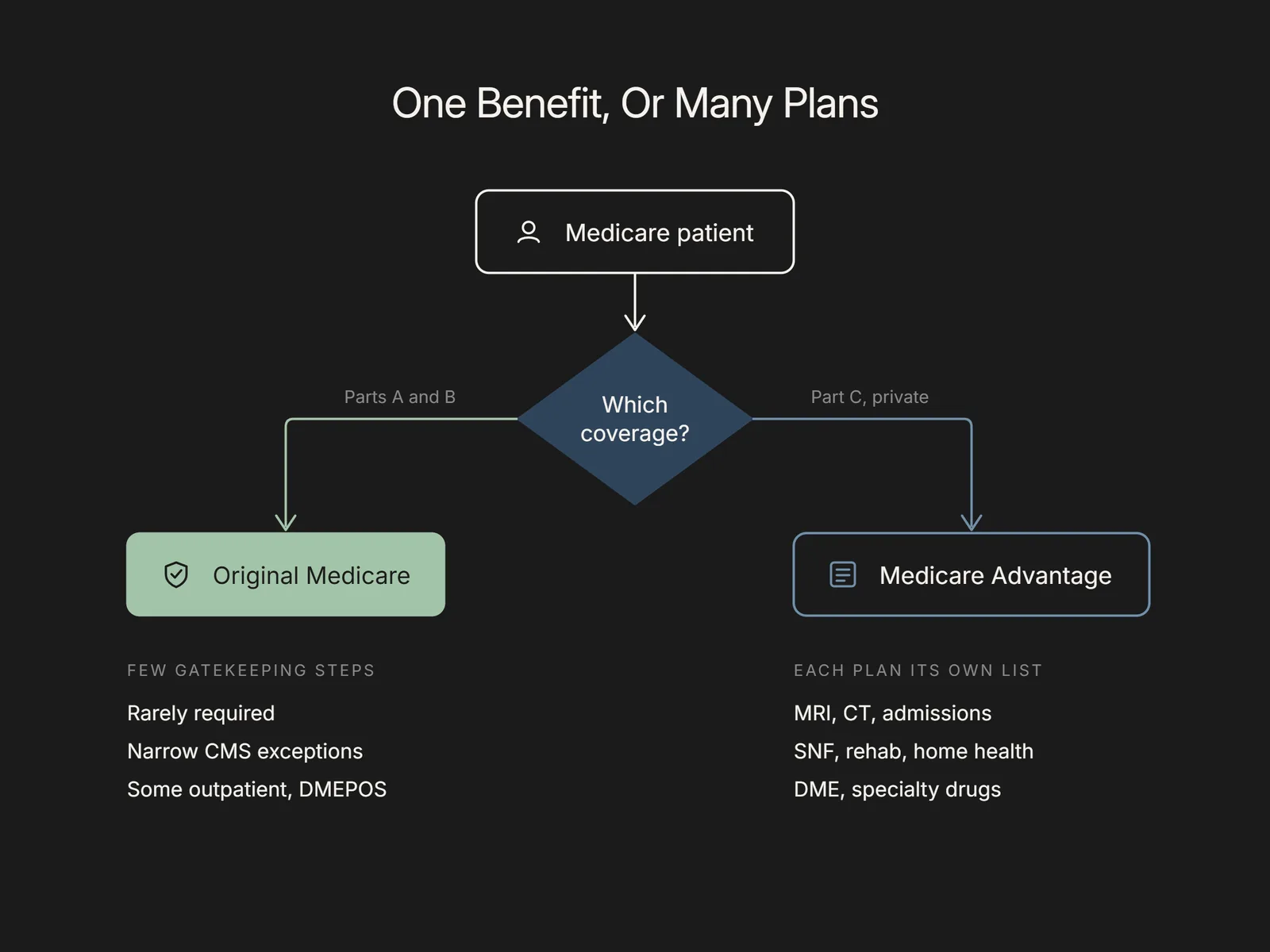
Original Medicare rarely requires prior authorization for most services, while Medicare Advantage (Part C) plans, which are run by private insurers under contract with CMS, commonly do. Under Original Medicare (Parts A and B), a beneficiary can generally see any provider that accepts Medicare without asking the program for advance approval, apart from a limited set of exceptions. A Medicare Advantage plan sets its own utilization rules, so a service that needs no authorization under Original Medicare may require one under a Part C plan. The specific services, the documentation, and the submission channel all vary by plan. That is the core distinction: Original Medicare is a single federal benefit with few gatekeeping steps, and Medicare Advantage is many private plans, each with its own prior-authorization list and process.
Does Medicare require prior authorization?
For most services under Original Medicare, no. Parts A and B pay for covered hospital and medical services from any provider that accepts Medicare, and the program does not generally ask providers to obtain advance approval before delivering care. There are limited, specific exceptions where CMS has added prior authorization to curb improper billing, including certain hospital outpatient department services and some categories of durable medical equipment, prosthetics, orthotics, and supplies. Those exceptions are narrow and defined by CMS rather than left to a private insurer's discretion. So when people say "Medicare requires prior authorization," they are usually describing a Medicare Advantage plan, not Original Medicare. Confirming which type of coverage a patient has is the first step in any access workflow, because it changes whether authorization is needed at all.
Want this mapped against your own call and claim volume? Book a 30-minute audit
What does Medicare Advantage require prior authorization for?
It depends on the plan, but many Medicare Advantage plans commonly require prior authorization for higher-cost, elective, or post-acute services. Typical categories include advanced imaging such as MRI and CT, planned inpatient hospital admissions, skilled nursing facility and inpatient rehabilitation stays, home health, durable medical equipment, and some specialty and infusion drugs. Each plan publishes its own prior-authorization list and updates it periodically, so the requirement for a given CPT or HCPCS service is a property of the member's specific plan, not of Medicare as a whole. The practical implication for a practice is that you cannot assume a rule from one plan applies to another. Checking the patient's plan-specific list before scheduling, and confirming coverage and benefits through insurance eligibility verification, prevents the most common and avoidable delays.
How long does a Medicare Advantage prior authorization take?
CMS sets timeliness standards for Medicare Advantage organization determinations. There is a standard decision timeframe and a shorter expedited timeframe that applies when waiting the standard period could seriously jeopardize the member's life, health, or ability to regain maximum function. According to CMS, health plans exchange eligibility and benefit information through standardized 270 and 271 transactions, and confirming coverage up front reduces the back-and-forth that stretches an authorization out. The real-world clock is often longer than the headline standard because a plan can pause it to request additional clinical documentation. When a request is time-sensitive, using the expedited pathway and submitting complete records the first time are the two levers that most reliably shorten the wait. The exact day counts are defined by CMS and by each plan's own processing, so verify them against the plan's current rules rather than assuming a fixed number.
See what AI can run at your facility. In a 30-minute audit we map the calls, eligibility, and follow-ups Flexbone can take off your team first.
Book an auditWhy do Medicare Advantage prior authorizations get denied?
Denials fall into two broad groups: administrative and clinical. Administrative denials stem from missing or incomplete documentation, a coding mismatch, an eligibility error, or a request routed to the wrong plan or benefit. Clinical denials occur when the plan judges a service not medically necessary under its published coverage criteria. Many denials in practice are administrative, meaning a complete and well-documented submission would have avoided them, which is why front-end accuracy matters so much. The volume of this work is significant: the American Medical Association reports that physicians complete about 39 prior authorizations per week and spend roughly 13 hours on them. When staff are processing that many requests, small gaps compound into denials. Reducing avoidable denials starts with attaching the right clinical evidence and mapping each request to the plan's own policy before submission. For the downstream side, our AI denials management page covers how appeals and rework fit together.
How do you appeal a Medicare Advantage denial?
Medicare Advantage has a defined, multi-level appeals process. The first level is a reconsideration by the plan itself, and if the plan upholds the denial, the case can move to an independent review entity and, depending on the amount and issue, to further levels beyond that. The denial notice states the reason for the decision and the deadline to file, so read it carefully and act inside the window. A strong appeal does two things: it cites the plan's own coverage policy for the service, and it attaches the clinical documentation that establishes medical necessity for this specific patient. When a delay in care could harm the member, an expedited appeal is available and follows a compressed timeframe. Because the process differs in its particulars from commercial appeals, it helps to treat Medicare Advantage as its own track. Our guide to Medicare and Medicaid prior authorization goes deeper on how government-payer rules shape both the initial request and the appeal.
Where automation fits in Medicare Advantage prior authorization
Most of the burden in Medicare Advantage prior authorization is repetitive and rule-bound: confirming which plan the patient has, checking the plan's authorization list, gathering documentation, submitting through the right channel, and following up by phone or portal until a determination lands. In the engagements we run, this is where AI agents remove the most manual load. Voice agents place and handle status calls, and browser agents work directly in payer portals and your EHR to submit requests and track them, while your staff review anything that needs clinical judgment. The goal is not to replace the clinician's decision but to take the queue-management and follow-up work off the team so authorizations move faster and fewer stall on avoidable gaps.
If you want to map exactly what AI can take off your Medicare Advantage prior authorization workload, book a call with Flexbone and we will start by reviewing a sample of your current authorizations to see where the time is going.