
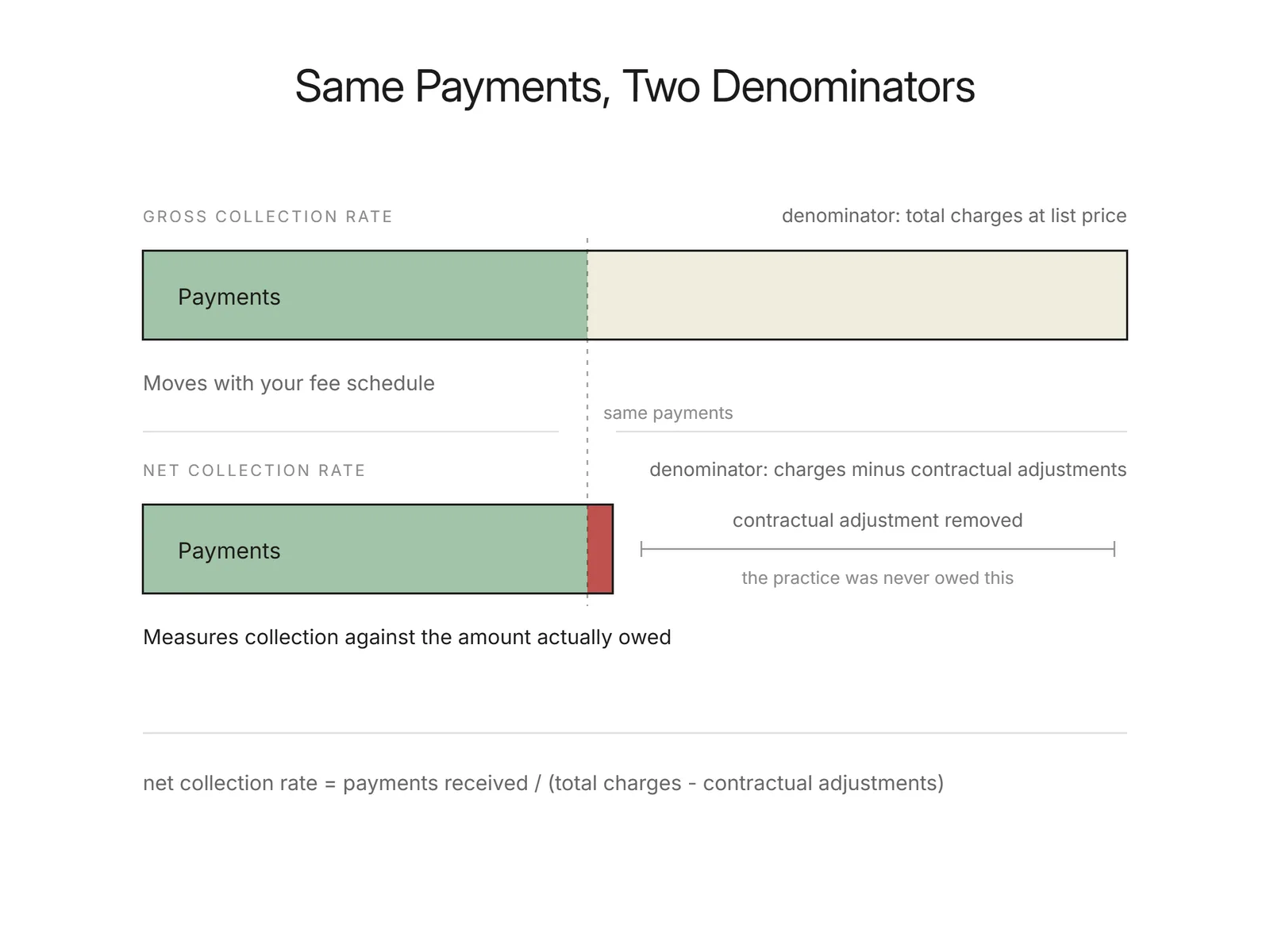
Net collection rate and gross collection rate both compare money collected to money billed, but they measure different things. Gross collection rate divides payments received by total charges at full list price. Because a practice sets those list prices well above what any payer contract actually allows, gross collection rate is distorted by pricing and tells you little about performance. Net collection rate divides payments received by net charges, which are total charges minus the contractual adjustments a practice agreed to in its payer contracts. That subtraction removes the amount the practice was never going to be paid, so net collection rate measures how well the practice collected the money it was actually owed. The formula: net collection rate = (payments received / (total charges minus contractual adjustments)) x 100. Net collection rate is the operational number of the two, and revenue cycle teams watch it to find revenue lost to denials, write-offs, and aging accounts.
What is net collection rate?
Net collection rate is the percentage of the money a practice was actually owed that it went on to collect. The amount owed is the allowed amount, which is what the payer contract says a service is worth after the contractual adjustment is removed. A contractual adjustment is the difference between the list-price charge and the contracted rate, and it is a write-off the practice agreed to in advance, not lost revenue. The allowed amount is what a payer such as Medicare, an Aetna plan, or a Blue Cross plan reports back on the remittance for a given CPT code, so the same service can carry a different allowed amount from one payer to the next. Net collection rate answers a narrow, useful question: of the dollars we had a right to collect, how many did we actually bring in? A high net collection rate means the practice is capturing nearly everything its contracts entitle it to. A low one means dollars are leaking out through denials that were never appealed, claims that aged past the filing deadline, or balances written off instead of worked.
Want this mapped against your own call and claim volume? Book a 30-minute audit
How do you calculate net collection rate?
Net collection rate is payments received divided by net charges, expressed as a percentage. In plain language, take the payments collected over a period, then divide by total charges minus contractual adjustments for that same period, and multiply by 100.
- Numerator: payments received, from both payers and patients.
- Denominator: net charges, which equal total charges minus contractual adjustments.
- Formula: net collection rate = (payments received / (total charges - contractual adjustments)) x 100.
The measurement window matters. Claims take time to adjudicate, so calculating the rate on a period that just closed understates it, because many claims have not paid yet. Most teams measure over a window with enough runout, often 90 to 120 days, so the bulk of claims have had a chance to pay before the numbers are locked. Using the same window every time is what makes the trend readable.
See what AI can run at your facility. In a 30-minute audit we map the calls, eligibility, and follow-ups Flexbone can take off your team first.
Book an auditWhat is the difference between gross and net collection rate?
The difference is the denominator, and it changes what each metric can tell you. Gross collection rate divides payments received by total charges at list price. Since a practice can set list prices at any markup it likes, gross collection rate moves whenever the fee schedule changes, even when collection performance is identical. A practice that doubles its list prices will see its gross collection rate fall by half while collecting exactly the same dollars. That makes gross collection rate close to meaningless as a performance measure, though it is easy to compute.
Net collection rate divides payments received by net charges, the amount allowed after contractual adjustments. It strips out the list-price distortion and measures collection against what the practice was actually owed. Because of that, net collection rate is comparable over time and across practices in a way gross collection rate is not. When people ask how well billing is performing, net collection rate is the number that answers the question.
What is a good net collection rate?
Many revenue cycle teams treat a net collection rate around 95 percent or higher as a target, and read a materially lower number as a signal that revenue is being lost somewhere in the cycle. Treat that figure as a common goal rather than a universal benchmark. The right target depends on payer mix, specialty, patient responsibility levels, and exactly how the rate is calculated, so a number that is healthy for one practice may be optimistic or lax for another. What carries the most information is the trend inside a single practice measured the same way each period. A net collection rate that drifts down quarter over quarter points to a growing gap between what the practice is owed and what it collects, which usually traces to rising denials, slower accounts receivable, or write-offs that could have been worked. Read the number as a diagnostic that tells you where to look, not as a grade on its own.
How do you improve net collection rate?
Improving net collection rate comes down to shrinking the gap between what a practice is owed and what it collects, and most of that gap is created before the collection stage. The main levers are:
- Reduce write-offs from denials and timely filing. Denials that are never reworked and claims that age past the filing deadline both turn owed dollars into write-offs. In HealthCare.gov marketplace plans, insurers denied 20% of in-network claims in 2023, and consumers appealed fewer than 1% of those denials, according to KFF. Every unworked denial is money the net collection rate says you were owed and did not collect.
- Work accounts receivable actively. Following up on open claims and unpaid balances before they age out keeps dollars from expiring in the A/R.
- Fix front-end accuracy. Clean claims that go out right the first time never become denials. Confirming coverage with a 270/271 eligibility check and securing prior authorization before service prevents the rejections that later become write-offs, along with clean ICD-10 and CPT coding so the claim is not returned. Prior authorization is a heavy manual load, with practices completing an average of 39 requests per physician each week and spending about 13 hours on them, per the AMA.
This is where AI agents fit. Flexbone's agents run insurance eligibility verification before the visit, handle prior authorization automation so approvals are in place before service, and follow up on claim status so denials surface early enough to work. Because that front-end and follow-up load is what feeds AI denials management, handling it at volume keeps owed dollars from leaking into write-offs. The work is audit-first: every action an agent takes is logged, so a person can review what was checked and what came back before anything is finalized.
If you want to see where your net collection rate is leaking and what AI can take on across eligibility, prior authorization, and denials, book a call with Flexbone.