There is no CPT code for a no-show that you can bill to insurance. Payers, government and commercial alike, do not reimburse missed appointments because a no-show is not a rendered service. What you can do is charge the patient directly under a written practice policy. Medicare permits this: CMS policy on charges for missed appointments allows practices to bill Medicare beneficiaries for no-shows as long as they charge non-Medicare patients the same way and treat it as a missed-business charge, not a covered service. Medicaid generally prohibits billing the patient. So the money from no-shows comes from your own fee schedule and collections process, not a reimbursable code, which is why a clear, consistently applied policy matters more than any billing trick.
Is there a CPT code for a no-show?
No. CPT codes describe services delivered to a patient, and a no-show is the absence of a service, so there is nothing to code and nothing to submit to a payer. As Tebra's guide to billing missed appointments explains, a no-show charge is posted to the patient's account as a practice fee, not filed as an insurance claim. Do not try to bill an evaluation and management (E/M) code for a visit that never happened; that misrepresents the encounter. The correct mechanic is a patient-responsibility charge governed by your own policy. Everything downstream, from Medicare's rules to your collection letters, follows from that one distinction: you are charging for a missed slot, not for care.
Want this mapped against your own call and claim volume? Book a 30-minute audit
Can you bill a patient a no-show fee?
Yes, you can bill the patient a no-show fee, within payer rules and a written policy. Medicare allows charging beneficiaries for missed appointments as long as you apply the same fee to all patients, Medicare and non-Medicare alike, and do not single out beneficiaries. Medicaid programs generally bar billing the patient for a no-show, so exclude Medicaid patients from the fee. Commercial coverage does not reimburse the fee, so it falls to the patient. Medical Economics lays out who to bill and when across these payer types. The safe approach: uniform fee, no discrimination by payer, Medicaid carved out, and the policy disclosed and signed before the visit so the charge is defensible.
A fee is collected after the slot is lost; confirmation happens before it. Flexbone focuses on the slot: voice agents confirm, rebook, and backfill from a waitlist ahead of the appointment. See AI patient coordinator.
See what AI can run at your facility. In a 30-minute audit we map the calls, eligibility, and follow-ups Flexbone can take off your team first.
Book an auditWhat should a no-show policy include?
A workable policy is specific, disclosed in advance, and applied consistently. Cover these elements: a clear definition of a no-show and a late cancellation, the notice window (commonly 24 to 48 hours), the fee amount and which visit types it applies to, the Medicaid carve-out, how many missed visits trigger the fee or a discharge review, and how you communicate it at scheduling and check-in. The AAFP discusses the missed-appointment charge as a patient-responsibility fee set by your own policy, and urges practices to weigh payer rules and patient hardship before applying it. Get a signed acknowledgment before rendering services, document every missed visit, and grant hardship exceptions through a defined process rather than case by case at the desk, which keeps the policy both fair and enforceable.
Does charging a fee actually reduce no-shows?
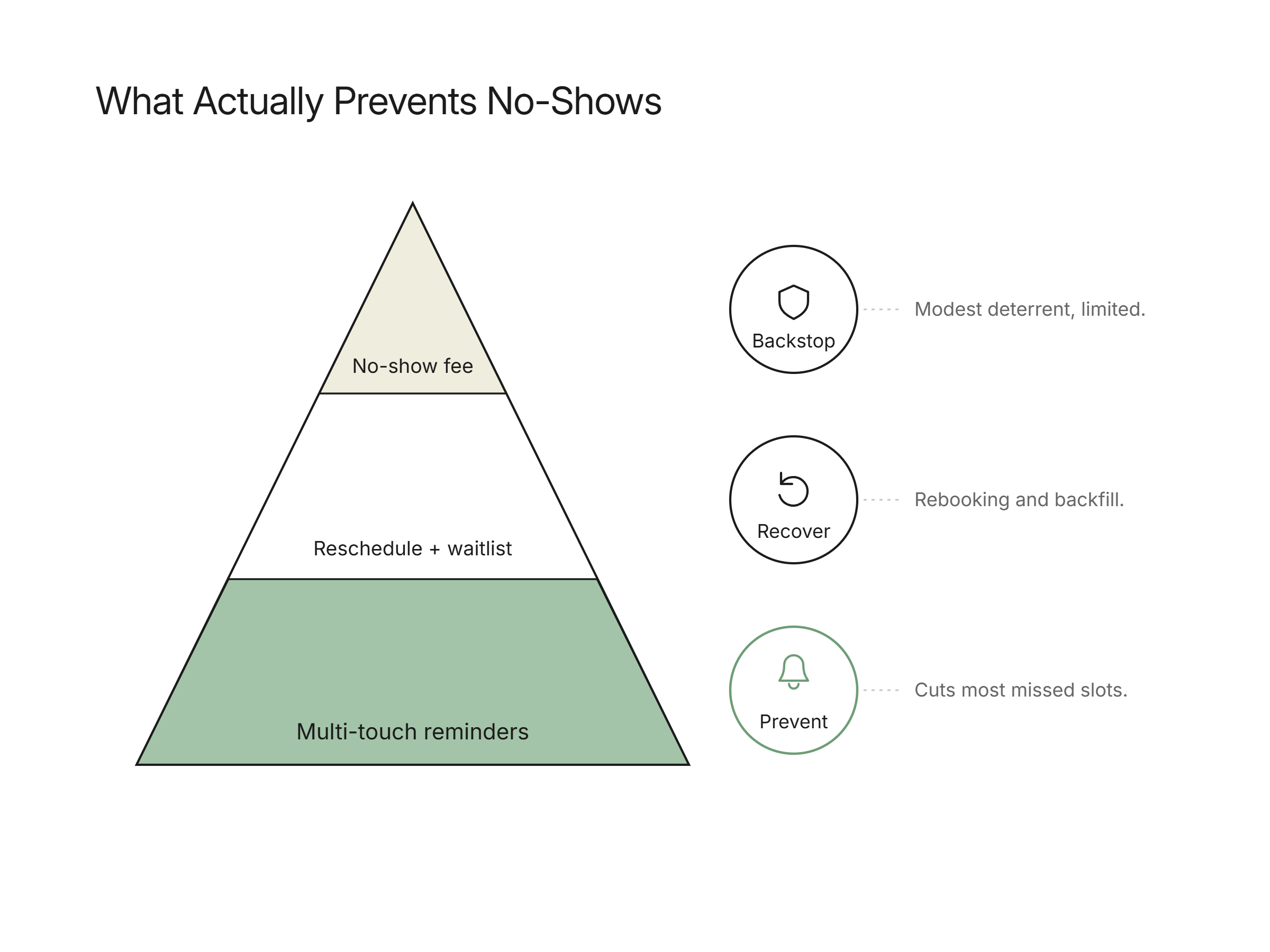
The evidence is mixed, so treat a fee as one modest lever, not the fix. A review of the question, to charge or not to charge for patient no-shows, found the deterrent effect limited and cautioned that fees can strain the patient relationship and push price-sensitive patients out of care entirely. Fees recover a little revenue and nudge some patients to keep appointments they might have skipped, but they do nothing about transportation, cost of care, or long lead times, which drive most misses. Practices that lean only on a fee tend to see small movement. Pair any policy with the interventions that address the actual causes: multi-touch reminders, easy rescheduling, and waitlist backfill.
How Flexbone runs the policy and the prevention
A no-show policy only works if it is communicated at every booking and every check-in, and if the prevention work runs alongside it. Flexbone deploys AI voice and messaging agents that work inside your EHR to disclose your policy at scheduling, confirm high-value visits, run multi-touch reminders, and backfill cancellations from a waitlist, with each action written back to the schedule. In the engagements we run, we automate the reminder and rescheduling cadence so the fee becomes a backstop rather than your primary defense against missed slots.
See how it fits your workflow: book a patient access audit, or read more on the AI patient coordinator.