No-show rates are not uniform, so the right benchmark is your specialty, not a single national figure. Well-run practices sit around 5 to 7 percent, per the MGMA benchmark, but published studies report much higher rates in many outpatient settings. As a working guide from the studies below: primary care commonly runs 5 to 20 percent, dental around 15 percent, orthopedics and other longer-slot specialties above 10 percent, and behavioral health the highest, often 20 to 40 percent. Federally qualified health centers (FQHCs) and safety-net clinics often run near 18 to 19 percent. Treat these as reported ranges, not fixed targets: your actual rate depends on payer mix, appointment lead time, and how you define a no-show. Compare against your own history first, then the specialty range.
What is the average no-show rate by specialty?
There is no single average, because setting drives most of the variation. A systematic review of outpatient clinics found no-show rates ranging widely across specialties and scheduling models, with many clinics in double digits. Reported ranges from that review and related practice data look roughly like this:
| Setting | Reported no-show range |
|---|---|
| Primary care | 5 to 20 percent |
| Dental | around 15 percent |
| Orthopedics and longer-slot specialties | 10 percent and up |
| Pediatrics | often 20 to 30 percent |
| Behavioral health | often 20 to 40 percent |
| FQHC and safety-net | around 18 to 19 percent |
Read these as ranges, not guarantees. Your payer mix, no-show definition, and reminder cadence move the number as much as the specialty label does.
Want this mapped against your own call and claim volume? Book a 30-minute audit
Why do FQHCs and safety-net clinics run higher?
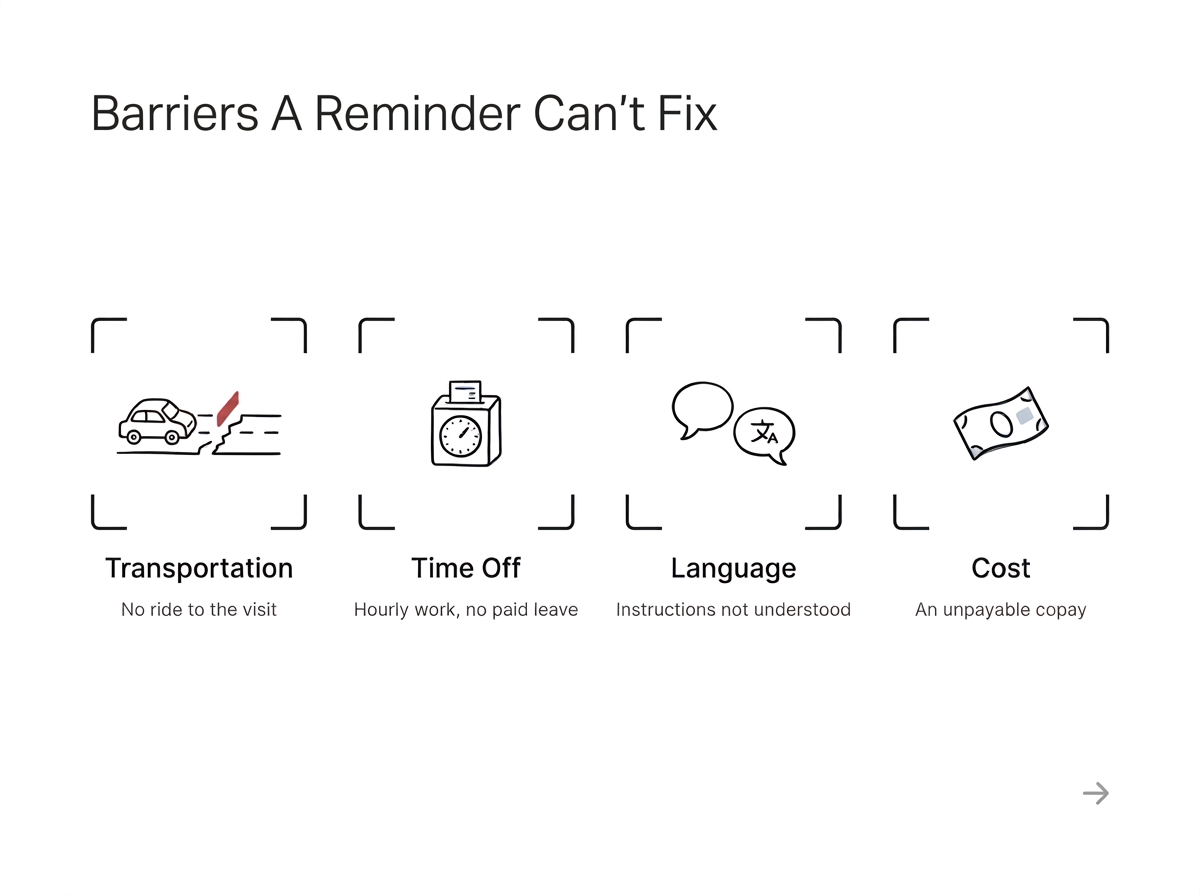
FQHCs and safety-net clinics carry higher no-show rates because their patients face more barriers to getting to a visit, not because the clinics manage scheduling poorly. A study at a federally qualified health center reported an 18.6 percent baseline no-show rate and cut it to 12.3 percent, but only with a multifaceted program: a centralized contact center, social work, financial assistance, expanded on-site lab access, and provider continuity. The drivers it targeted are social determinants of health: transportation insecurity, hourly jobs without paid time off, language barriers, childcare gaps, and financial strain. Reminders alone did little; the gains came from removing those barriers. When the obstacle is a missing ride or an unpayable copay, a reminder does not change the outcome. Reduction in these settings has to address the underlying friction, not just remind patients that the appointment exists.
Whatever the specialty baseline, the controllable part is confirmation and rebooking before the day. Flexbone runs those calls with voice agents and records each outcome. See AI patient coordinator.
See what AI can run at your facility. In a 30-minute audit we map the calls, eligibility, and follow-ups Flexbone can take off your team first.
Book an auditWhat is a realistic target for your specialty?
A realistic target is a few points below your current rate, moving toward your specialty's well-run range, rather than a blanket 5 percent. Set the goal off your own baseline: a behavioral health clinic at 32 percent that reaches 24 percent has done more real work than a primary care office trimming 7 percent to 6. Research on no-show prevalence and predictors shows that the clinic setting, patient demographics, and appointment characteristics all predict who misses, so the achievable target depends on your panel and case mix. Set the target per segment, hold your no-show definition constant, and re-measure quarterly. Chasing a single industry number across every specialty usually just demoralizes the teams already running the hardest schedules.
How do you close the gap?
Close the gap by matching the intervention to the cause rather than adding a second reminder and hoping. For forgetting, multi-touch reminders across text, voice, and email help. For access and life friction, the fixes are structural: easier rescheduling, shorter lead times, and waitlist backfill so a freed slot is not lost. Appointment design matters too. A study of safety-net clinics found that longer appointment duration reduced future missed appointments, a reminder that scheduling structure, not just patient behavior, shapes the rate. Start with the segment carrying the highest rate and largest volume, apply one change, and measure. Layer the next intervention only after you can see the first one move the number.
How Flexbone closes the gap inside your EHR
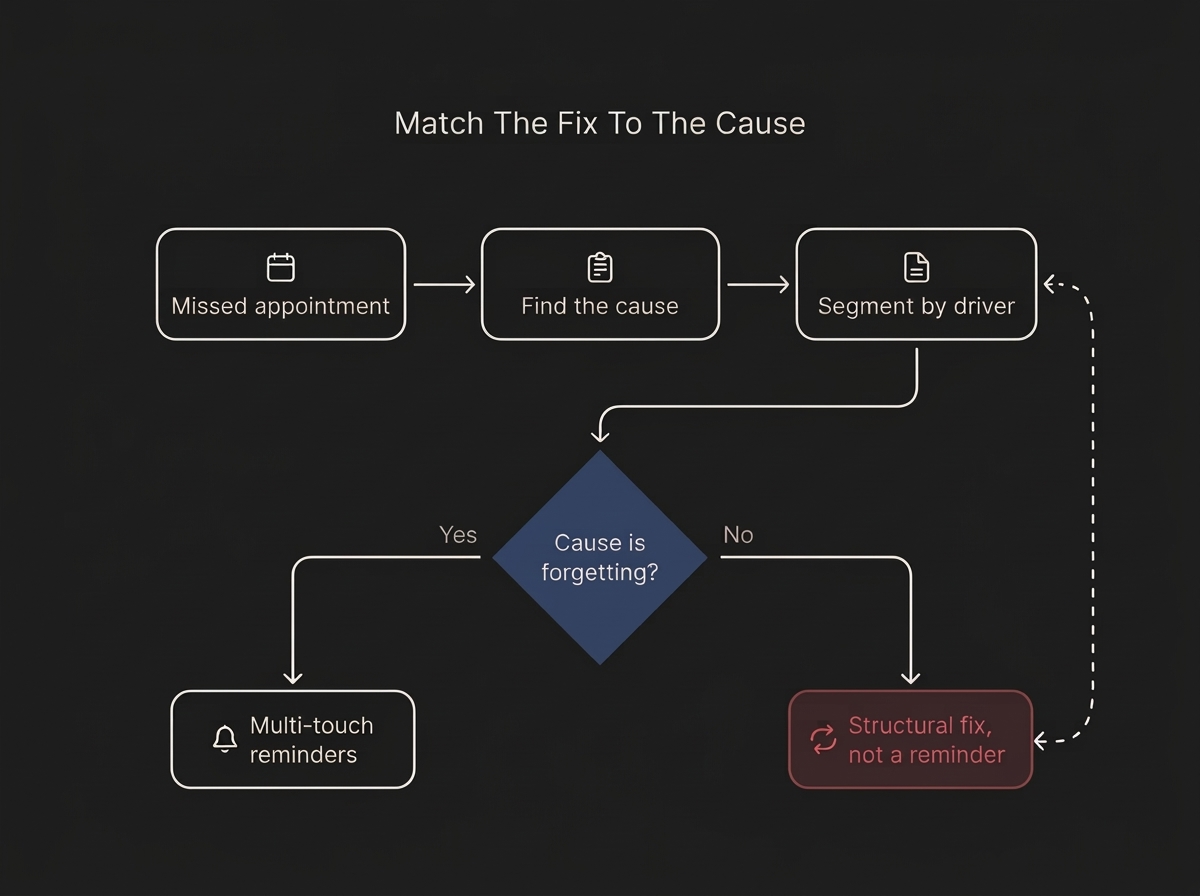
Knowing your specialty benchmark is the easy part; running the fix across each provider and visit type, day after day, is where practices stall. Flexbone deploys AI voice and messaging agents that work inside your EHR to run multi-touch reminders, offer one-step rescheduling, and backfill openings from a waitlist, with each action written back to the schedule. In the engagements we run, we first measure your rate by segment against your specialty range, then automate against the segments furthest from target.
See how your specialty compares: book a patient access audit, or read more on the AI patient coordinator.