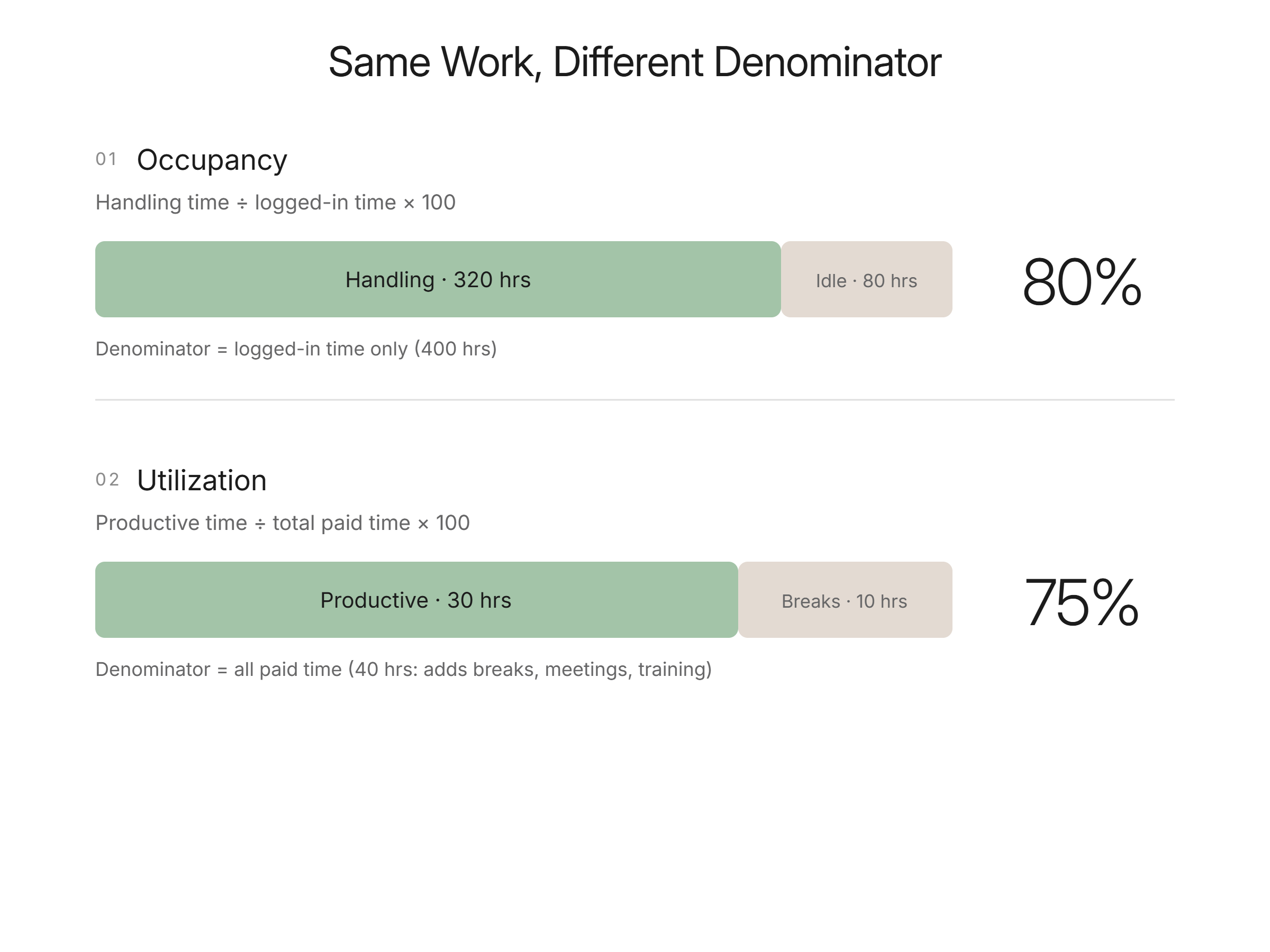
Occupancy and utilization both describe how busy agents are, but they measure different windows of time. Occupancy is the share of logged-in, available time an agent spends on call-related work: talk, hold, and after-call work. Utilization is the share of total paid time spent on productive work, which includes breaks, meetings, and training in the denominator. As CallCentreHelper puts it, occupancy considers only live logged-in time while utilization considers total time at work. That single difference matters: occupancy tells you whether staffed agents are slammed or idle in the moment, and utilization tells you how much of the payroll dollar turns into handled contacts. Read them together. High occupancy with low utilization usually means shrinkage, not laziness, is eating your capacity.
What is the occupancy formula?
Occupancy rate = (total handling time / total logged-in time) x 100. Handling time covers talk, hold, and after-call work, and can include chats or emails in a blended center. Calabrio frames occupancy as the portion of available time agents spend actively handling interactions rather than waiting for the next one. A worked example: if agents were logged in and available for 400 hours last week and spent 320 of those hours handling contacts, occupancy is (320 / 400) x 100, or 80 percent. The remaining 20 percent is available-but-idle time, waiting for calls to arrive. Occupancy rises when volume outruns staffing and falls when the center is overstaffed for the demand, which makes it a fast read on whether your schedule matches the day.
Want this mapped against your own call and claim volume? Book a 30-minute audit
What is the utilization formula?
Utilization measures productive work against all paid time, so it folds in the hours occupancy ignores. Peopleware describes utilization as the percentage of paid time spent on productive activity, with breaks, meetings, and training sitting in the denominator through shrinkage. One common form is: utilization = (total handling time + other productive time) / total paid time x 100. If an agent is paid for 40 hours, handles contacts for 26, spends 4 in training, and loses 10 to breaks and meetings, utilization is (26 + 4) / 40 x 100, or 75 percent. Because the denominator is larger than occupancy's, utilization reads lower than occupancy for the same agent. It answers a budgeting question: how much of what you pay for becomes usable work.
Both numbers rise when repetitive calls crowd the queue and fall when those calls are handled elsewhere. Flexbone moves that repetitive volume to voice agents, choosing call types from recordings, which lowers occupancy without cutting service. See contact center automation.
See what AI can run at your facility. In a 30-minute audit we map the calls, eligibility, and follow-ups Flexbone can take off your team first.
Book an auditWhat is a healthy occupancy target?
Most centers aim for occupancy between 75 and 85 percent. Squaretalk puts the healthy band in that range, where agents spend the majority of their time on interactions without being pinned back to back. Below 70 percent usually signals overstaffing or soft demand, which is expensive but easy on agents. Above 85 percent, the pressure of near-constant calls starts to show up in quality and turnover. The right number is not identical across channels or call types: a chat queue can sustain higher occupancy than a voice queue because agents handle several conversations at once and control pacing. Set your target against your own channel mix and average handle time, then watch it alongside attrition rather than pushing it as high as the roster will bear.
What happens above 85% occupancy?
Sustained occupancy above 85 percent is where the metric turns from efficient to harmful. Giva warns that rates above roughly 85 to 90 percent accelerate agent burnout and drag down service quality as the gap between calls disappears. With no recovery time between contacts, agents get less empathetic, make more errors, and rush after-call work, which quietly pushes problems into repeat calls. Push past 95 percent and agents effectively have no breathing room at all, and long-term that shows up as absenteeism and resignations. The trap is that high occupancy looks like productivity on a dashboard while it erodes the workforce that produces it. If you see occupancy climbing past the mid-80s for weeks, treat it as a staffing or demand signal, not a target to celebrate.
How Flexbone keeps human occupancy in the healthy band
Occupancy spikes above 85 percent when volume arrives faster than the roster can absorb it, and adding headcount is slow and expensive. Flexbone's AI agents take first-tier volume the moment it lands, so the calls that would have piled onto your staffed queue never reach it. That keeps human occupancy in the 75 to 85 percent band where quality holds, even on a surge day. Across a BPO, an insurance operation, a health system, or a public-sector line, the pattern is the same: automation absorbs the routine load so people handle the complex work at a sustainable pace. Because Flexbone audits your interaction mix before automating, you can model the occupancy relief for each call type first. Book a demo to see the numbers on your own volume.