
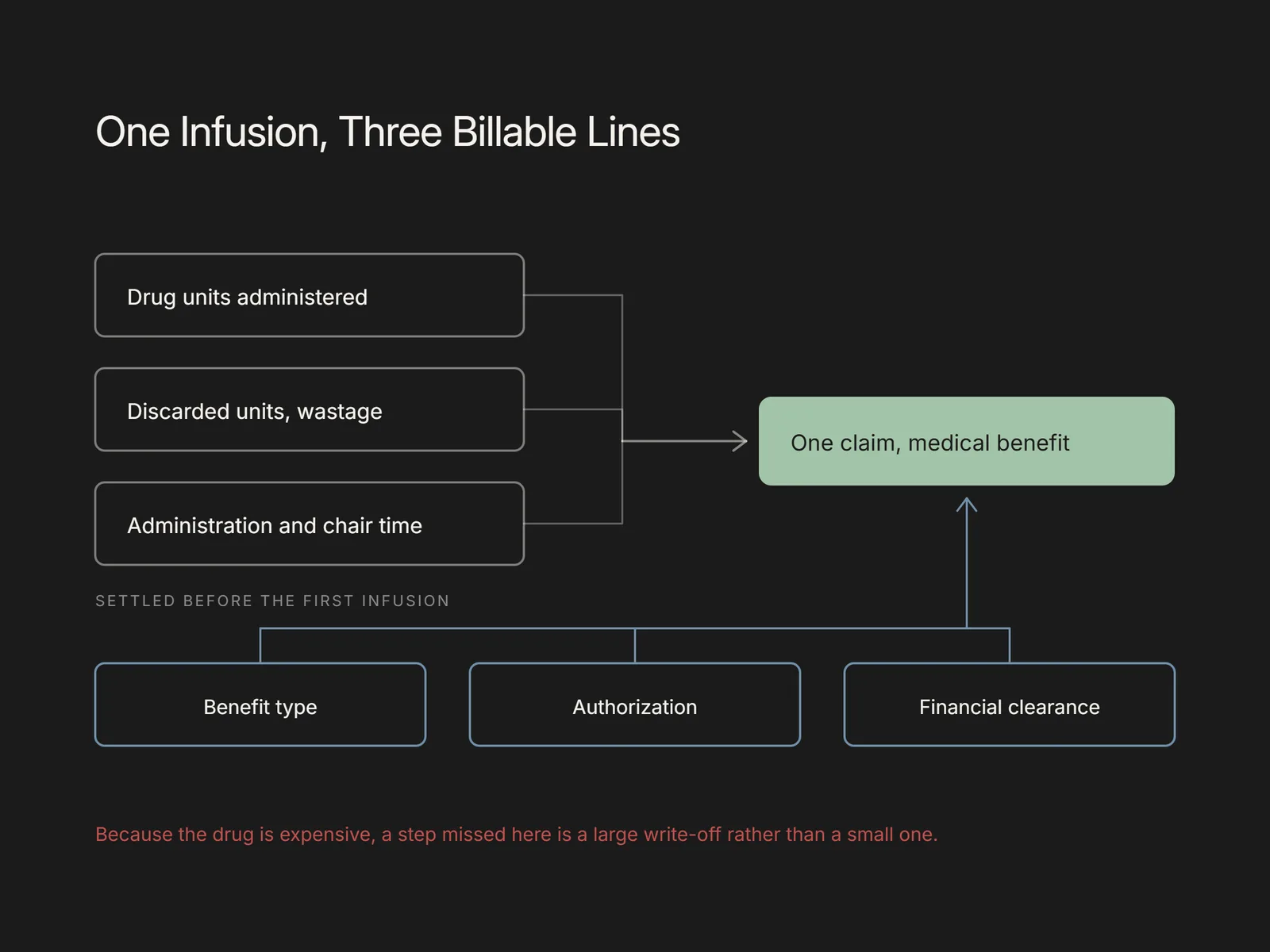
Oncology billing is distinct because much of the money is in the drugs, not the office visit. High-cost chemotherapy and immunotherapy agents are infused or injected in the clinic, and under the common buy-and-bill model the practice purchases the drug, holds it in inventory, administers it, and bills the payer under the medical benefit for both the drug and the administration. That structure adds work a routine visit does not have: drug-specific units, documentation of any discarded amount (wastage), and infusion administration and chair-time coding. It also raises the stakes on the front end, where benefit investigation, copay assistance, and prior authorization on regimens and imaging determine whether an expensive claim pays cleanly. When one of those steps is missed, the denial is a large write-off rather than a small one.
What makes oncology billing complex?
Oncology billing is complex because a single treatment combines a costly drug, the labor to administer it, and payer rules that apply to each separately. The drug component is billed by units tied to the amount given, and single-dose vials often leave a discarded remainder that must be documented as wastage under payer policy. The administration component covers the infusion or injection itself and the chair time involved, which are coded distinctly from the drug. Layered on top are prior authorization requirements on the regimen and on supporting services such as advanced imaging, plus benefit investigation to confirm the drug is covered under the medical benefit rather than the pharmacy benefit. Each of these has its own documentation and its own failure mode, so a claim that is correct on the drug can still be denied on the administration, the authorization, or the benefit. That combination is what separates oncology from most office-based specialties.
Want this mapped against your own call and claim volume? Book a 30-minute audit
How does buy-and-bill work for oncology drugs?
Buy-and-bill is the model in which the practice acquires the drug, administers it, and then bills the payer for it, as opposed to a specialty pharmacy dispensing and billing for it. The practice orders the drug from a distributor, stores it, and carries its acquisition cost as inventory until a paid claim reimburses it. When the patient is treated, the claim reports the drug and the units administered along with the administration service, and the payer reimburses under the medical benefit. The alternative is the pharmacy benefit, sometimes handled through white-bagging or brown-bagging, where a specialty pharmacy supplies the drug and the practice only administers it. Which path applies depends on the drug, the plan, and the payer's policy, which is why confirming medical versus pharmacy benefit up front is a routine part of oncology intake. Getting that determination wrong is a common source of denied or misrouted claims.
Buy-and-bill puts the practice's money at risk until the claim pays, which makes the authorization the first control. Flexbone confirms authorization and regimen coverage before the drug is ordered. See oncology drug authorization.
How does drug wastage billing work?
Drug wastage billing exists because the prescribed dose frequently does not match the vial size, and payers that reimburse the discarded portion require it to be documented precisely. Many infused and injected oncology drugs are supplied in single-dose vials, so a patient whose dose uses part of a vial leaves a remainder that cannot be reused. When a payer reimburses for that discarded amount, the practice reports the administered units and the wasted units separately, typically using a specific modifier that flags the discarded quantity, and the medical record has to support both figures. Policies differ on how much wastage is payable and how it must be recorded, so the safe practice is to document the exact units drawn, given, and discarded at the time of administration. Missing wastage documentation is a frequent reason these lines are denied or reduced, and because the drugs are expensive, the dollar impact is not trivial.
See what AI can run at your facility. In a 30-minute audit we map the calls, eligibility, and follow-ups Flexbone can take off your team first.
Book an auditHow does prior authorization work for chemotherapy regimens?
Prior authorization for chemotherapy is approval a payer grants before treatment, based on the specific regimen and the patient's clinical picture. The practice submits the planned drug or regimen, the diagnosis, and supporting documentation, and the payer reviews it against its medical-necessity and regimen criteria, sometimes routed through a designated oncology review program. Advanced imaging used for staging or monitoring, and some supportive-care drugs, often require their own authorization as well. Because regimens are adjusted over a course of care, an authorization tied to one drug, dose, or cycle count may need updating when the plan of care changes, and treating outside the approved parameters risks a denial. The volume is real: physicians complete an average of about 39 prior authorizations each per week and spend roughly 13 hours on them, according to the AMA. In oncology, where each authorization can gate a high-cost infusion, missing or mistiming one has an outsized effect on both revenue and the treatment schedule.
Why do oncology claims get denied?
Oncology claims are denied for a mix of front-end and drug-specific reasons, and the cost of each denial is high because of the drugs involved. A missing or expired prior authorization on the regimen or on supporting imaging is one of the most common. Others include drug units or wastage that do not match the documentation, billing the drug under the wrong benefit (medical versus pharmacy), administration coding that does not line up with what was performed, and eligibility or coordination-of-benefits errors captured before treatment began. Denials are not rare across health insurance generally: in HealthCare.gov marketplace plans, insurers denied 20% of in-network claims in 2023, and consumers appealed fewer than 1% of them, per KFF. When an oncology claim is denied, the correction path starts by reading the denial's CARC and RARC codes on the 835 remittance, which identify whether the problem was the authorization, the units, the benefit, or the eligibility, and route the rework or appeal accordingly.
How do you prevent oncology billing denials?
Preventing oncology denials is mostly front-end discipline applied consistently before the first infusion. The steps that carry the most weight are: verify whether each drug falls under the medical or pharmacy benefit so the claim routes correctly; run a full benefit investigation and enroll the patient in copay assistance or hub services early, since these therapies are expensive and financial clearance affects both access and collections; secure prior authorization for the regimen and any advanced imaging, and update it whenever the plan of care changes; document drug units and wastage precisely at the time of administration; and when a denial arrives, read the CARC and RARC codes on the 835 to route the correction. Much of this is repeatable, rules-based work: insurance eligibility verification, regimen and imaging authorization tracked through the payer, and AI denials management that categorizes each denial by code. Handling it early and the same way every time prevents write-offs rather than reworking them.
Flexbone deploys AI voice and browser agents that take on the repetitive front-end and payer-communication work behind oncology billing: they run eligibility and benefit investigation, confirm medical versus pharmacy benefit, help move patients through hub services and copay enrollment, submit and follow up on regimen and imaging authorization, and read denials on the 835 by CARC and RARC to route the next step. The agents work inside the systems your team already uses and log every action for review, alongside deeper infusion, oncology, and specialty drug prior authorization workflows. If you want to see what this looks like on your own claims, book a call with Flexbone and we will run a quick audit of what AI can take off your oncology billing.