Onshore medical billing keeps the work with staff in the same country as your practice, so they share your time zone, language, and legal jurisdiction. Offshore billing sends it to agents abroad, usually India or the Philippines, at a much lower labor cost per seat. The classic tradeoff is price against control: offshore cuts the hourly rate, onshore keeps supervision, payer calls, and appeals close and reduces the distance that protected health information travels. The sharper question is no longer just onshore versus offshore labor. The repetitive, rules-based billing work is now something voice and browser agents can run directly, which lets you keep security and oversight US-based while decoupling cost from seat count. This guide compares the two labor models honestly, then shows where an AI-first approach with US-based staff for exceptions fits.
What is the difference between onshore and offshore medical billing?
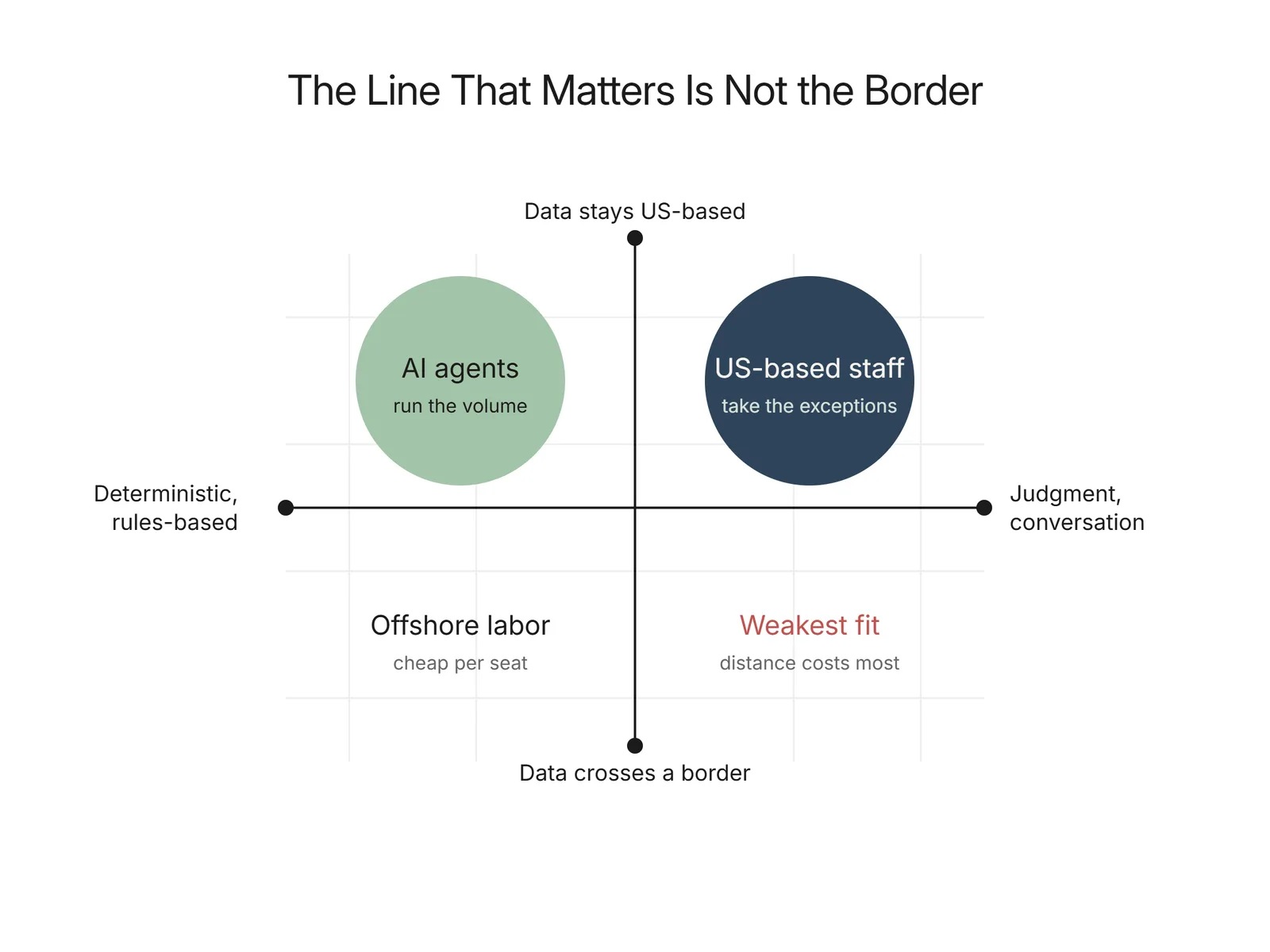
Onshore and offshore describe where the billing labor sits, not what the work is. Onshore billing runs through staff in the same country as the practice, whether in-house or a domestic billing company, so they share the jurisdiction, business hours, and language of your front office and your payers. Offshore billing contracts a team in a lower-cost country to do the same charge entry, eligibility checks, denial follow-up, and posting. Much of that is standardized electronic work: the 837 claim and 835 remittance transactions move through a clearinghouse, and a 270/271 eligibility check runs the same way whether the biller sits in Ohio or Manila. The functional difference shows up in work that needs a live conversation or judgment. A payer phone queue, a peer-to-peer appeal, or a confused patient asking about a balance is easier to handle from the same time zone and legal context, while a batch of claim-status lookups or clean charge entry does not care where the person sits. That split, conversational and judgment-heavy versus deterministic and rules-based, is the line that matters more than the border, and it is the line an AI-first model is built to exploit.
Want this mapped against your own call and claim volume? Book a 30-minute audit
Is offshore medical billing cheaper than onshore?
Per seat, offshore billing is clearly cheaper, and that gap is the reason it exists. An offshore biller's fully loaded cost is a fraction of a US biller's, so for high-volume, rules-based tasks the arithmetic favors offshore. The savings narrow once you count the full picture rather than the hourly rate. Rework on rejected claims, denials that need a US-based appeal, oversight and QA time, and calls that cross a twelve-hour time gap all sit on top of the seat rate. Denials are the expensive part to get wrong: KFF found that insurers denied about 20 percent of in-network HealthCare.gov claims in 2023, and consumers appealed fewer than 1 percent of them. A billing operation that files clean claims and works denials promptly protects revenue that a cheaper seat producing more rework can quietly lose. Compare vendors on cost per clean claim and cost per resolved denial, not the headline rate, and read our guide to medical billing companies for the fuller cost breakdown.
Is offshore medical billing HIPAA compliant and secure?
Offshore billing can be HIPAA compliant, but the responsibility to make it so stays with you. HIPAA obligations follow the data, not the geography, so an offshore vendor handling protected health information needs a signed business associate agreement, enforced access controls, encryption, and auditable handling, the same as a domestic one. The difference is the risk you carry when the data leaves the country. You are relying on security practices in another jurisdiction, with less direct visibility into who accesses records and how a breach would be investigated and enforced. That is not a reason offshore cannot work, but it is real exposure to weigh against the per-seat savings. It is also the clearest argument for keeping the data domestic: if you can move the repetitive work off your team without moving protected health information offshore, you remove that jurisdictional risk while keeping the cost benefit. Our overview of healthcare BPO covers how vendors structure this compliance layer.
See what AI can run at your facility. In a 30-minute audit we map the calls, eligibility, and follow-ups Flexbone can take off your team first.
Book an auditOnshore, offshore, or AI-first: how do you decide?
Match the model to the work, not the whole billing operation to one vendor. Billing work tends to split into two buckets, and the right home differs for each.
| Factor | Lean offshore labor | Lean onshore or AI-first |
|---|---|---|
| Task type | Deterministic, high-volume, rules-based | Judgment-heavy, conversational, exception work |
| Examples | Charge entry, eligibility, claim status | Appeals, complex denials, patient balance calls |
| Cost structure | Low per-seat labor rate | US oversight, or low marginal cost per automated task |
| Data and compliance | Protected health information crosses a border | Data and staff stay US-based |
| Time zone and control | Offset hours, indirect oversight | Same hours, direct supervision |
The deterministic bucket is exactly what offshore teams are usually hired for, and it is also what voice and browser agents can now run directly, at a low marginal cost per task rather than a per-seat rate. That reframes the decision. Instead of choosing a labor location for the repetitive work, you automate it, and you reserve people for the exceptions. The prior-authorization load is a good example of work heavy enough to be worth automating: the American Medical Association reports practices complete about 39 prior authorizations per physician per week, roughly 13 hours of staff time. Automating the status checks and documentation assembly in that flow frees the people you keep for the appeals and payer conversations that actually need them.
How does an AI-first model with US-based staff work in billing?
An AI-first billing operation runs the repeatable, rules-based tasks with agents and routes only the exceptions to people. Voice agents call payers, including Medicare, Medicaid, and commercial plans, to run eligibility and check claim status, and browser agents work inside your billing system and payer portals like Availity to post charges, submit 837 claims through the clearinghouse, and pull 835 remittances, each action logged. Anything the agents cannot resolve, a denial that needs an appeal, an ambiguous payer response, a patient who needs a real conversation, escalates to staff. Through the Flexbone partnership with Nav Central, a 24/7 clinical command center, those staff are US-based, so the judgment work and any protected health information that needs a human stay domestic and under direct oversight. That is the structural advantage over the plain onshore versus offshore choice: security and control are US-based, while cost is not tied to seat count because the volume work runs on agents rather than a room full of billers. In the engagements we run, this keeps the compliance posture of onshore work without paying an onshore per-seat rate for the deterministic tier. The phone workload alone justifies moving it, since MGMA reports that phones are still a backlog costing medical practices time. You can read more about how the model is staffed in our overview of Flexbone and Nav Central.
If you want to see which parts of your billing operation an AI-first model can run and which should stay with US-based staff, book a call with Flexbone and we will map it against your actual claim and denial mix.