
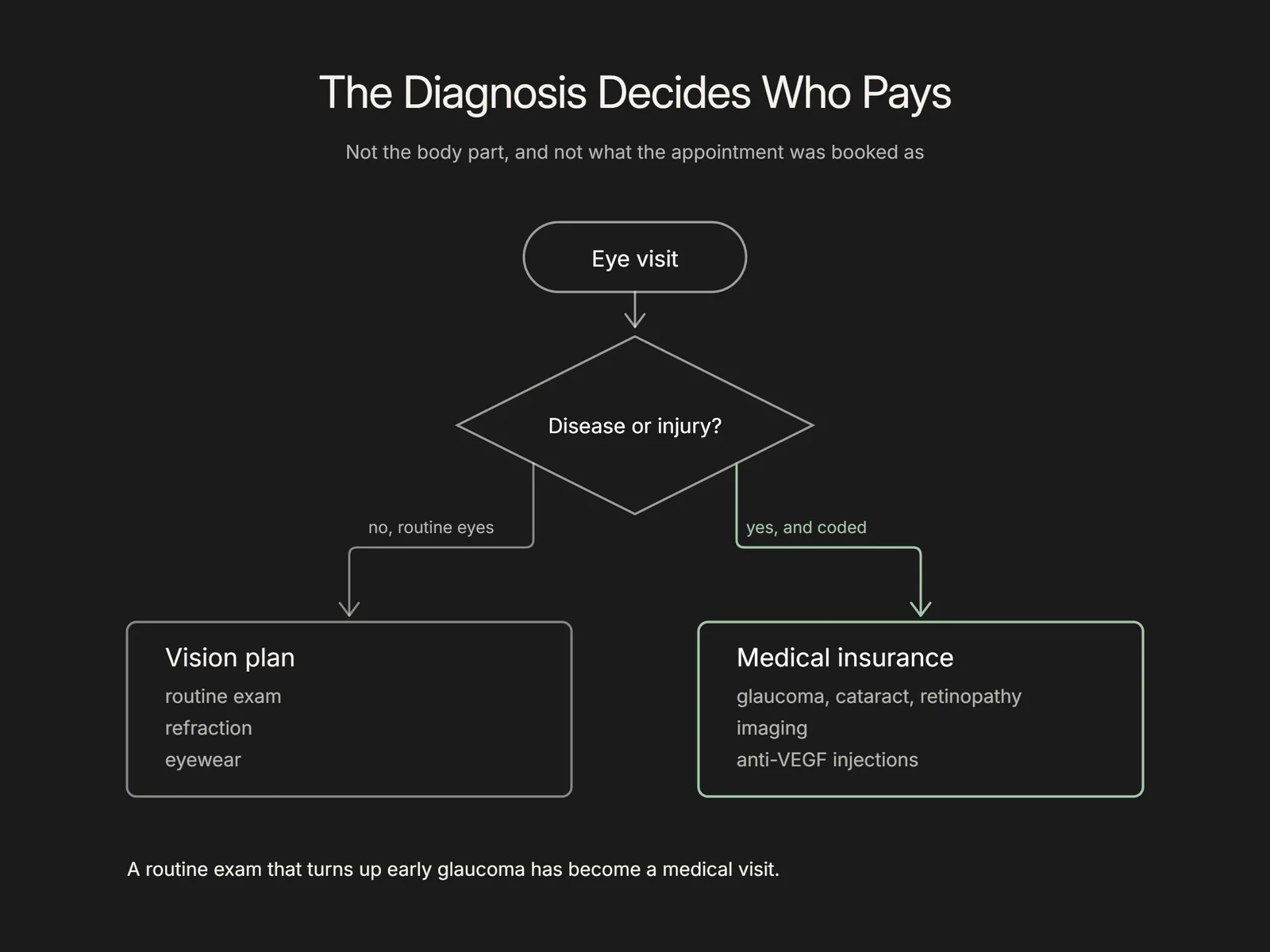
Ophthalmology billing works like the rest of medical billing, with a few features specific to eye care that make it harder to get right. The first is a split between two kinds of coverage: medical insurance pays for diagnosing and treating eye disease, while a separate vision plan pays for routine exams and eyewear. The diagnosis decides which one is billed. The second is a set of eye-specific examination codes, the ophthalmological service codes, that exist alongside the standard evaluation and management codes used elsewhere in medicine. A practice bills one family or the other for each visit. The third is high-cost injectable drugs. Anti-VEGF agents such as Eylea, Lucentis, and Avastin are usually handled through buy-and-bill, where the practice buys the drug, administers it, and bills for it. Many of these drugs, and some imaging, require prior authorization before the payer will pay.
What makes ophthalmology billing complex?
Ophthalmology sits at the intersection of primary eye care, medical disease management, in-office drug administration, and eyewear, and each carries its own billing rules. A single patient can arrive for a routine check, be diagnosed with a disease, and then need imaging and a drug injection, all of which route differently. For each visit the practice has to decide which insurer is responsible, which family of exam codes fits, whether the diagnosis supports the service, and whether the payer required an approval first. Retina practices also carry expensive drugs in inventory and bill for them directly, so a billing error can be a real financial loss rather than a simple resubmission.
Want this mapped against your own call and claim volume? Book a 30-minute audit
What is the difference between medical and vision billing?
The distinction is about the reason for the visit, not the body part. Medical billing applies when the encounter is about diagnosing or treating eye disease or injury: glaucoma, cataracts, diabetic retinopathy, macular degeneration, dry eye, an infection, or trauma. Those claims go to the patient's medical insurance, including Medicare and Medicaid for many older patients, under an ICD-10 diagnosis that supports medical necessity. Vision billing applies to routine care for otherwise healthy eyes, such as an annual exam, a refraction for a glasses prescription, and the eyewear itself, and goes to a separate vision plan if the patient has one. The trap is that many patients have both, and the presenting complaint can shift the visit from one to the other: a patient scheduled for a routine exam who turns out to have early glaucoma has become a medical visit. Billing the wrong plan is a frequent cause of denials, so staff verify both benefit types before the visit rather than guessing after it.
What are ophthalmological service codes versus E/M codes?
Ophthalmology has a dedicated set of eye examination CPT codes that describe an intermediate or comprehensive eye exam. These ophthalmological service codes are specific to the specialty. Alongside them sit the standard evaluation and management (E/M) codes used throughout medicine, selected based on the complexity of the visit and the documentation. For a given encounter, a practice bills from one family or the other, not both, and the choice depends on what was performed and what the record supports. The two families have different documentation expectations and can pay differently, so selecting the wrong one, or coding a level the note does not support, leads to denied or downcoded claims. We describe the concept rather than bet on specific code numbers, because the exact codes and their rules change and are payer specific; verify current values against an authoritative coding source before you bill.
See what AI can run at your facility. In a 30-minute audit we map the calls, eligibility, and follow-ups Flexbone can take off your team first.
Book an auditHow does anti-VEGF injection billing and buy-and-bill work?
Anti-VEGF drugs are injected into the eye to treat retinal conditions such as wet macular degeneration and diabetic macular edema. The three names that come up most often are Eylea, Lucentis, and Avastin. Because these are administered in the office, they are usually handled under buy-and-bill: the practice purchases the drug, stores it, injects it during the visit, and then bills the payer for both the drug and the injection procedure. Buy-and-bill puts the financial risk on the practice, because it has already paid for an expensive medication before the claim is adjudicated, so a denied, underpaid, or miscounted claim can leave it out of pocket. The drug is reported with its own HCPCS code and a unit count, and the claim has to link to an ICD-10 diagnosis that supports it. Accurate drug and units reporting, correct diagnosis linkage, and confirmed coverage before administration keep these claims clean. The specific codes and units differ by product and update over time, so we describe the mechanism rather than quote figures that would age.
How does prior authorization work in ophthalmology?
Prior authorization is the payer's requirement that certain services be approved before they are delivered. In ophthalmology it most often applies to the high-cost anti-VEGF injections and to some diagnostic imaging. The plan reviews the diagnosis and the medical necessity for the requested drug or study, and issues an approval, often with an authorization number, before the service. Administering a drug before the approval comes back is a direct path to a denial the practice cannot easily reverse, especially painful when the office already bought the drug. The burden is not small in general medical practice: physicians report completing about 39 prior authorizations each per week, spending roughly 13 hours on them, according to the American Medical Association. Requirements vary by payer, plan, and drug, so the reliable approach is to check the specific rule for that patient and service ahead of the appointment. For how these approvals run across eye and adjacent specialties, see our guide to eye, ENT, and oral prior authorization.
Why do ophthalmology claims get denied?
Denials in eye care cluster around the same few points where the specialty is distinct: billing the wrong plan in the medical-versus-vision split, selecting the wrong exam code family or an unsupported level, a missing or expired prior authorization on an anti-VEGF drug or imaging study, and eligibility or benefit details that were never verified before the visit. Denials are common across the industry: insurers denied about 20 percent of in-network claims on HealthCare.gov plans in 2023, and consumers appealed fewer than 1 percent of them, according to KFF. Because ophthalmology denials often involve expensive injectable drugs, working them promptly and appealing the winnable ones matters more here than in a lower-cost specialty. For catching and reworking these, see our approach to AI denials management, and for the checks that prevent them up front, insurance eligibility verification.
AI agents can take on the repetitive parts of this work: verifying whether a visit falls under medical or vision benefits, running the prior authorization on anti-VEGF drugs and imaging before the appointment, and working denials so the winnable ones get appealed instead of written off. If you run an ophthalmology or optometry practice, you can book a call with Flexbone to run a quick audit of what AI can take off your eye-care billing.