Orthopedics billing is the process of coding and claiming the full range of musculoskeletal care: office visits, surgery, advanced imaging, injections, durable medical equipment, and physical therapy. What makes it distinct is the mix. A single patient may generate a surgical claim with a global period, an MRI that needs prior authorization, a joint injection, a brace billed as durable medical equipment, and a course of therapy, each governed by its own coding and documentation rules. Surgery and advanced imaging also carry a high prior authorization load, and imaging requests often route through a radiology benefit manager such as eviCore or Carelon rather than the plan directly. The work goes wrong most often at the edges: a missed authorization, a modifier that does not match the note, or a service billed inside a global period without justification.
What makes orthopedic billing complex?
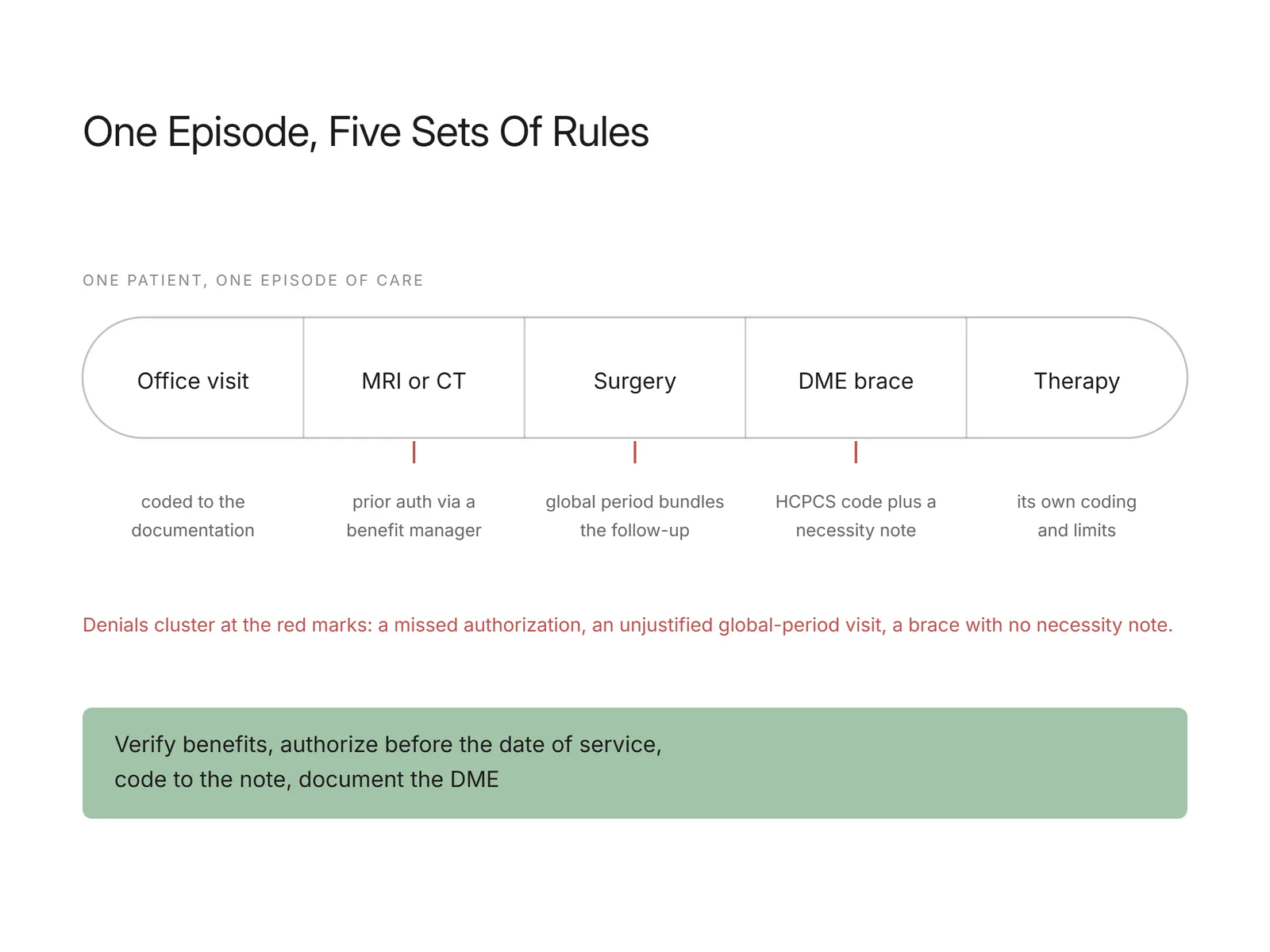
Orthopedic billing is complex because one specialty spans several billing categories that other specialties handle in isolation. A practice bills evaluation and management visits, surgical procedures, advanced imaging like MRI and CT, image-guided and in-office injections, durable medical equipment such as braces and supports, and physical therapy, sometimes for the same patient across one episode of care. Each category has its own coding conventions, modifier requirements, and documentation standards, so a claim that is clean in one area can still deny in another. Surgery adds global periods, where follow-up care is bundled into the original payment, and imaging and surgery add a prior authorization burden that lands on the front office before the clinical work happens. Orthopedic revenue cycle work is both coding-heavy and authorization-heavy, and a gap in either place delays payment.
Want this mapped against your own call and claim volume? Book a 30-minute audit
How do surgical global periods work?
A global surgical period is a defined window attached to a procedure during which normal follow-up care is considered part of the surgery's payment. Because the payment for an operation already includes the routine post-operative visits, those visits are not billed again separately inside the window. Minor procedures typically carry short global periods and major surgeries carry longer ones, with the specific length set by the payer's fee schedule rather than a single universal number. The place this trips up billing is unrelated care during the window. If a patient returns inside a global period for something not connected to the surgery, that service can still be billed, but it needs the correct modifier and a note showing why it falls outside the bundle. Billing a bundled visit separately, or failing to flag a genuinely separate one, is a frequent source of orthopedic denials and post-payment recoupments.
Global periods and surgical authorizations are both date arithmetic against payer rules, which suits an agent. Flexbone tracks them and flags visits that fall inside a global period before billing. See orthopedic authorization.
How does prior authorization work for orthopedic imaging and surgery?
Prior authorization is a payer's requirement that certain services be approved before they are performed. In orthopedics, advanced imaging such as MRI and CT and many surgical procedures are common triggers. For imaging, a notable wrinkle is that many commercial plans do not review the request themselves: they delegate it to a radiology benefit manager such as eviCore or Carelon, which checks clinical criteria like whether conservative treatment was documented first. The load on physicians is heavy across specialties. The American Medical Association reports that practices complete an average of about 39 prior authorizations per physician each week, taking roughly 13 hours of physician and staff time. The mechanics are the same regardless of who reviews: confirm whether the service needs authorization, submit the documentation, and get the approval number on file before the date of service, using the 278 transaction for the request. Missing it is one of the cleanest ways to turn a payable claim into a denial.
See what AI can run at your facility. In a 30-minute audit we map the calls, eligibility, and follow-ups Flexbone can take off your team first.
Book an auditHow is durable medical equipment billed in orthopedics?
Durable medical equipment, or DME, is billed separately from the professional service and follows its own rules. In orthopedics this covers items dispensed to the patient: knee braces, walking boots, cervical collars, back supports, and similar devices. Each item has a HCPCS Level II supply code, and payers generally expect a documented order plus a medical-necessity note in the chart explaining why the device is required. Coverage also varies: some payers require prior authorization for specific items, some restrict which supplier can bill, and some bundle certain supports into a related procedure. Because these requirements differ by plan and by item, the reliable step is to verify the DME benefit and any authorization requirement before dispensing the device. A brace handed to a patient without a medical-necessity note or a required authorization is a common write-off, since the supporting documentation is hard to reconstruct after the fact.
Why do orthopedic claims get denied?
Orthopedic denials cluster around a handful of causes that map to the parts above. A missing or incorrect prior authorization for imaging or surgery is near the top, especially when a radiology benefit manager's criteria were not met. A modifier that does not match the documentation is another, including services billed inside a global period without the justification to unbundle them. DME billed without a medical-necessity note or a required authorization rounds out the list. Denials are a large problem across insurance generally: a KFF analysis of 2023 data found that insurers denied 20 percent of in-network claims on HealthCare.gov, and consumers appealed fewer than 1 percent of those denials. Coding gaps also matter here: an ICD-10 diagnosis that does not support the CPT procedure or the DME item is a documentation denial in disguise. When a claim does deny, the electronic remittance advice, the 835, carries claim adjustment reason codes (CARC) and remittance advice remark codes (RARC) that name why. Reading those codes tells you whether the problem was authorization, coding, bundling, or documentation, which is what makes a denial workable rather than a guess.
How do you prevent orthopedic billing problems?
Prevention follows the order of the workflow. First, verify the patient's benefits and confirm what the plan covers, including the DME benefit. Second, secure prior authorization for imaging and surgery before the date of service, submitting through the payer or its radiology benefit manager and using the 278 transaction where supported. Third, code to the documentation: apply modifiers and global-period rules so the claim reflects what is separately billable. Fourth, document DME medical necessity in the chart when the device is dispensed. Finally, when a denial arrives, read it on the 835 by its CARC and RARC codes and route it to the right fix rather than resubmitting blindly. Related front-end work is covered in our guides on orthopedic, spine, and pain prior authorization, insurance eligibility verification, and AI denials management. For how the front-desk calls, scheduling, and authorization run together in an orthopedic practice, see AI call handling for orthopedic practices.
AI agents fit the orthopedic workflow at the labor-heavy edges: voice and browser agents verify benefits, gather the clinical criteria a radiology benefit manager wants, file imaging and surgery authorizations, and read denials on the 835 so the right ones get worked first. Each action is logged and reviewable, and a person confirms the clinical facts before anything goes to a payer. If you want to see where this fits your practice, book a call with Flexbone and we can run a quick audit of what AI can take off your orthopedic billing.