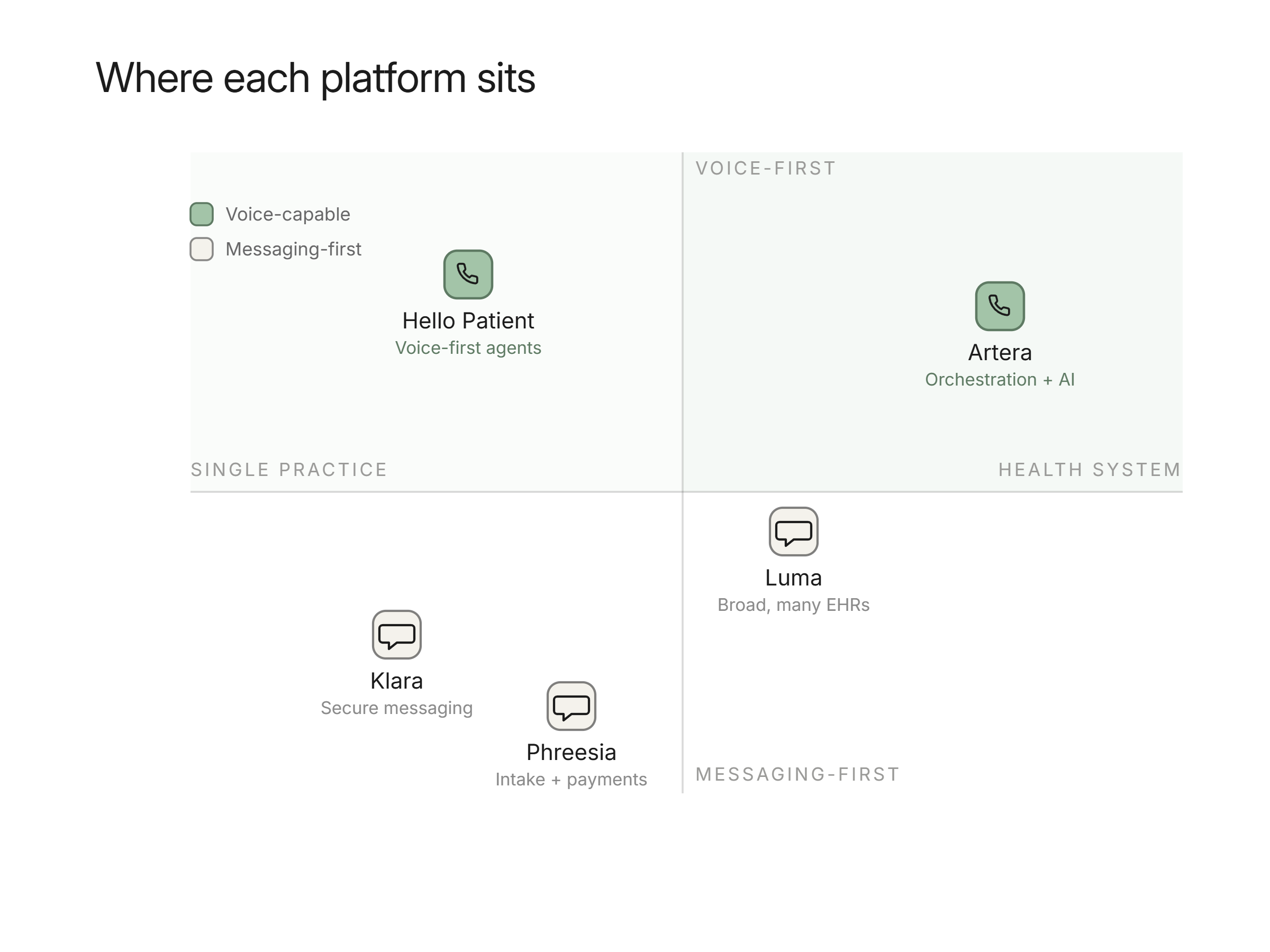
Klara, Luma, Phreesia, Artera, and Hello Patient all help practices message patients, but they solve different problems. Klara centers on secure two-way messaging and is now part of ModMed. Luma is a broad engagement platform that connects to many EHRs. Phreesia leads with patient intake and payments and adds messaging around it. Artera focuses on orchestrating communication across a health system's other tools and has moved into AI agents. Hello Patient is a newer entrant built around autonomous voice and text agents. The category is drawing real capital: Artera reported reaching $100 million in committed annual recurring revenue alongside a $65 million growth investment. This guide compares them on texting, EHR fit, and where a voice AI agent belongs alongside any of them.
How do Klara, Luma, Phreesia, Artera, and Hello Patient compare?
Each platform occupies a different center of gravity, so the right choice follows your primary gap. Luma describes itself as operational AI for healthcare with connections to a large number of EHR and practice-management systems, per its platform overview. The table below summarizes the general positioning; confirm specifics with each vendor for your specialty and EHR.
Texting platforms route messages to staff, and the work of answering still sits with a person. Flexbone takes a different approach, with voice agents that complete scheduling and confirmation requests directly. See AI patient coordinator.
| Platform | Primary focus | Two-way texting | Voice AI |
|---|---|---|---|
| Klara | Secure patient messaging, now part of ModMed | Yes, core capability | Limited, messaging-first |
| Luma | Broad engagement across many EHRs | Yes | Adding AI agents |
| Phreesia | Patient intake and payments | Yes, around intake | Limited |
| Artera | Orchestration across a system's tools | Yes | Yes, AI virtual agents |
| Hello Patient | Autonomous voice and text agents | Yes | Yes, voice-first |
Want this mapped against your own call and claim volume? Book a 30-minute audit
Which handles two-way texting best?
Two-way texting is table stakes for all five, so the differentiator is what surrounds it. Klara is built around the messaging thread itself and consolidates text, chat, and voicemail into one conversation, which suits practices whose main need is clean back-and-forth. Phreesia ties texting to intake and payments. Artera positions its texting inside a broader orchestration and AI-agent layer that can span a health system's existing tools and, the company says, supports messaging across many languages with HIPAA-compliant two-way texting. For a single specialty practice, Klara's focused thread is often enough. For a multi-hospital system coordinating several downstream vendors, Artera's orchestration is the stronger fit. Match the texting tool to the size and complexity of the organization, not to a feature checkbox.
See what AI can run at your facility. In a 30-minute audit we map the calls, eligibility, and follow-ups Flexbone can take off your team first.
Book an auditWhich integrates with your EHR?
EHR integration is where these platforms separate most, because messaging is only useful if it writes back to the chart. Luma emphasizes breadth, connecting its communication tools to a large set of EHR and practice-management systems, as described on its patient communication page. Klara connects to several third-party systems including athenaOne, AdvancedMD, ModMed, and Nextech, and is most tightly coupled to ModMed as its parent. Phreesia and Artera integrate with major EHRs, and Hello Patient integrates with practice-management and EHR systems as part of its agent setup. The practical test is not the count of logos on a page. It is whether the platform reads and writes the exact system your practice runs, and how deep that write-back goes. Ask each vendor for a reference customer on your specific EHR.
Where does a voice AI agent fit alongside them?
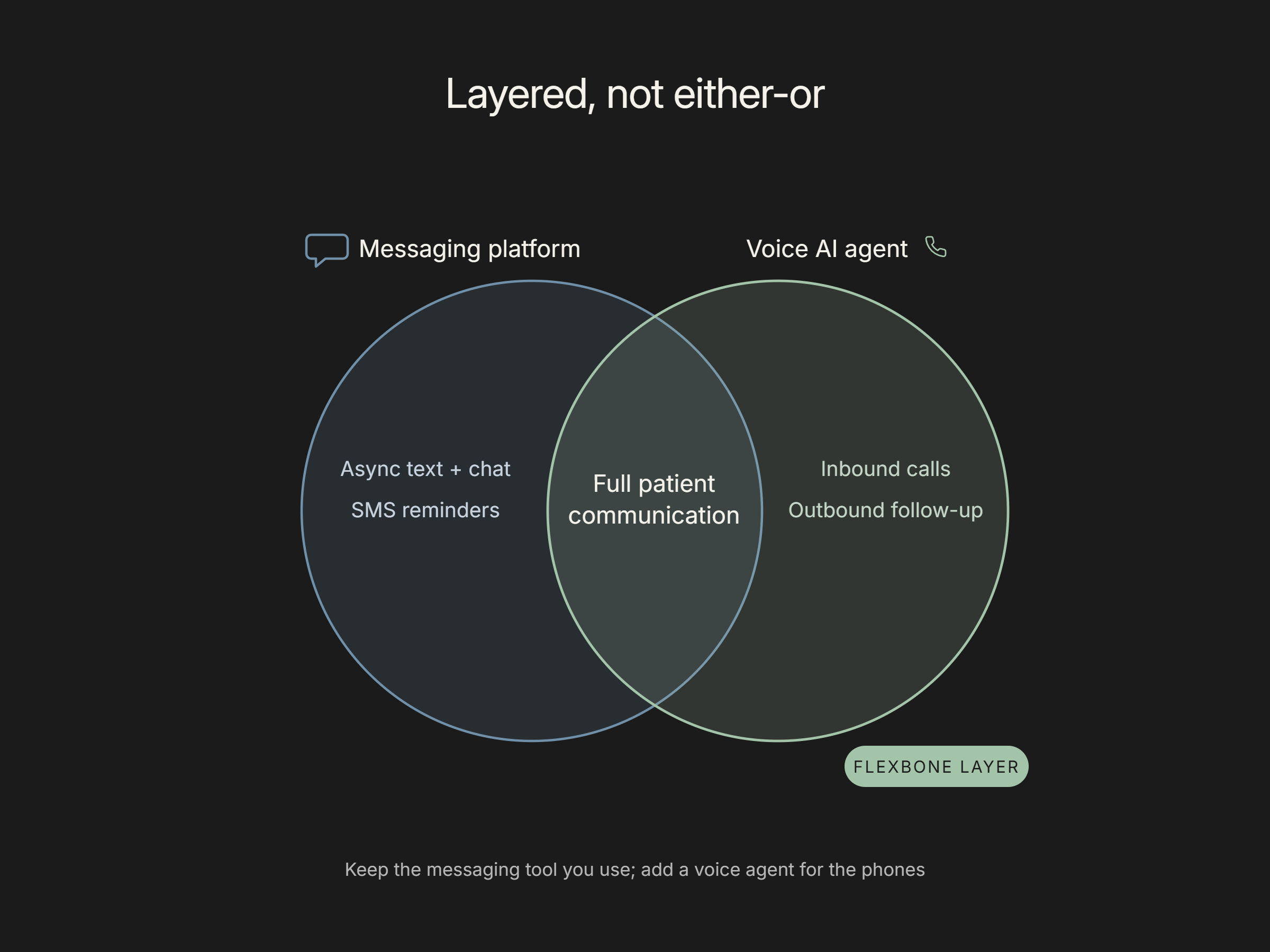
Most of these platforms are strong at asynchronous text and chat, which leaves the phones. Inbound calls and outbound reminder and follow-up calls still consume front-desk time even at practices with good texting. That is the gap a voice AI agent fills. Newer entrants are built voice-first for this reason: Hello Patient raised $22.5 million to scale autonomous voice and SMS agents that answer calls, schedule, triage, and follow up. The pattern to plan for is layered, not either-or. Keep the messaging platform your practice already uses for text, and add a voice agent to take call volume off staff. The two work together: the text thread handles what patients prefer to type, and the voice layer handles what they still call in for.
How Flexbone adds a voice and automation layer
Flexbone provides the voice and automation layer that sits alongside whichever of these platforms you run. We are audit-first: we review a sample of your calls before automating, so the voice agents target your real call patterns rather than a generic script. Our agents answer inbound patient calls, place outbound reminders and follow-ups, and complete revenue-cycle calls like eligibility and claim-status follow-up, working inside your existing EHR and on payer portals. That means a practice on Klara, Luma, Phreesia, or Artera keeps its messaging tool and adds Flexbone for the phones, with a human reviewing exceptions and everything HIPAA compliant and SOC 2-aligned. See our healthcare calls page for how the voice layer works.
Book a demo: https://www.flexbone.ai/contact