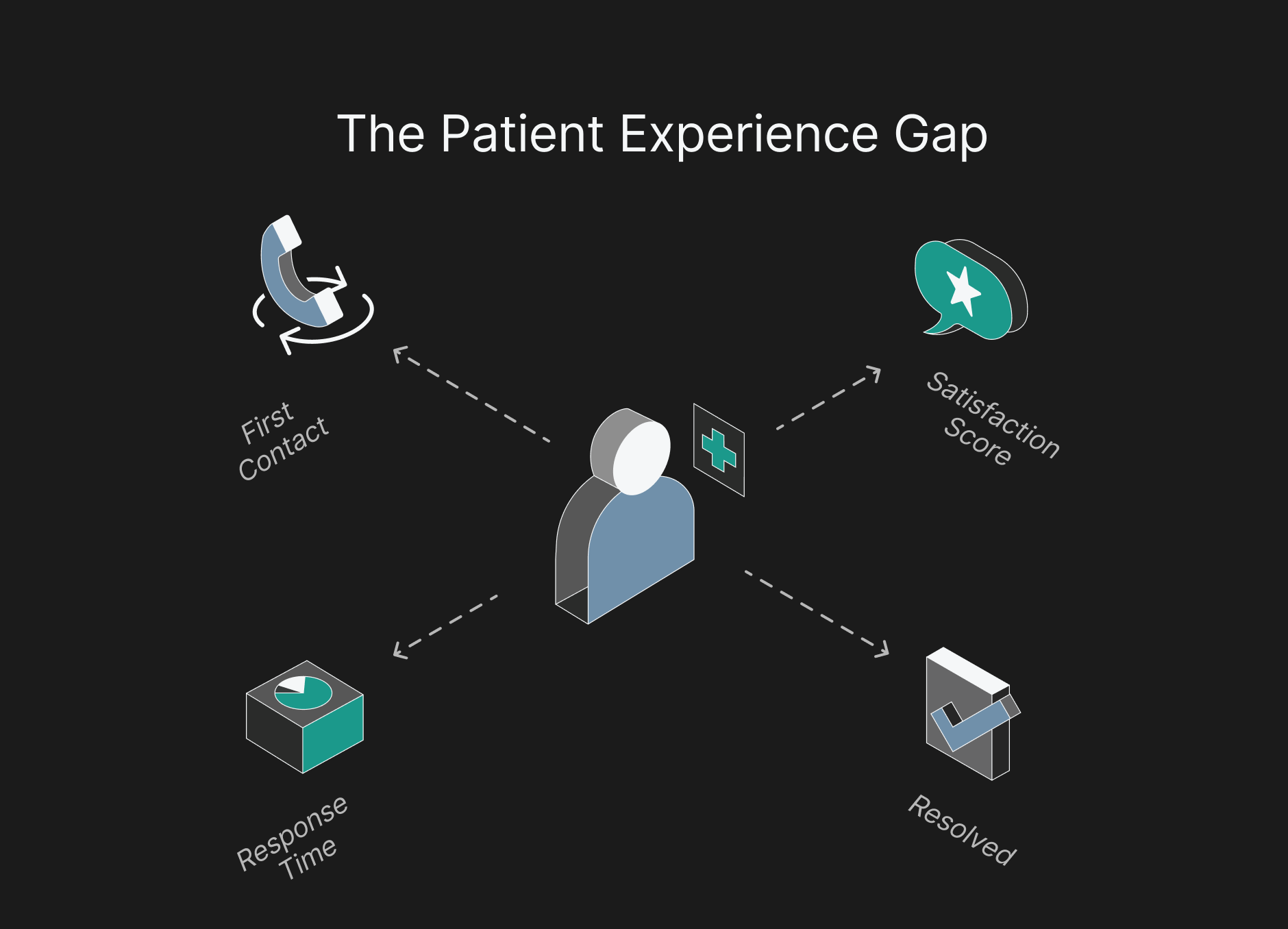
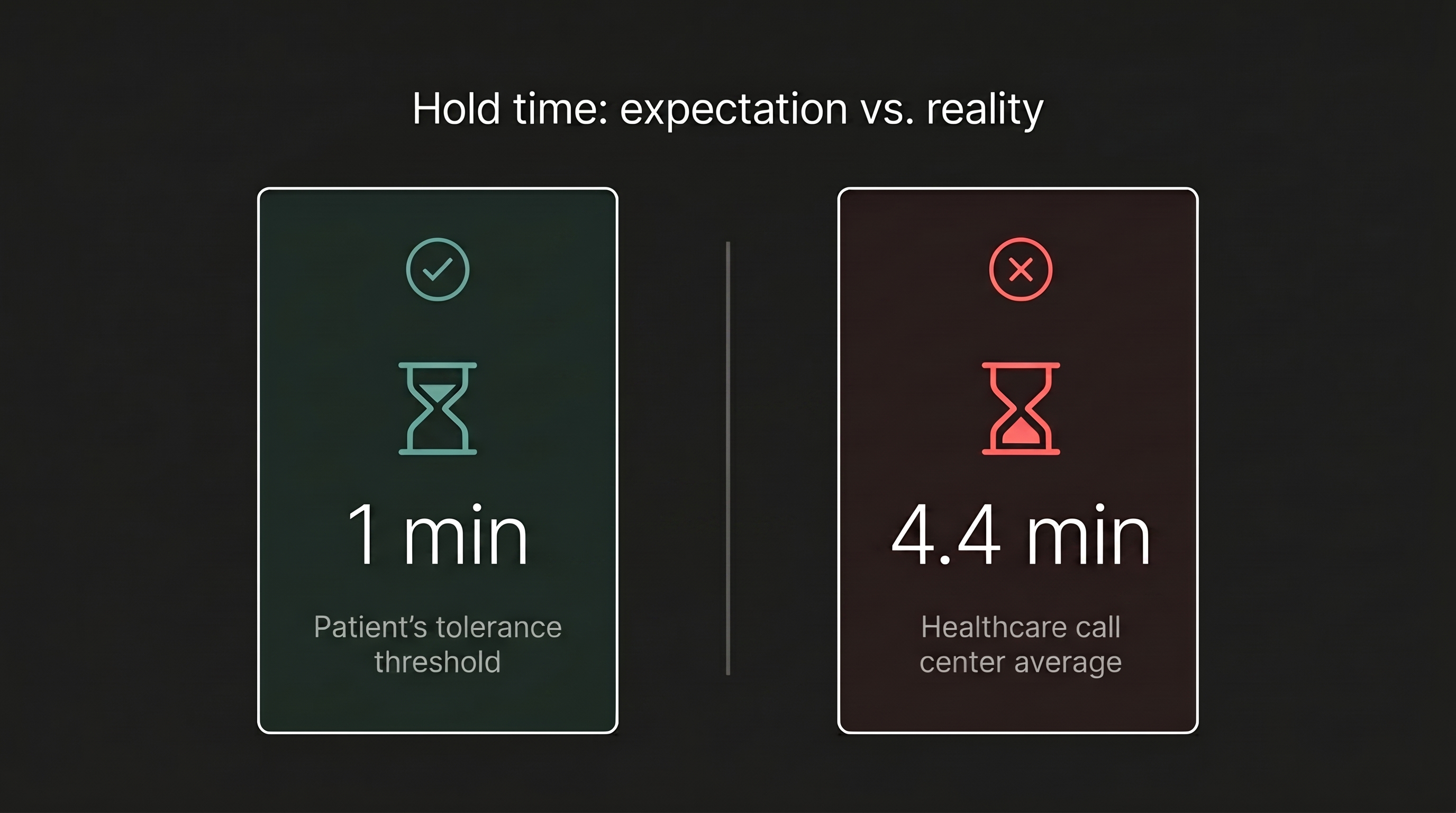
Call center performance is one of the strongest operational drivers of patient satisfaction. Sixty percent of patients are unwilling to wait on hold for more than one minute, yet the average healthcare call center keeps them waiting about 4.4 minutes. That gap in access and responsiveness feeds directly into patient satisfaction scores, Medicare reimbursement, and long-term member retention.
Patient satisfaction has become the metric that connects operational decisions to financial outcomes. With up to 2% of Medicare payments tied to experience scores through the Hospital Value-Based Purchasing program, the phone interaction that feels routine to your team may be the one that shapes a patient's entire perception of your organization.
This guide explains exactly how call center operations influence patient satisfaction, which metrics matter most, and what you can do to improve both. For the broader operational picture, start with our healthcare call center optimization guide.
What Patient Satisfaction Really Measures in Healthcare
Patient satisfaction measures how well a healthcare organization meets patient expectations across care, communication, access, billing, and follow-up. It is usually tracked through standardized surveys and operational scores.
HCAHPS (Hospital Consumer Assessment of Healthcare Providers and Systems) is the national standard. The survey includes 32 questions covering communication with nurses and doctors, hospital staff responsiveness, discharge information, and overall rating. HCAHPS results are publicly reported and directly influence Medicare reimbursement. Thirty percent of a hospital's Value-Based Purchasing Total Performance Score comes from HCAHPS patient experience measures, putting over $1.9 billion in annual Medicare payments at stake across the industry.
CAHPS (Consumer Assessment of Healthcare Providers and Systems) extends beyond hospitals. Health plans, physician practices, and home health agencies use CAHPS variants that feed into CMS Star Ratings. For Medicare Advantage and Medicaid managed care plans, ratings below 4.0 can mean losing millions in bonuses.
CSAT (Customer Satisfaction Score) is the internal metric most call centers track. It is calculated by dividing positive survey responses by total responses and multiplying by 100, giving a near-real-time view of patient experience.
NPS (Net Promoter Score) measures loyalty rather than one interaction. It asks how likely a patient is to recommend the provider. Scores above 50 are considered excellent in healthcare, while many organizations sit between 10 and 30.
The common thread: every one of these scores is shaped, in part, by what happens when a patient picks up the phone.
Want this mapped against your own call and claim volume? Book a 30-minute audit
How Your Call Center Shapes Patient Satisfaction Scores
For many patients, the phone is the first and most frequent contact with your organization. Not the exam room. Not the portal. The phone.
Hold time and repeat calls are the call-center experiences a patient feels directly, and both come from volume the team cannot absorb at peak. Flexbone takes the repetitive part of that volume with voice agents, chosen from the practice's recorded calls, so staff time goes to the calls where a person changes the experience. See healthcare call automation.
A study published in the American Journal of Managed Care examined 252,145 veterans across 285 VHA medical facilities and found a clear link between call center performance and patient satisfaction. Facilities with the longest average speed of answer had lower scores for urgent care access.
The same study found that when VHA facilities reduced average speed of answer from 87 seconds to 69 seconds over two years, patient perceptions of access improved.
The data extends beyond wait times. Consider how the call experience compounds:
- 96% of patient complaints relate to customer service , not clinical care. The phone is where most of those complaints originate.
- Patients with negative phone experiences are 4x more likely to switch providers. In competitive markets, that churn hits your bottom line directly.
- 42% of patients report communication barriers when trying to connect with their provider. The call center is the barrier or the bridge.
- Only 27.8% of patients report getting same-day answers to their medical questions. That means nearly three-quarters are left waiting, and many will call again.
The pattern is clear. Your call center is not a back-office function. It is the front door to your patient experience, and its metrics feed directly into satisfaction and reimbursement.
See what AI can run at your facility. In a 30-minute audit we map the calls, eligibility, and follow-ups Flexbone can take off your team first.
Book an auditThree Metrics That Connect Call Center Ops to Patient Satisfaction
Call center KPIs do not all carry the same weight for patient satisfaction. Three metrics have the strongest connection.
1. First Call Resolution (FCR)
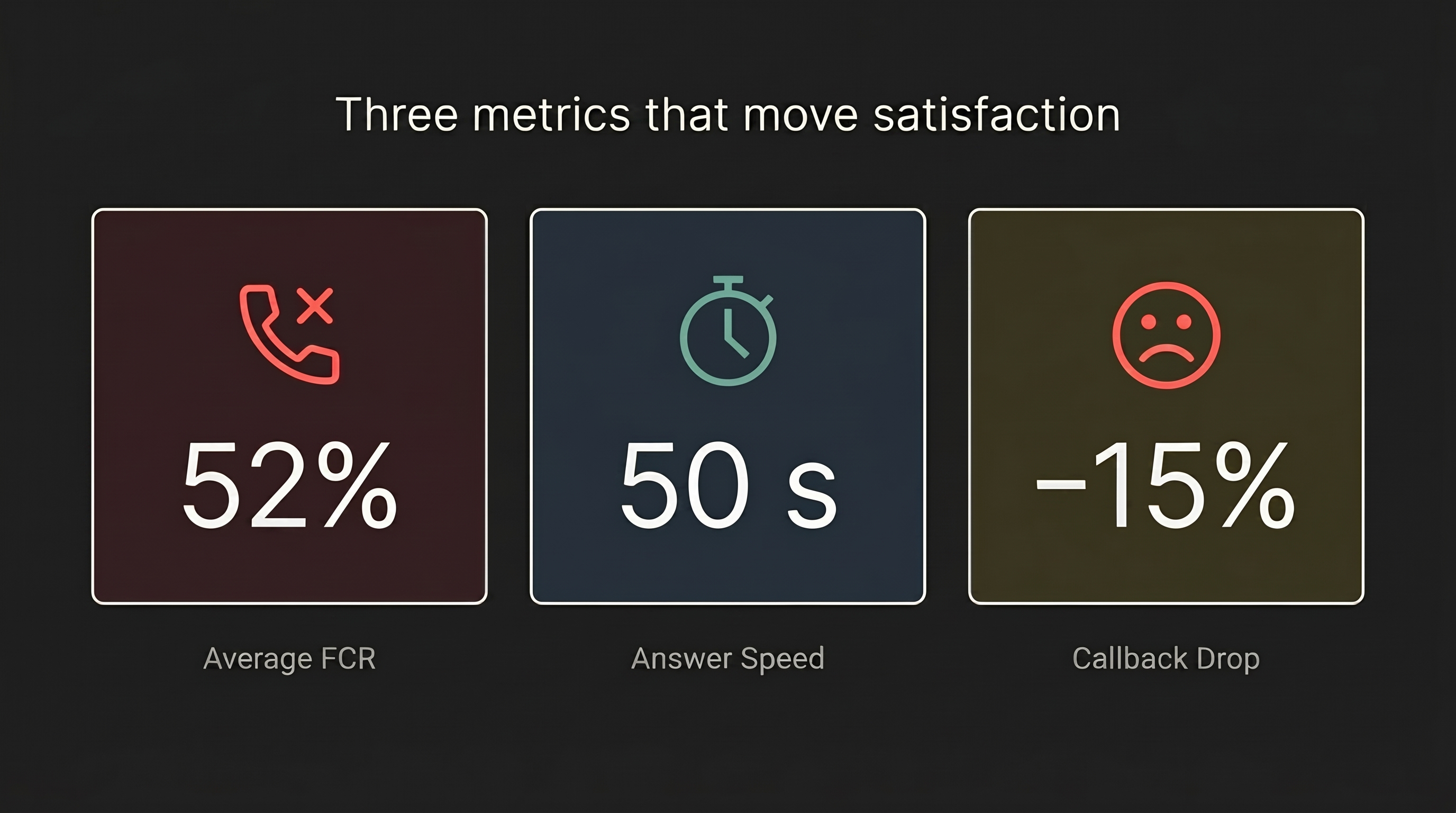
FCR measures whether a patient's issue gets resolved during the initial interaction. The healthcare industry average is approximately 52%, which means nearly half of all patient calls require a follow-up. The benchmark for positive satisfaction impact is 70% to 75%.
Every percentage point matters. Satisfaction drops about 15% each time a patient has to call back about the same issue. If you want to improve CSAT, FCR is the strongest lever. For a detailed breakdown, see our guide on first call resolution in healthcare.
2. Average Speed of Answer / Hold Time
The VHA study found that facilities in the worst quartile for ASA had significantly lower satisfaction scores (OR 0.84-0.85). The Healthcare Financial Management Association sets a benchmark of 50 seconds. Most healthcare call centers operate well above that.
Hold time perception varies by context. A patient calling about a denied prior authorization experiences a 3-minute hold differently than someone confirming an appointment time. But the aggregate data is unambiguous: every second of hold time erodes trust. For a deeper look at the math, read our average handle time formula guide.
3. Quality and Consistency of Interactions
Beyond speed and resolution, the quality of the conversation itself matters. 68% of patients say healthcare providers need better communication skills. When agents provide inconsistent information, skip empathy cues, or fail to explain next steps, satisfaction drops even when the call is technically "resolved."
Quality is harder to measure than FCR or ASA, which is why many organizations rely on call center quality assurance programs that score interactions against defined criteria.
How to Improve Patient Satisfaction Through Call Center Operations
Improving patient satisfaction is not about one initiative. It requires operational changes that work together.
Audit Calls in Full, Not Just a Sample
Most healthcare call centers review only 1% to 5% of calls through manual QA. That means 95% or more of patient interactions go unexamined.
Moving to 100% call analysis through AI-powered speech analytics or automated scoring helps identify patterns sampling misses, such as recurring complaints, missed empathy cues, and process breakdowns.
Map and Eliminate Repeat-Call Drivers
Start by categorizing why patients call back. In most healthcare organizations, the top drivers fall into predictable buckets.
Once you identify the top three to five drivers, assign ownership and set reduction targets. Eliminating even one major repeat-call category can improve FCR by several points.
Give Agents Access to Complete Patient Information
42% of communication barriers come from agents not having the information they need. When your call center platform is not integrated with your EHR (Epic, athenahealth, or eClinicalWorks), scheduling system, and claims database, agents spend time asking patients to repeat information or placing them on hold while they search across systems.
Tight EHR integration gives agents a unified view of appointments, claims, eligibility from the 270/271 response, balances, and authorized clinical notes. The result is faster resolution, fewer transfers, and a patient who feels known.
Train for Healthcare-Specific Communication
Generic call center training does not prepare agents for the emotional weight of healthcare calls. A patient calling about a denied claim for their child’s therapy is not like a customer asking about a shipping delay.
Effective healthcare call center training covers:
- Empathy language that acknowledges the patient's situation without empty apologies
- Benefits and eligibility literacy so agents can accurately interpret plan documents
- De-escalation techniques specific to anxious or upset patients
- Warm transfer protocols that pass context to the next agent or department
Close the Loop with Post-Interaction Follow-Up
57% of patients expect automated appointment and medication reminders. That expectation also applies to call center interactions.
When a patient calls about a prior authorization, they expect an update when the status changes, not another call to ask. Proactive follow-up by text, email, or portal message reduces repeat calls and shows the issue is being managed.
Measure, Report, and Act on CSAT Continuously
CSAT data only matters if it drives action. Send surveys right after interactions while the experience is fresh. Review scores weekly at the team level and monthly at the organization level.
Set clear targets. If your current CSAT is 72%, aim for 78% within two quarters.
The strongest approach ties CSAT back to call types, agents, and time periods. This turns a broad metric into a useful diagnostic tool.
The Role of Technology in Closing the Satisfaction Gap
The strategies above require technology that most legacy call center platforms were not built to provide.
AI-powered call analysis makes 100% call review possible without proportionally increasing QA headcount. Speech analytics tools can score calls for compliance, empathy, and resolution in near real time, giving supervisors visibility they have never had before.
EHR integration eliminates the information silos that force agents to toggle between systems or place patients on hold. When a patient calls, the agent should see everything relevant to that patient without asking the patient to repeat it.
Sentiment tracking identifies at-risk interactions as they happen, not weeks later when a complaint arrives or a member churns. Real-time sentiment alerts let supervisors intervene during calls rather than reviewing recordings after the damage is done.
Automated workflows handle the follow-up tasks that agents forget or deprioritize: sending status updates, scheduling callbacks, routing complex cases to specialized teams.
Platforms like Flexbone AI combine these capabilities, including 100% call analysis, EHR integration with 15+ systems, and real-time sentiment tracking. The goal is not to replace agents, but to give them the context and support needed to resolve issues on the first call.