
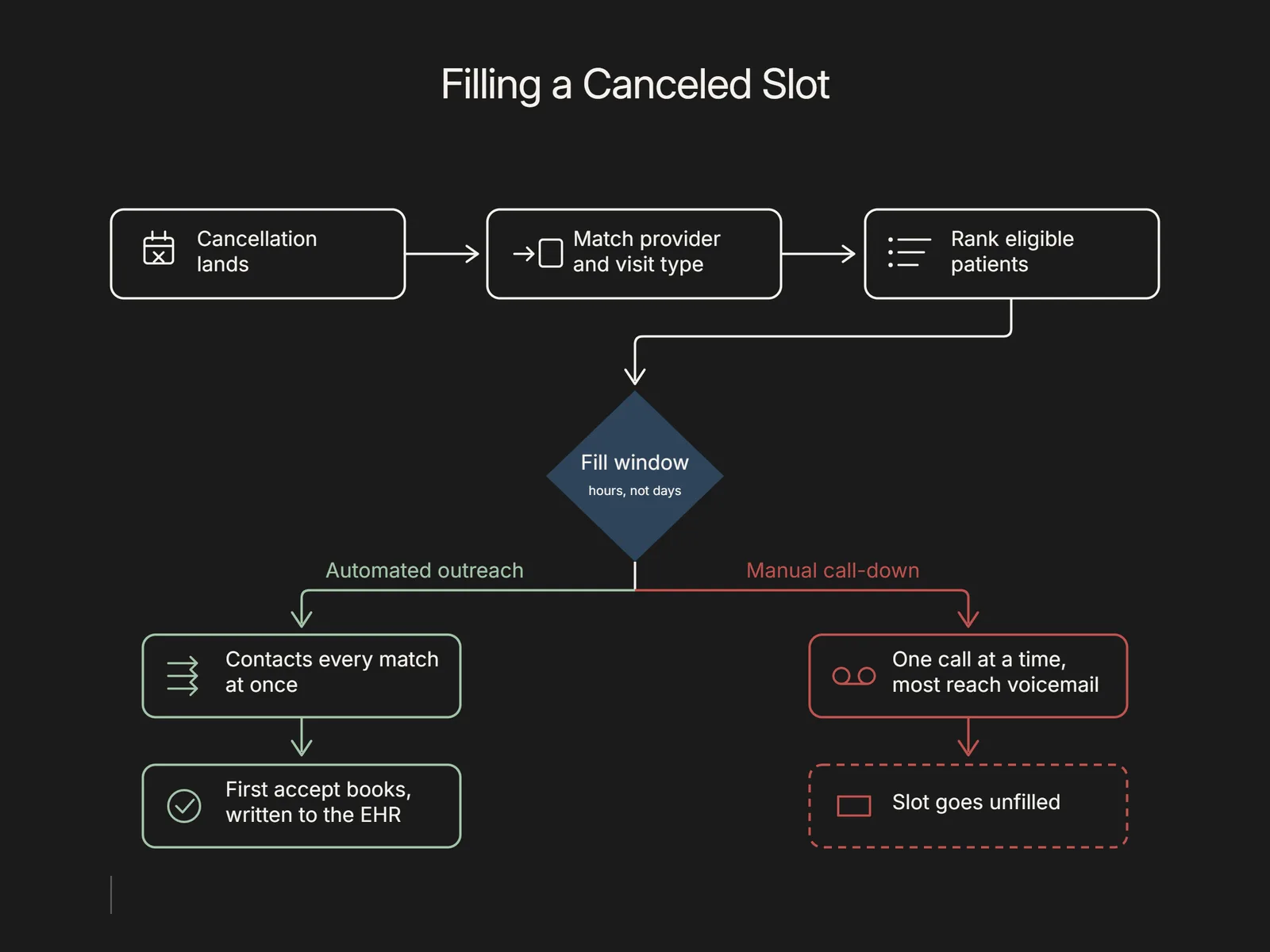
Patient waitlist management is the practice of keeping a ranked list of patients who want an earlier appointment and contacting them in order the moment a slot opens. When a cancellation lands, the open time is matched to patients who fit the same provider and visit type, they are reached in priority order, and the first person who accepts is booked into the slot. Done well, patient waitlist management protects two things at once: the practice's revenue, because a backfilled slot is paid work instead of an empty room, and patient access, because someone who was waiting gets seen sooner. The hard part is speed. A cancellation the day before an appointment leaves only hours to reach the next patient, which is why automated outreach usually beats a manual call-down list.
What is patient waitlist management?
Patient waitlist management is the workflow a practice uses to track patients who want to be seen earlier and to move them into slots that open through cancellations. It has two parts. The first is capture: at booking time you record which provider and visit type the patient needs and when they can realistically come in, so the list is more than a pile of names. The second is action: when a slot frees up, you work the list in priority order rather than calling whoever comes to mind. Priority can reflect clinical urgency, how long someone has waited, or how soon they need the specific visit type. Without the capture step, a waitlist becomes a stale note in the schedule that no one trusts, and staff stop using it.
Want this mapped against your own call and claim volume? Book a 30-minute audit
How does a waitlist fill a canceled appointment slot?
A waitlist fills a canceled slot by matching the opening to patients who are eligible for it and reaching them until one accepts. The match is not just any open time to any waiting patient. It has to line up the provider, the visit type and length, and the location, because a 15-minute follow-up slot does not fit a new-patient visit that needs 40 minutes. Once the eligible patients are identified, they are contacted in priority order, and the first person who confirms is booked into the slot while the others are told it is taken. Timing is the constraint. Many cancellations arrive within a day of the appointment, so the window to fill the slot is measured in hours, and a list that gets worked the next morning has usually missed it.
Does patient waitlist management protect revenue and access?
Yes, on both counts, because a backfilled slot is a slot that gets paid for and a patient who gets seen. The revenue case rests on how costly empty slots are. A long-run study of outpatient clinics found a mean no-show rate of 18.8 percent and an average cost of $196 per missed appointment, which is the size of the gap a waitlist works against. The access case rests on scheduling flexibility. A systematic review of outpatient clinics found that open-access approaches that shorten the wait to be seen reduced no-show rates in 62.5 percent of the studies reviewed. A waitlist is one of those approaches: it pulls waiting patients forward into time that would otherwise sit empty, so the practice recovers revenue and the patient gets earlier care from the same event.
See what AI can run at your facility. In a 30-minute audit we map the calls, eligibility, and follow-ups Flexbone can take off your team first.
Book an auditWhat should patient waitlist software do?
Waitlist software should close the gap between a cancellation and the outreach that fills it, without asking staff to run the calls by hand. At a minimum it should store each patient's provider, visit type, and availability so the list is actionable, detect when a matching slot opens, and contact eligible patients in priority order. When someone accepts, it should book them into the slot and write the appointment back to the EHR so the schedule stays the single source of truth, then log every attempt for review. Two properties separate useful software from a spreadsheet. First, it acts immediately rather than at the next manual pass, because the fill window is short. Second, it handles the outreach volume in parallel, so a slot that frees up at 4 p.m. does not wait behind a receptionist's other calls.
Manual call-down list versus automated outreach
A manual call-down list works, but it competes for staff time the practice rarely has to spare. When a slot opens, someone has to notice it, pull the list, and phone patients one at a time until a person answers and says yes. Each call takes minutes, most go to voicemail, and the receptionist is usually doing this between inbound calls and front-desk work. The result is that same-day cancellations often go unfilled, not because no patient wanted the slot but because no one had time to reach them fast enough. Automated outreach changes the economics by removing the human bottleneck from the first pass. It detects the opening, contacts eligible patients at once, and only involves staff when a patient needs something the system is not scoped to handle. The manual list is still a reasonable fallback for complex cases; it is a poor primary method for time-sensitive backfill.
How does Flexbone automate patient waitlist outreach?
Flexbone runs the waitlist as an outbound workflow tied to your schedule. When a slot opens, the AI voice agents call the waitlist in priority order, offer the specific opening, and book the first patient who accepts, then write the appointment back to the EHR so your schedule stays current. The design is audit-first: each call is logged with a transcript and outcome, so the team can review what the agent offered, who accepted, and what was written back before trusting it further. Anything outside the defined scope, such as a clinical question or a request to change providers, is handed to a staff member with the context attached rather than answered by the system. The same agents can run related front-desk work as an automated healthcare receptionist or as an AI patient coordinator across scheduling and reminders. On compliance, deployments are built to be HIPAA compliant under a signed business associate agreement and are aligned with SOC 2 practices, with encryption, access controls, and audit logging. We do not claim to eliminate no-shows; we work to fill the slots a cancellation would otherwise leave empty.
Getting started
If unfilled cancellations are costing your practice slots your patients would gladly take, the fastest way to see whether automated waitlist outreach fits your schedule is to walk through your own booking and cancellation flow with us. Book a demo and we will map how the workflow would run against your EHR and your visit types.