
Physical therapy billing follows the same claim path as the rest of medical billing, but four features make it distinct. PT services split into timed procedures, billed in units based on how long you spend one-on-one with the patient, and untimed procedures, billed once per session no matter the duration. The number of timed units you can charge is governed by the 8-minute rule, which converts total treatment minutes into billable units. Most payers cover therapy through a plan of care with visit authorization, approving a set number of visits or a date range rather than an open benefit, which forces reauthorization when the cap is reached. Therapy-specific modifiers must be attached to identify the plan of care and to separate distinct services. Because a typical episode runs many high-frequency visits, small errors in any of these repeat across every claim.
What makes physical therapy billing complex?
Physical therapy billing is complex because a single visit combines several coding rules that other specialties handle separately. One session can include an evaluation, one or more timed procedures such as therapeutic exercise or manual therapy, and one or more untimed procedures such as an unattended modality, each with its own billing logic. The timed services have to be reconciled against the total treatment time before the claim can be coded correctly, which is a calculation, not a lookup. Therapy is also usually authorized as a course of care with a visit limit, so the billing team is tracking how many approved visits remain and when to request more. Add therapy modifiers and recertification deadlines, and the same claim has to satisfy a coding rule, an authorization rule, and a documentation rule at once. The volume compounds it: a course of PT is often two or three visits a week for several weeks, so a habit that produces one denial produces dozens.
Want this mapped against your own call and claim volume? Book a 30-minute audit
What is the 8-minute rule?
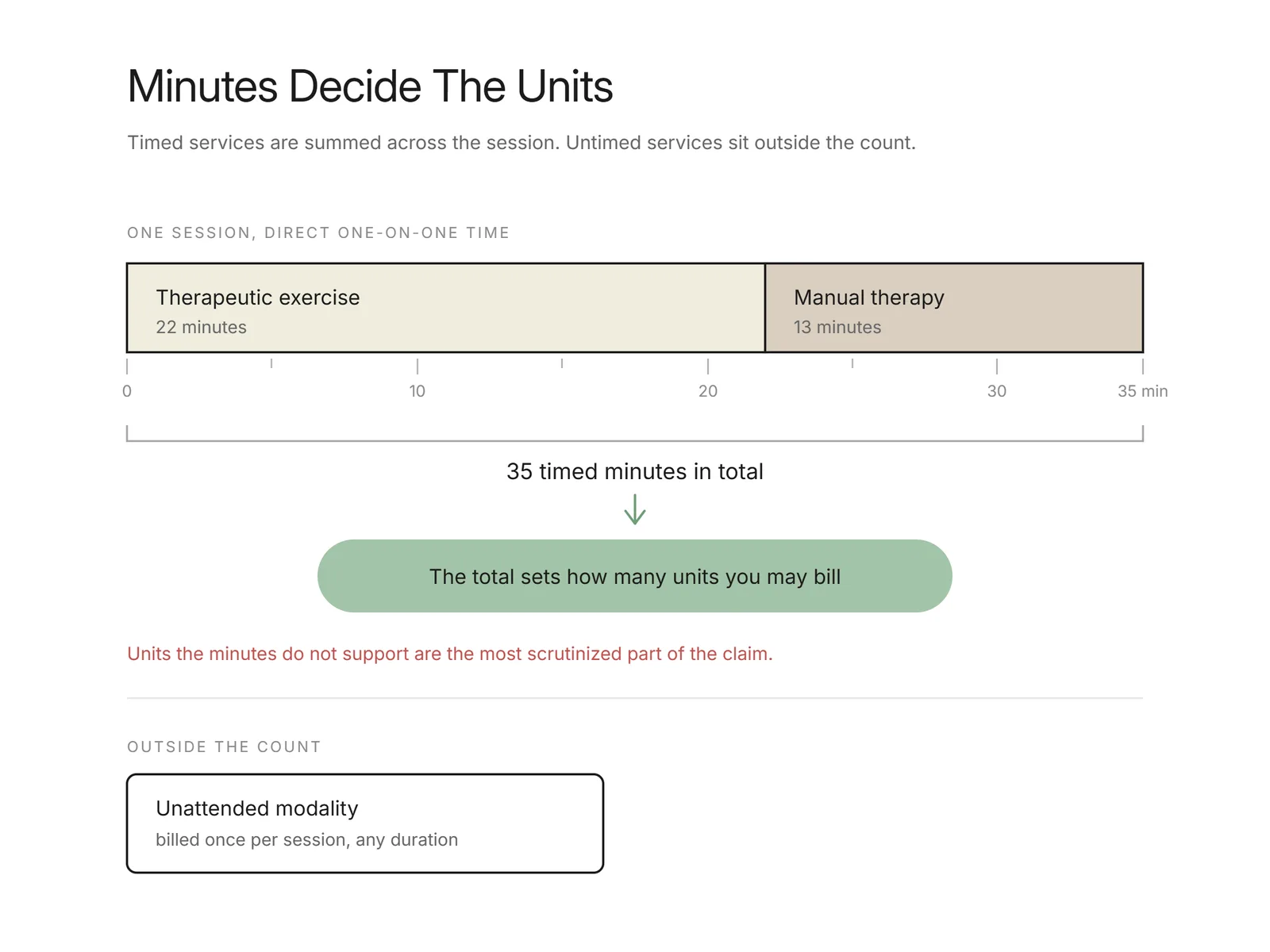
The 8-minute rule is the method payers use to translate the minutes of a therapy session into the number of billable units for timed services. Timed procedures are reported in units, and the rule sets a minimum amount of direct, one-on-one treatment you must provide to bill each unit. In general terms, you need to furnish at least eight minutes of a timed service to charge one unit of it, and the total minutes of timed treatment across the session determine how many units in total you are allowed to bill. When several timed services are delivered in the same visit, the minutes are summed and the total is what caps the unit count, so you cannot bill each service as if it stood alone. Untimed services sit outside this entirely: they are billed once per session regardless of duration, because a unit of an untimed code represents the service, not a block of time. Overstating units the minutes do not support, or understating what was actually delivered, is one of the most scrutinized parts of a therapy claim. Because Medicare and some commercial payers apply the counting rules with subtle differences, the exact minute thresholds should be confirmed against each payer's own policy rather than assumed.
How does physical therapy prior authorization work?
Physical therapy prior authorization is usually organized around the plan of care rather than the individual visit. After the initial evaluation, the therapist establishes a plan, and the clinic submits it to the payer, which then approves a defined course of treatment: commonly a specific number of visits, a number of units, or a date window, rather than open-ended coverage. Care delivered inside that approval is payable; visits beyond the cap are not, unless the clinic obtains more. When the approved visits are used up and the patient still needs treatment, the clinic requests reauthorization, typically by sending updated progress notes that show continued medical necessity. This is why tracking visits against the authorized cap matters as much as getting the first authorization: a clinic that loses count bills visits it was never approved for. Prior authorization is also a heavy administrative load in its own right. The AMA reports physicians complete about 39 prior authorizations each week, spending roughly 13 hours on them, and therapy is one of the service lines where authorization and reauthorization recur throughout an episode. Requirements differ sharply by payer and plan, so the reliable practice is to verify the therapy benefit and any authorization requirement before the first visit. For the payer- and platform-specific mechanics of submitting and tracking these, see therapy and behavioral prior authorization. For how visit authorization, plan-of-care tracking, and eligibility run together in a therapy clinic, see AI for physical therapy practices.
See what AI can run at your facility. In a 30-minute audit we map the calls, eligibility, and follow-ups Flexbone can take off your team first.
Book an auditWhat are therapy modifiers?
Therapy modifiers are short codes appended to a procedure to tell the payer something the base code does not carry on its own. In physical therapy, a few categories come up repeatedly. One identifies that the service was furnished under a physical therapy plan of care, which some payers require on every therapy line to route and price the claim correctly. Another signals that two timed procedures performed in the same session were separate and distinct services rather than components of one, so both are eligible to be paid instead of bundled together. On certain plans, an additional attestation indicates that continued therapy above a payer's dollar or visit threshold is medically necessary and supported by the documentation. The specific two-character codes vary by payer and change over time, so the operative discipline is to apply the modifier the payer's current policy calls for and make sure it matches the documentation, rather than memorizing a fixed set. Because an omitted or incorrect modifier is a routine denial trigger, modifier accuracy is checked on the front end alongside authorization and coding.
Why do physical therapy claims get denied?
Most physical therapy denials trace back to the front end, before the claim is even coded. The recurring causes are a missing or expired authorization, or visits billed past the approved cap; a therapy modifier that is absent, wrong, or inconsistent with the note; timed units that do not reconcile with the total treatment minutes under the 8-minute rule; and eligibility issues, such as an exhausted therapy benefit or a plan change, that the clinic did not catch before the visit. Documentation problems compound these, most often a plan of care that was not signed or recertified within the required window. None of this is unique to therapy in kind, but the high visit frequency means a single bad pattern repeats across an entire episode. Denials are a broad industry problem: KFF found that insurers denied 20% of in-network HealthCare.gov claims in 2023, and patients appealed fewer than 1% of them, which means most denied revenue is simply lost when no one reworks it. The prevention is upstream: confirm the benefit and authorization before the visit and code each claim to match the documentation. Standardized electronic checks exist for this, using the 270/271 eligibility transaction to confirm coverage and benefits before care is delivered. For the claims that still get rejected, AI denials management categorizes the denial reason and reworks the claim, and consistent insurance eligibility verification removes a large share of the front-end causes in the first place.
AI voice and browser agents can take on the repetitive parts of PT billing directly: they verify the therapy benefit and visit limit before the first appointment, track completed visits against the authorized cap and submit reauthorization with the current progress notes when the cap is near, and work denials by identifying the reason and refiling or appealing with the right documentation. If you want to see how much of this an agent could handle in your clinic, book a call with Flexbone to run a quick audit of what AI can take off your PT billing.