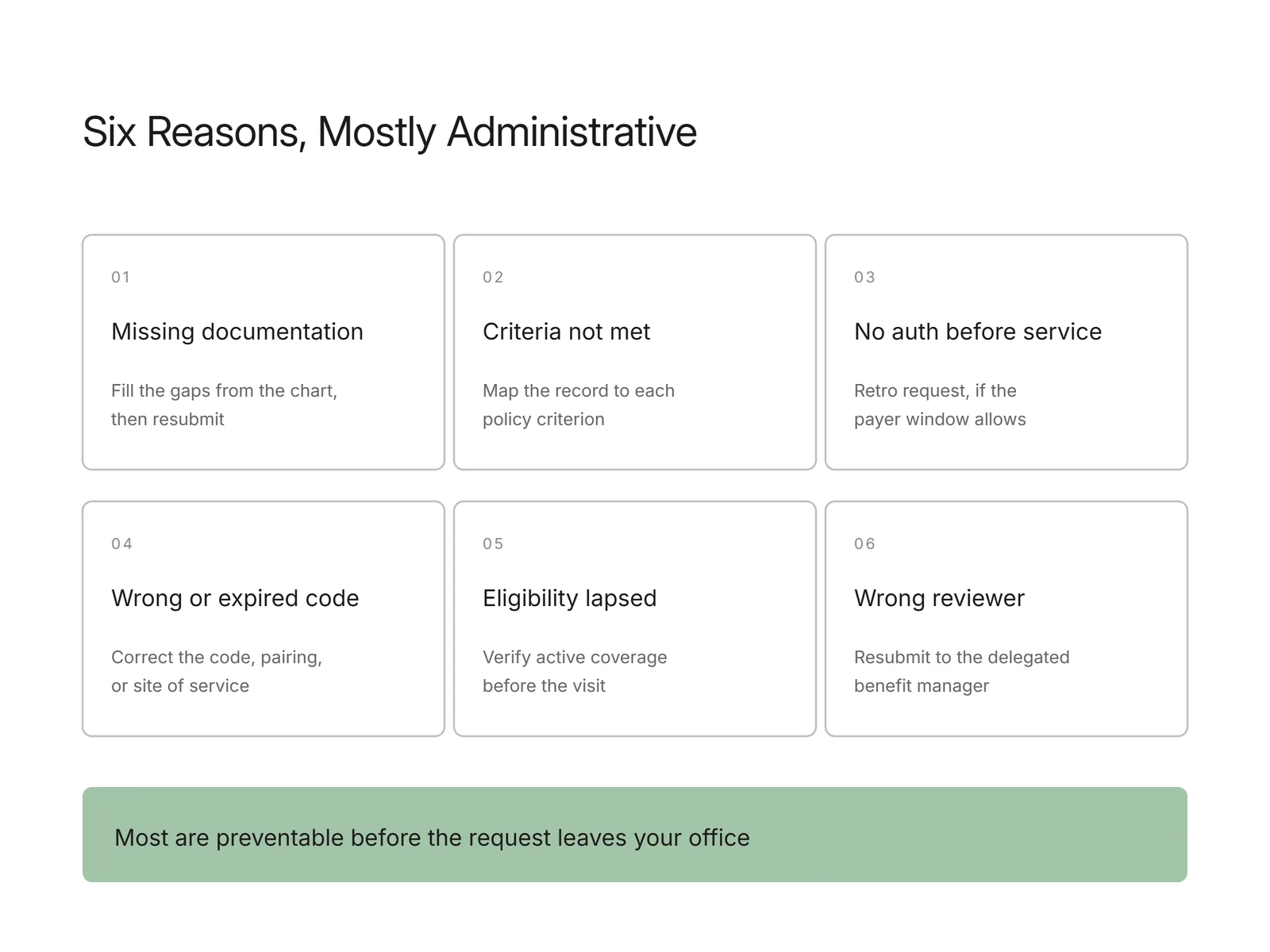
Prior authorizations are denied for a short list of recurring reasons: missing or insufficient clinical documentation, medical-necessity criteria that are not met, no authorization obtained before the service was rendered, a wrong or expired procedure code or site of service, an eligibility or coverage problem, and submission to the wrong reviewer or benefit manager. Most are administrative rather than clinical, which means most are preventable before the request leaves your office. Prior authorization is also a heavy workload to get wrong: the AMA reports physicians handle about 39 prior authorizations per week, spending roughly 13 hours on them. The sections below give the cause, the fix, and the prevention step for each reason, and where an AI agent catches the problem before submission.
Why is a prior authorization denied for missing documentation?
Insufficient or missing clinical documentation is one of the most common reasons a prior authorization is denied. The payer needs specific evidence to approve the request: relevant notes, prior test results, conservative treatments already tried, and the ordering rationale. When any required piece is missing, the request is denied or pended even though the care is appropriate.
The fix is to identify what the payer's policy asks for, gather it from the record, and resubmit with the gaps filled. The prevention step is a documentation checklist per payer and per procedure so nothing is submitted incomplete. An AI agent can run this before submission: it reads the requirement for the code and plan, pulls the matching notes from the chart, and flags what is missing so a person can supply it.
Want this mapped against your own call and claim volume? Book a 30-minute audit
What does it mean when a prior authorization is denied for medical necessity?
A medical-necessity denial means the payer applied its coverage policy and concluded the request does not meet the criteria for that service. Unlike a missing-document denial, the records may be complete but do not show the patient satisfying each element of the policy, such as a step-therapy rule requiring that a lower-cost therapy was tried first.
Read across the reasons and most are procedural: a missing document, a coding mismatch, the wrong benefit path. Flexbone targets the procedural ones, catching them before submission rather than appealing them afterward, and it identifies which recur by classifying a practice's own denied requests.
To fix it, read the policy the payer cited, confirm the patient meets each criterion, and resubmit or appeal with documentation mapped to those criteria. Appealing is worth it even though few do: KFF found insurers denied 20 percent of in-network HealthCare.gov claims in 2023, and consumers appealed fewer than 1 percent. When the denial turns on clinical judgment rather than a missing record, a peer-to-peer review with the payer's medical director is often the fastest way to overturn it. An AI agent compares the documented clinical picture against the published policy and surfaces an unmet criterion up front; when a denial lands, the same agents draft the appeal and schedule the peer-to-peer call.
See what AI can run at your facility. In a 30-minute audit we map the calls, eligibility, and follow-ups Flexbone can take off your team first.
Book an auditCan you get a prior authorization after the service was performed?
Sometimes. If the service was rendered before authorization was obtained, the claim is usually denied because none was on file, a timing failure rather than a clinical one. Many payers accept a retroactive, or retro, request within a stated window, often a few business days, usually only when the service was urgent or eligibility could not be confirmed in advance, and it must document why authorization could not be obtained. Emergency care is generally exempt, though the payer can still review it afterward.
The prevention step is to confirm whether a service requires authorization before it is scheduled, then track the request to an approval number before the date of service. Many plans exchange these requests through the X12 278 transaction, though portals are still common. An AI agent checks the requirement at scheduling and monitors status, so a pending case is escalated before the appointment rather than becoming a denial.
Why is a prior authorization denied for a coding or site-of-service error?
Coding and site-of-service errors are frequent and avoidable. The request can be denied because the CPT or HCPCS code is wrong, has expired or been replaced, does not match the documented ICD-10 diagnosis, or lists a site of service the plan does not cover. A payer that authorizes a procedure in an ambulatory surgical center may deny it as an inpatient case, so the authorized code and setting must match what is billed. The resulting remittance carries CARC and RARC codes that name the reason.
The fix is to correct the code, the diagnosis pairing, or the place of service and resubmit. To prevent it, validate the CPT, HCPCS, and ICD-10 values against the plan's covered settings before submission. An AI agent confirms the code is active, consistent with the diagnosis, and valid for the intended setting.
Why is a prior authorization denied for eligibility or the wrong benefit manager?
Two related routing problems commonly drive denials. The first is eligibility: the patient's coverage was inactive on the date of service or the service falls outside the benefit, so the payer denies regardless of clinical merit. This is common with Medicare and Medicaid plans, whose coverage can lapse between visits. Confirming active coverage before the visit is the standard defense, and CMS supports this with the 270/271 eligibility transaction under Administrative Simplification, the electronic inquiry and response that returns benefit detail.
The second problem is sending the request to the wrong reviewer. Many plans delegate specific categories, most visibly advanced imaging, to a benefit manager such as eviCore or Carelon. A request routed to the plan instead of the delegated benefit manager, or one that misses that reviewer's criteria, is denied on procedure. The fix is to resubmit through the correct entity; the prevention step is to identify the responsible reviewer for the code and plan up front. An AI agent verifies eligibility ahead of the visit and routes each request to the correct plan or benefit manager, then drafts the appeal if a denial occurs.
How Flexbone prevents prior authorization denials
Most prior authorization denials come from the same administrative gaps: a missing document, an unmet criterion, a late request, a mismatched code, or a misrouted submission. Flexbone deploys AI voice and browser agents that check the requirement, assemble the documentation, verify eligibility, and submit each request to the correct reviewer before it goes out, then draft the appeal and schedule the peer-to-peer when a denial lands. A person reviews the clinical rationale first, and the work runs inside your existing systems. See how these fit together on our prior authorization automation, AI denials management, and insurance eligibility verification pages.
If you want to see this against your own denial mix, book a call with Flexbone and we will run a quick audit of what AI can take off your prior authorization workload.