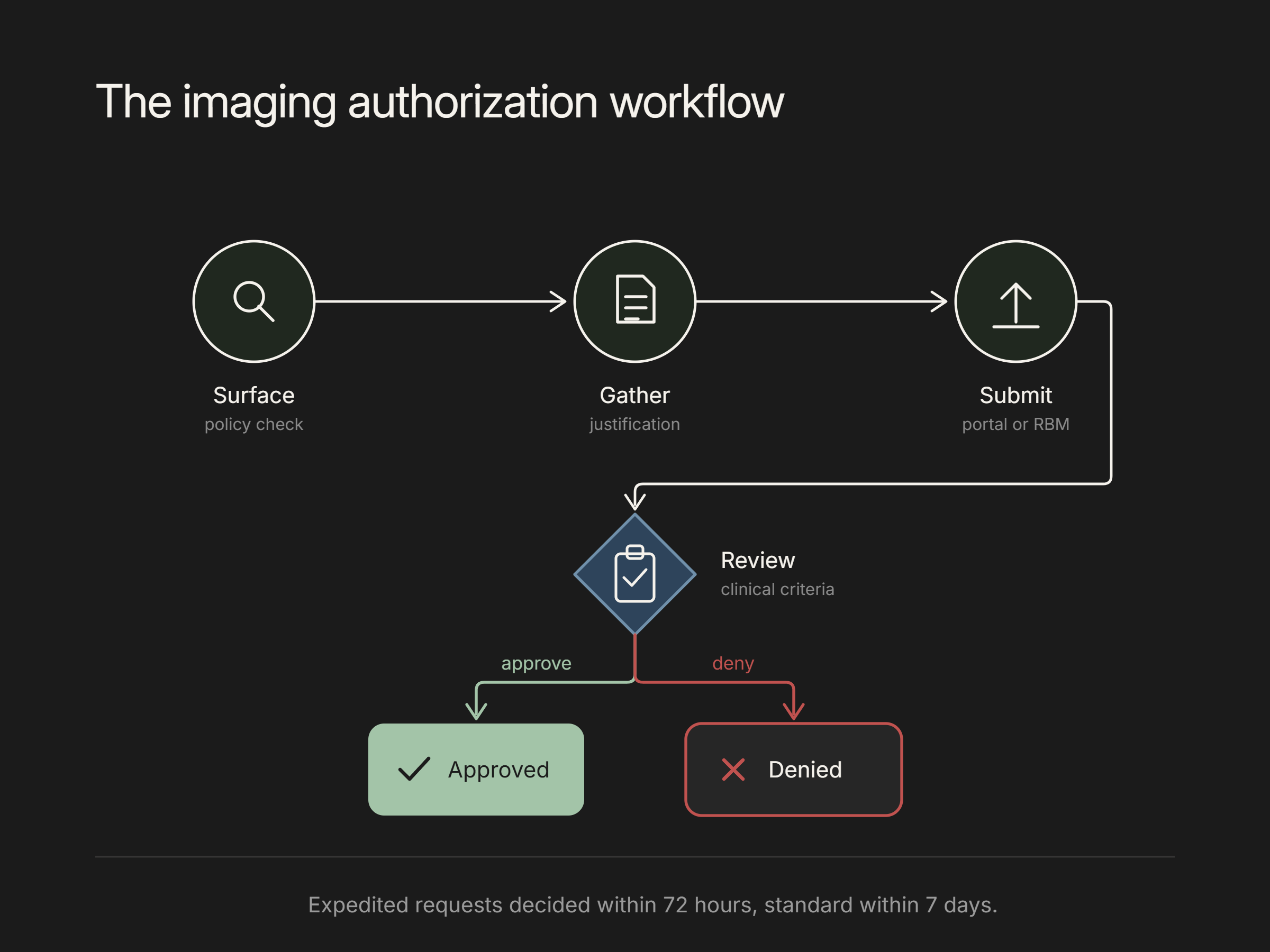
Prior authorization for imaging is a payer requirement that the ordering clinician justify an advanced imaging study before the health plan will cover it. It applies most often to MRI, CT, PET, and nuclear cardiology, and less often to plain X-rays or ultrasound. The workflow runs in a set order. The ordering office identifies that a study needs review, gathers the diagnosis and prior workup, and submits the request to the health plan or the radiology benefit manager the plan contracts with. The reviewer checks the request against clinical criteria and returns an authorization number, a denial, or a request for more information. An approval lets scheduling and billing proceed; a denial comes with a reason and an appeal path. Under the CMS final rule, affected payers must decide within 72 hours for expedited requests and 7 calendar days for standard requests.
Which imaging studies usually require prior authorization?
Advanced imaging is reviewed more often than basic imaging. MRI prior authorization and CT scan prior authorization are common because these studies are expensive and can sometimes be replaced by a lower-cost option or a period of conservative treatment. PET scans, nuclear cardiology, and some interventional procedures fall in the same category. Plain X-rays and ultrasound are usually not reviewed. Whether a specific study needs approval depends on the plan, the ordering diagnosis, and the site of service, so the same MRI can require review under one plan and not another. Prior authorization is a leading source of physician administrative work: in the American Medical Association's 2024 survey, practices reported completing an average of 43 prior authorization requests per physician each week, per the AMA. The first step for any imaging order is to check the plan's medical policy for that study.
Want this mapped against your own call and claim volume? Book a 30-minute audit
What role do radiology benefit managers like eviCore and Carelon play?
A radiology benefit manager, or RBM, is a company a health plan hires to review advanced imaging requests on its behalf. eviCore and Carelon are two of the larger RBMs, and many commercial and Medicare Advantage plans route MRI, CT, and PET requests to one of them rather than reviewing the studies in-house. The ordering office submits the study code, the diagnosis, and the prior workup through the RBM's web portal or phone line, and the RBM checks the request against its clinical criteria. The RBM then approves the study, denies it, or asks for more clinical detail. Because the RBM sits between the practice and the plan, the office often has to learn a separate portal and a separate set of criteria for each RBM its patients' plans use.
See what AI can run at your facility. In a 30-minute audit we map the calls, eligibility, and follow-ups Flexbone can take off your team first.
Book an auditHow does the imaging prior authorization workflow work?
The workflow has five stages. First, the requirement surfaces when the clinician orders an advanced study and the scheduling or authorization team checks the plan's policy. Second, the office gathers the clinical justification: the ordering diagnosis, the symptoms, the prior imaging or conservative treatment tried, and relevant notes. Third, the office submits the request through the plan's portal, the RBM's portal, an electronic prior authorization transaction, or by phone. Fourth, the reviewer checks the request against clinical criteria and returns an authorization number, a denial, or a request for more information. Fifth, if the study is approved, scheduling and billing proceed under the authorization; if it is denied, the office works the appeal or peer-to-peer review. Software that automates these handoffs is covered in our guide to prior authorization automation. Flexbone runs this end to end for imaging groups: see AI for radiology and imaging centers.
How long does prior authorization for imaging take?
Timelines vary by plan and by whether the request is standard or expedited. Under the CMS Interoperability and Prior Authorization Final Rule, affected payers must send a prior authorization decision within 72 hours for expedited requests and within 7 calendar days for standard requests, according to CMS. The rule also requires payers to give a specific reason for a denial, which helps the office decide whether to resubmit or appeal. A request that needs additional clinical records takes longer, because the review clock often does not start until the documentation arrives. Delays matter for patients: in the AMA's 2024 survey, 94 percent of physicians said prior authorization delayed access to necessary care, and 24 percent reported that it led to a serious adverse event for a patient in their care, per the AMA.
How does Flexbone help with imaging prior authorization?
Flexbone runs voice and workflow agents that handle the repetitive parts of the imaging prior authorization process. An agent can submit an imaging authorization through an RBM portal such as eviCore or Carelon, hold on the plan's phone queue to check or expedite a pending request, and write the authorization number and status back to the EHR so the scheduling team sees it in one place. Each call and submission is logged, so a person can review what the agent did and why. We do not decide medical necessity or override a payer's clinical criteria; the agent gathers and moves information, and clinical judgment stays with the practice. Flexbone is built to be HIPAA compliant and is aligned with SOC 2 controls. You can see how the underlying phone workflows run in our overview of healthcare calls.
How can practices reduce imaging prior authorization denials?
Denials tend to cluster around a few causes: a study that does not match the documented symptoms, missing conservative treatment, or an incomplete prior workup. Checking the plan's or RBM's criteria before submitting, attaching the relevant notes on the first pass, and tracking each denial reason so the pattern is visible all reduce rework. When a request is denied, a peer-to-peer review with the reviewing physician is often faster than a written appeal. Consistent, well-documented submissions shorten the cycle for patients and cut the phone time the office spends chasing status. To see how Flexbone can carry that work for your imaging orders, book a demo.