
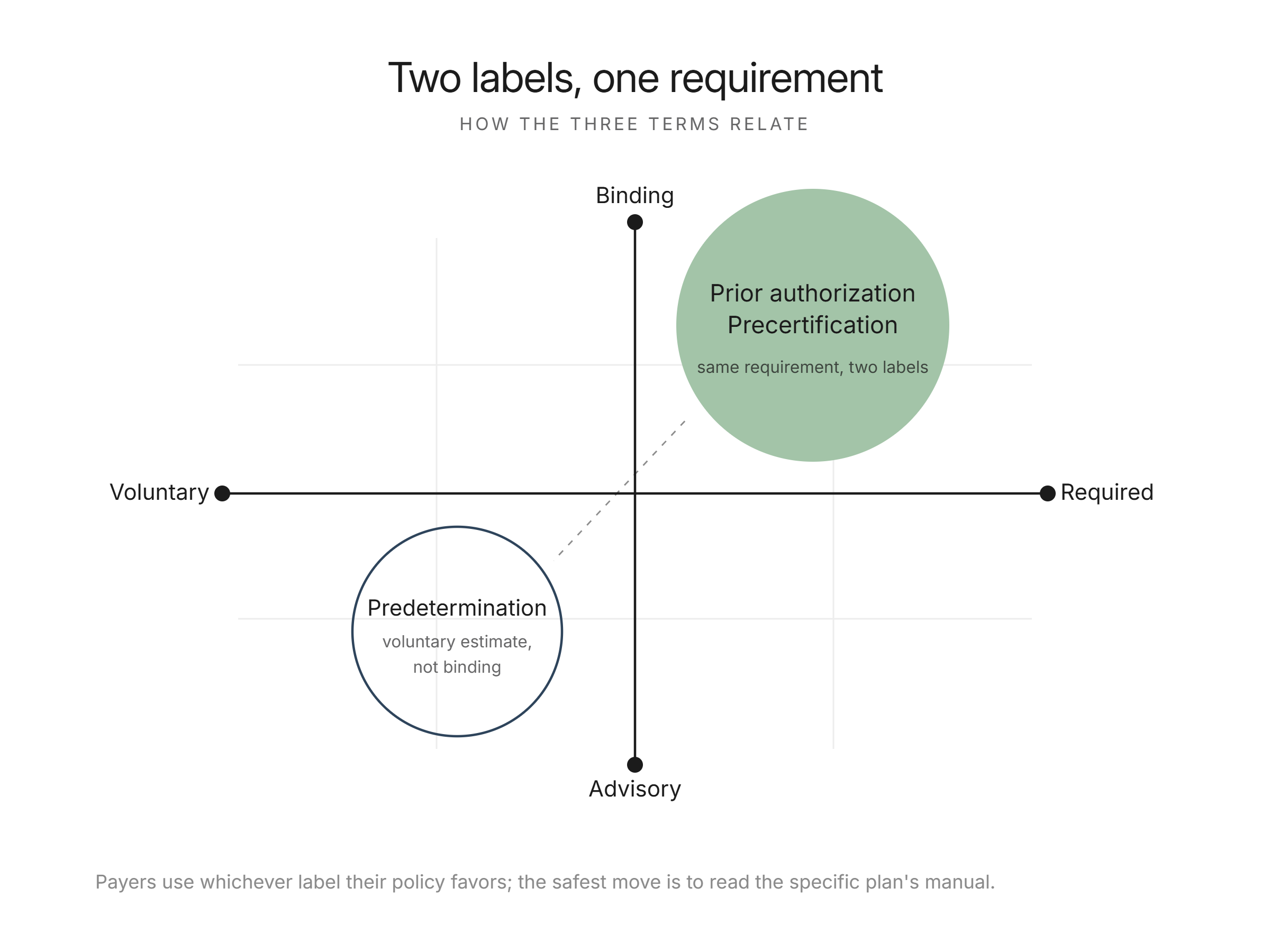
Precertification vs prior authorization is largely a naming difference. Both describe a health plan requirement to approve a service before it is delivered, and many payers use the terms interchangeably. Prior authorization, also called preauthorization or precertification, is a binding coverage decision the plan makes before care. Predetermination is different: it is a voluntary, non-binding estimate of whether a service is likely to be covered and at what benefit level, requested before treatment to reduce surprises. The practical distinction is that an approved prior authorization or precertification generally commits the plan to cover the service if other conditions are met, while a predetermination is advisory and does not guarantee payment. The table below summarizes definition, timing, and whether each term is binding.
| Term | Definition | Timing | Binding? |
|---|---|---|---|
| Prior authorization | Required plan approval that a service is medically necessary before it is delivered. | Before the service; must be secured or the claim can be denied. | Yes, generally binds the plan to cover the service if other conditions are met. |
| Precertification | Same concept as prior authorization; the label many plans use, often for inpatient admissions or high-cost outpatient care. | Before the service. | Yes, functions the same as prior authorization. |
| Predetermination | Voluntary request for an estimate of coverage and benefit level before treatment. | Before the service, but optional. | No, it is advisory and does not guarantee payment. |
What is precertification, and how does it differ from prior authorization?
Precertification is the process of getting a health plan to confirm, before a service is delivered, that it will be covered based on medical necessity and plan rules. In practice, precertification and prior authorization describe the same requirement, and payers use whichever label their policies favor. Some plans apply "precertification" to hospital admissions and certain outpatient procedures, and "prior authorization" to medications and other services, but the underlying step is identical: submit clinical documentation, wait for a coverage decision, and proceed only after approval. Because the terms overlap, the safest approach is to read the specific plan's provider manual rather than assume a fixed distinction across payers.
Want this mapped against your own call and claim volume? Book a 30-minute audit
What is predetermination versus prior authorization?
Predetermination versus prior authorization is where the meaningful difference sits. A predetermination is a voluntary request asking the plan to review a proposed service and estimate whether it would be covered and at what benefit level. It is useful for elective or high-cost procedures where the patient wants a clearer picture of financial responsibility before scheduling. A prior authorization, by contrast, is often mandatory: if the plan requires it and you skip it, the claim can be denied. The other key contrast is that a predetermination is not binding. The plan's estimate does not obligate it to pay, and final coverage still depends on eligibility, benefits, and claim details at the time of service.
Operationally the three terms describe one motion: a request, supporting documents, and a response to track. Flexbone runs that motion under whatever name a payer uses, which is why the vocabulary matters more to the reader than to the workflow. The workflow is in prior authorization automation.
See what AI can run at your facility. In a 30-minute audit we map the calls, eligibility, and follow-ups Flexbone can take off your team first.
Book an auditIs precertification a guarantee of payment?
No. An approved precertification or prior authorization confirms the plan considers the service medically necessary at the time of review, but it is not a promise of payment. Payment still depends on the patient being eligible on the date of service, the benefit covering the specific procedure, the provider network status, and accurate claim coding. A service can carry a valid authorization and still be denied if the patient's coverage lapsed or the submitted codes do not match what was authorized. This is why front-office teams verify eligibility and benefits alongside the authorization rather than treating approval as the final word.
How long can a prior authorization decision take?
Turnaround varies by plan, service, and whether the request is urgent. Under the CMS Interoperability and Prior Authorization final rule (CMS-0057-F), impacted payers, including Medicare Advantage organizations, Medicaid and CHIP programs, and qualified health plans on the federally facilitated exchanges, must send prior authorization decisions within 72 hours for expedited requests and seven calendar days for standard requests, with operational requirements phasing in beginning in 2026 (CMS). Commercial plan timelines are set by contract and state law, so they differ. The administrative load is significant: in an AMA survey conducted in late 2024, practices reported completing an average of 39 prior authorization requests per physician each week and spending about 13 hours of physician and staff time on them (AMA).
How does Flexbone handle prior authorizations?
Flexbone uses AI agents to work the authorization process end to end, with an audit-first design so every action is logged and reviewable. The agents check the payer and plan to determine whether a service requires prior authorization or precertification, gather the required clinical documentation, and submit the request through the payer's channel. They then follow up on pending cases, track status changes, and write the outcome back into the EHR so the record stays current without manual re-keying. This connects to broader prior authorization automation and pairs with electronic prior authorization standards as payers adopt them. Flexbone is HIPAA compliant and SOC 2 aligned, and the agents surface uncertain cases for staff review rather than acting beyond what the documentation supports.
How can practices reduce authorization delays?
Delays usually trace back to a few recurring gaps: unclear requirements, missing clinical documentation, and slow follow-up on pending requests. Practices tend to reduce them by confirming requirements at scheduling, standardizing the documentation each common procedure needs, and assigning clear ownership for status checks so nothing stalls in a queue. Verifying eligibility and benefits at the same time helps catch coverage problems an authorization alone would not reveal. As electronic and API-based decisioning expands under the CMS rule, more of this checking and follow-up can be handled programmatically, which shortens the wait between request and decision.
Want to see how AI agents determine requirements, submit, and follow up on authorizations while writing results back to your EHR? book a demo.