
Radiology billing works differently from most specialties because a single imaging study usually splits into two billable parts. The professional component covers the radiologist's interpretation and report; the technical component covers the scanner, contrast, supplies, and technologist time. When one organization performs and reads the study, it can bill the two together as a global service; when a facility captures the image and a separate group reads it, each bills only its own component. Layered on top of that split is heavy prior authorization on advanced imaging such as MRI, CT, and PET, usually routed through a radiology benefit manager, plus medical-necessity and referring-provider documentation the imaging center does not control. Most denials trace back to these three areas: a missing authorization, thin documentation, or a component billed by the wrong entity.
What makes radiology billing complex?
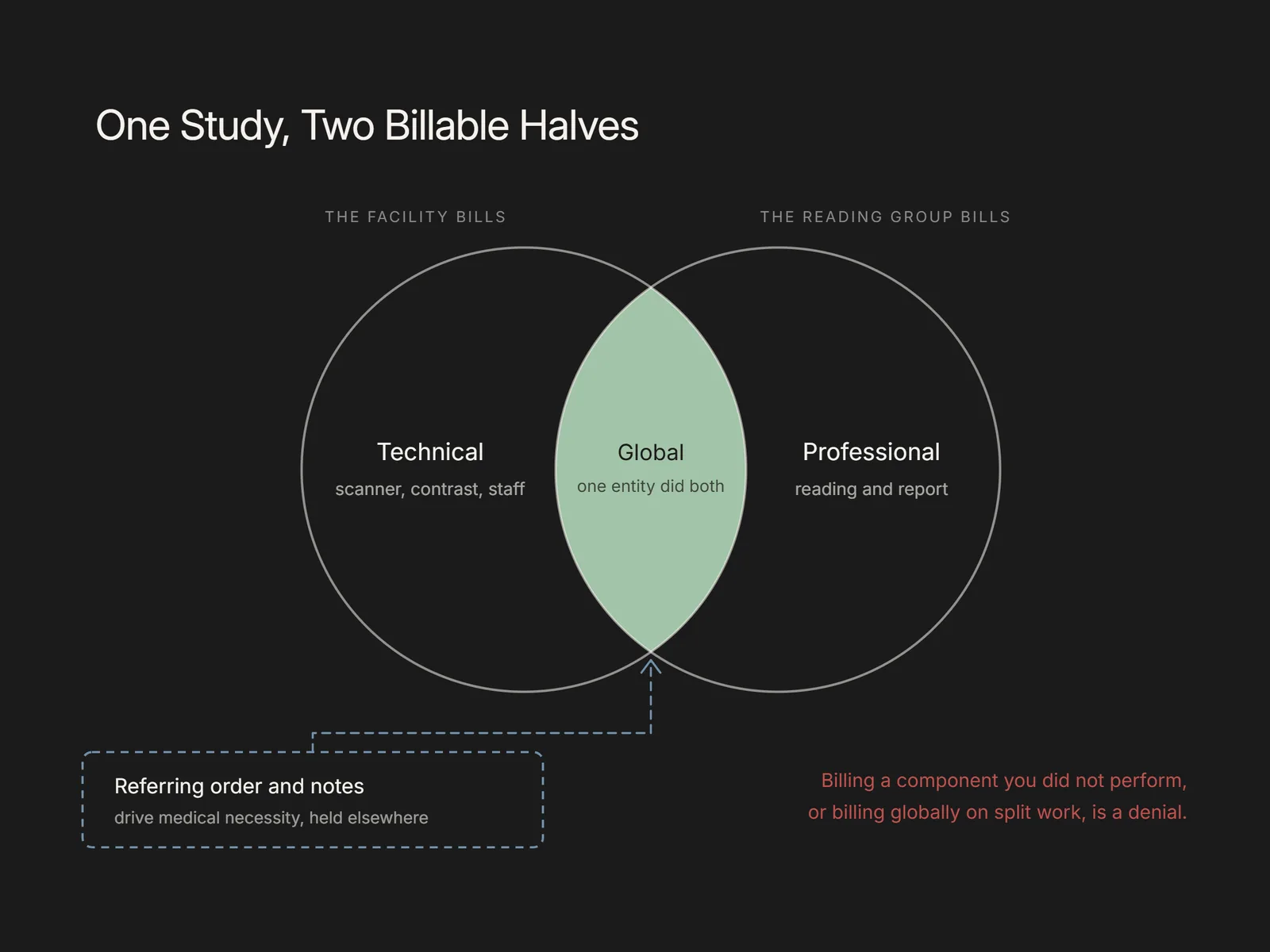
Radiology billing is complex because the work of producing an imaging result is often divided across two entities, and the billing has to follow that division exactly. The scanner, the room, the contrast, and the technologist sit on the technical side, while the radiologist who reads the study and dictates the report sits on the professional side. In a hospital outpatient setting, the facility typically bills the technical side and an independent reading group bills the professional side, so the same study can produce two claims. A freestanding imaging center that owns its equipment and employs its radiologists can bill both together. The referring physician adds a third party whose order and clinical notes drive medical necessity, yet who never touches the claim. That fragmentation, more than any single rule, is what makes radiology billing error prone.
Want this mapped against your own call and claim volume? Book a 30-minute audit
What is professional versus technical component billing?
Professional versus technical component billing describes how a diagnostic imaging service divides into two payable pieces. The professional component is the radiologist's interpretation: reviewing the images, applying clinical judgment, and producing a signed report. The technical component is everything required to acquire the image: the equipment, the supplies, the contrast, and the staff time to run the scan. Payers recognize each piece separately, so a claim can bill the professional component alone, the technical component alone, or both combined as a global service. The correct choice depends on who did what. A reading group that only interprets studies bills the professional side; a facility that only operates the scanner bills the technical side; an entity that does both can bill globally. Billing a component your organization did not perform, or billing globally when the work was split, is a direct path to a denial or a takeback on audit.
Radiology denials often trace to authorization rather than coding: the scan performed differs from the one authorized. Flexbone compares the two before the claim goes out. See imaging authorization.
How does prior authorization work for advanced imaging?
Prior authorization for advanced imaging works by having the ordering provider, or the imaging center on their behalf, request approval before the scan is performed. Most commercial and Medicare Advantage plans require prior authorization for MRI, CT, PET, and nuclear medicine, and they frequently delegate that review to a radiology benefit manager rather than handling it in house. The benefit manager compares the ordered study against medical-necessity criteria, then returns a decision with a reference number and a window during which the authorization is valid. If the study is performed outside that window, or a different study is performed than the one approved, the authorization no longer protects the claim. This is administrative weight that lands hard on practices: the American Medical Association reports physicians complete about 39 prior authorizations per week and spend roughly 13 hours on them. For imaging, the practical rule is to confirm the authorization is on file and still valid before the patient is scanned.
See what AI can run at your facility. In a 30-minute audit we map the calls, eligibility, and follow-ups Flexbone can take off your team first.
Book an auditWhat is a radiology benefit manager?
A radiology benefit manager is a company a health plan delegates to manage prior authorization and medical-necessity review for advanced imaging. Rather than the payer reviewing every MRI or CT request itself, it contracts a benefit manager, such as eviCore or Carelon, to apply imaging criteria and issue approvals or denials on its behalf. For the imaging center, this means the authorization request often goes to the benefit manager's portal or phone line rather than the payer's, and the criteria applied are the benefit manager's published guidelines for that study and indication. Which benefit manager handles a given case depends on the plan, so the same imaging center works with several across its payer mix, each with its own submission process. Knowing which entity reviews which plan, and submitting a complete clinical packet the first time, is what keeps a request from bouncing back for more information and delaying the scan.
Why do radiology claims get denied?
Radiology claims get denied for a handful of recurring reasons, most of which are visible before the scan if the front end is disciplined. A missing or expired prior authorization on advanced imaging is a frequent cause, as is a study that does not match the one that was approved. Medical-necessity denials happen when the referring provider's order and notes do not support the imaging that was ordered, which is hard for the imaging center because it does not hold that documentation itself. Component errors, billing globally when the work was split or billing a component the practice did not perform, produce denials and audit takebacks. Eligibility and coverage gaps that were not verified before the visit round out the list. Denials are common across health care generally: KFF found that insurers denied 20% of in-network claims on HealthCare.gov in 2023, and patients appealed fewer than 1% of them.
Most of these are preventable upstream. Confirm the prior authorization is in place and still valid through the correct radiology benefit manager, and confirm the approved study matches what will actually be scanned. Verify the referring order and its medical-necessity documentation are on file, and follow up with the referring office when a note is missing. Verify benefits electronically through the 270/271 eligibility transaction so coverage gaps surface before the visit, not on the remittance. Split the professional and technical components correctly, or bill globally only when a single entity did both. When a denial does land, read it on the 835 remittance by its CARC and RARC codes so the reason is specific, then route it to the right fix instead of a blanket resubmission. This pre-scan authorization and verification workflow is what protects imaging revenue, and it pairs with imaging and radiology prior authorization on the front end and AI denials management on the back. For how the authorization, scheduling, and denial work fits together in one imaging operation, see AI for radiology and imaging centers.
How Flexbone helps with radiology billing
Flexbone deploys AI voice and browser agents that carry the repetitive front-end and back-end work in radiology billing. Browser agents log into radiology benefit manager and payer portals to confirm authorizations and eligibility, run the 270/271 check, and read denials off the 835 by CARC and RARC so each one routes to the right fix; voice agents place the calls to benefit managers and referring offices and sit through the hold queue, so staff pick up a case only when there is a decision or an exception to act on. Escalations and anything unclear go to a person. If you want to see what this could take off your imaging authorization and billing, book a call with Flexbone and we will run a quick audit of your current workload.