RCM in medical billing stands for revenue cycle management. It is the financial process a healthcare organization uses to track a patient encounter from the first scheduled appointment through to the final payment, and medical billing is one stage inside it. The revenue cycle runs from scheduling and registration, through eligibility verification, prior authorization, charge capture, and coding, to claim submission, payment posting, denial management, and patient collections. Billing is the part that turns the service into a claim and posts what the payer sends back. RCM is the wider job of keeping every step accurate so a claim pays cleanly the first time. Organizations manage the cycle as one system, rather than running its steps in isolation, because the stages are linked: a missed eligibility check at registration becomes a denied claim weeks later, after the service has already been delivered.
What does RCM stand for in medical billing?
RCM stands for revenue cycle management. In medical billing it refers to the full financial and administrative process that connects a clinical encounter to the payment for that encounter. The cycle begins when a patient schedules a visit and ends when the balance, from both the payer and the patient, is fully resolved. Billing teams often use the term for the entire process, but billing itself is a specific stage: preparing and submitting the claim and reconciling the payment. The management part matters because the steps are interdependent. What a front desk captures at registration determines whether the claim a biller submits two weeks later is accepted, so RCM treats registration, coding, and payment as one connected workflow rather than separate tasks.
Want this mapped against your own call and claim volume? Book a 30-minute audit
What are the steps of the revenue cycle?
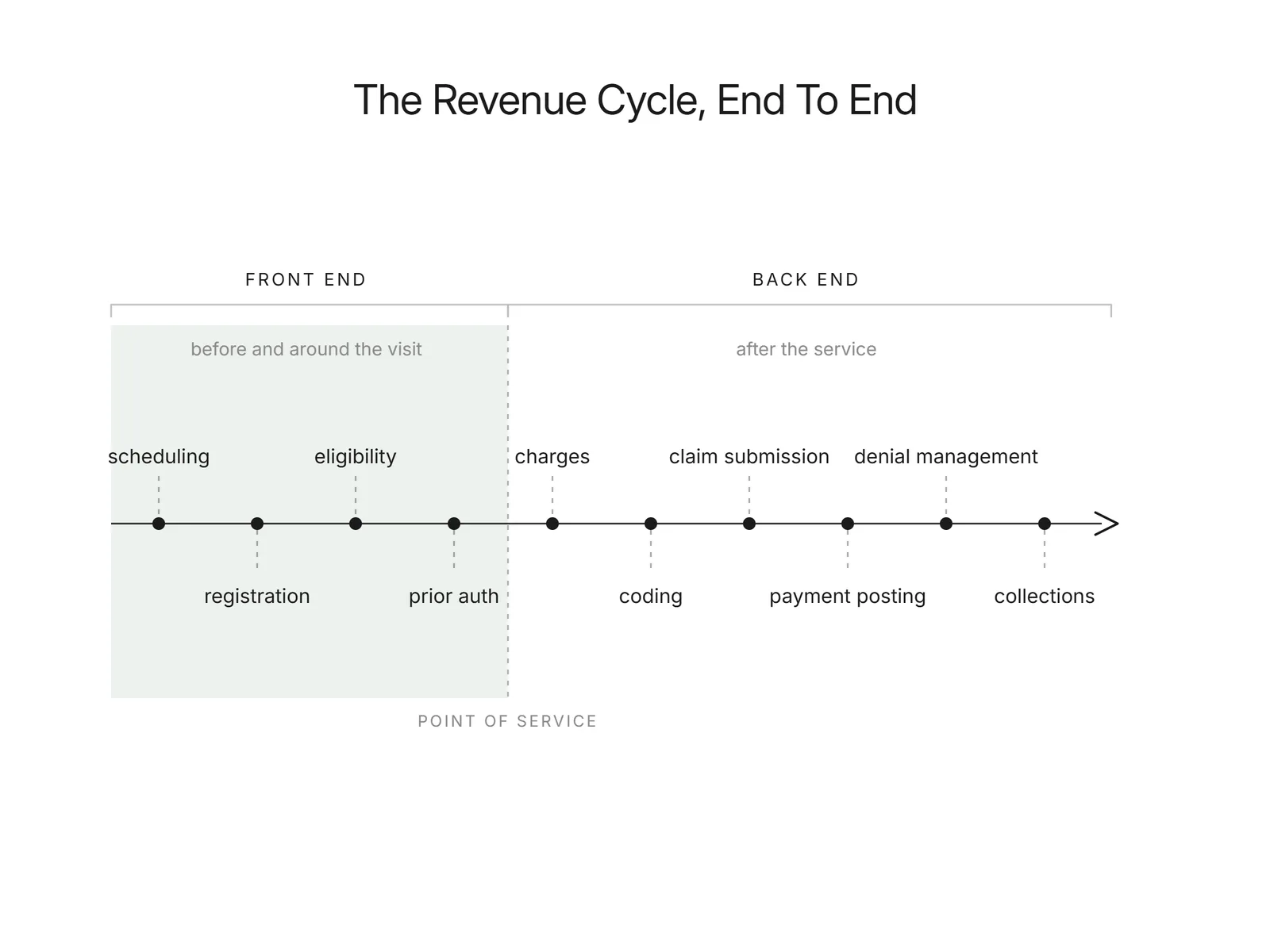
The revenue cycle moves through a repeatable sequence, from the first appointment to the final payment. The main steps are:
- Scheduling. Book the visit and capture initial patient and insurance details.
- Registration. Confirm demographics and coverage, and collect the information the claim will need.
- Eligibility verification. Confirm the patient's plan is active and covers the planned service.
- Prior authorization. Obtain payer approval for services that require it before they are delivered.
- Charge capture. Record every billable service and item from the encounter.
- Coding. Translate the care into standardized procedure and diagnosis codes.
- Claim submission. Send the claim to the payer in the standard electronic format.
- Payment posting. Record what the payer paid and why, and reconcile against the claim.
- Denial management. Investigate, correct, and appeal claims the payer rejected.
- Patient collections. Bill the patient for the remaining balance and resolve it.
Each step feeds the next, so an error introduced early travels downstream until a payer or a patient catches it. That is why a small data problem at registration can surface as a denial after the service is already complete.
What is the difference between RCM and medical billing?
Medical billing and RCM are related but not the same, and the distinction is where a lot of confusion starts. Medical billing is the stage that prepares and submits claims and posts the payments that come back. Revenue cycle management is the wider process around it, including scheduling, registration, eligibility verification, prior authorization, coding, denial management, and collections. Put plainly, billing is one link in the chain, while RCM is the management of the whole chain from scheduling to final payment. Treating billing as the entire revenue cycle is a common mistake, because it concentrates attention on claim submission while the errors that cause most denials happen earlier, during registration and verification. A biller can submit a technically correct claim and still see it denied because coverage was never confirmed or a prior authorization was never obtained, which is exactly what RCM exists to catch before the claim goes out.
See what AI can run at your facility. In a 30-minute audit we map the calls, eligibility, and follow-ups Flexbone can take off your team first.
Book an auditWhat is front-end vs back-end RCM?
The revenue cycle is commonly split into a front end and a back end, divided roughly at the point of service. The front end covers everything before and around the visit: scheduling, registration, eligibility verification, prior authorization, and financial counseling. Its job is to make sure the encounter is set up to bill correctly. The back end covers everything after the service: charge capture, coding, claim submission, payment posting, denial management, appeals, and patient collections. Its job is to turn the completed service into collected revenue. The split matters because the two halves have different owners and different failure modes, yet they are tightly coupled. A front-end eligibility check, which providers and payers exchange as a standardized 270/271 transaction under CMS Administrative Simplification rules, prevents a back-end denial later, per CMS. Most avoidable rework originates on the front end and only becomes visible on the back end, so front-end accuracy is the cheapest place to fix a claim.
Where does the revenue cycle break down?
The revenue cycle tends to break down where accurate data has to be captured under time pressure, and where staff have to chase information from payers. Common failure points include registering a patient under an expired or wrong plan, skipping or mistiming a prior authorization, and coding a service in a way the payer will not accept. These problems are hard to see until the claim is denied. The scale is real: in HealthCare.gov marketplace plans, insurers denied 20% of in-network claims in 2023, and consumers appealed fewer than 1% of those denials, according to KFF. Prior authorization is a second heavy drain: practices report completing an average of about 39 requests per physician each week and spending roughly 13 hours on them, per the AMA. When a denial does land, the fix is rarely automatic. Someone has to read the denial code, find the missing detail, and decide how to respond, which is why back-end recovery is slower than getting the front end right in the first place.
How is RCM automated?
Automation in RCM works best when it is pointed at the repetitive, rules-based tasks that feed clean claims, and kept away from the judgment calls. The strongest fit is the front-end and status work: eligibility and benefit checks, prior authorization submission and follow-up, and claim status inquiries. These involve high volumes of payer lookups and phone calls that are slow for staff but well-defined enough to run consistently, so handling them early prevents downstream denials rather than reworking them. Coding and appeals are different. Coding needs a coder's read of clinical documentation, and an appeal needs a person to build an argument against a specific denial, so those stay with staff. A practical way to see the divide is to list your revenue-cycle steps and mark each as rules-based or judgment-based. The rules-based steps are where AI agents remove the manual chasing, while the judgment-based steps keep a human in the loop. If you are evaluating help, it is worth understanding how revenue cycle management companies divide this work, and where agents can run insurance eligibility verification and support AI denials management without taking coverage or payment decisions on their own.
If you want to map which parts of your revenue cycle AI agents can run, from eligibility and prior authorization through claim status follow-up, book a call with Flexbone and we will walk your workflow step by step.