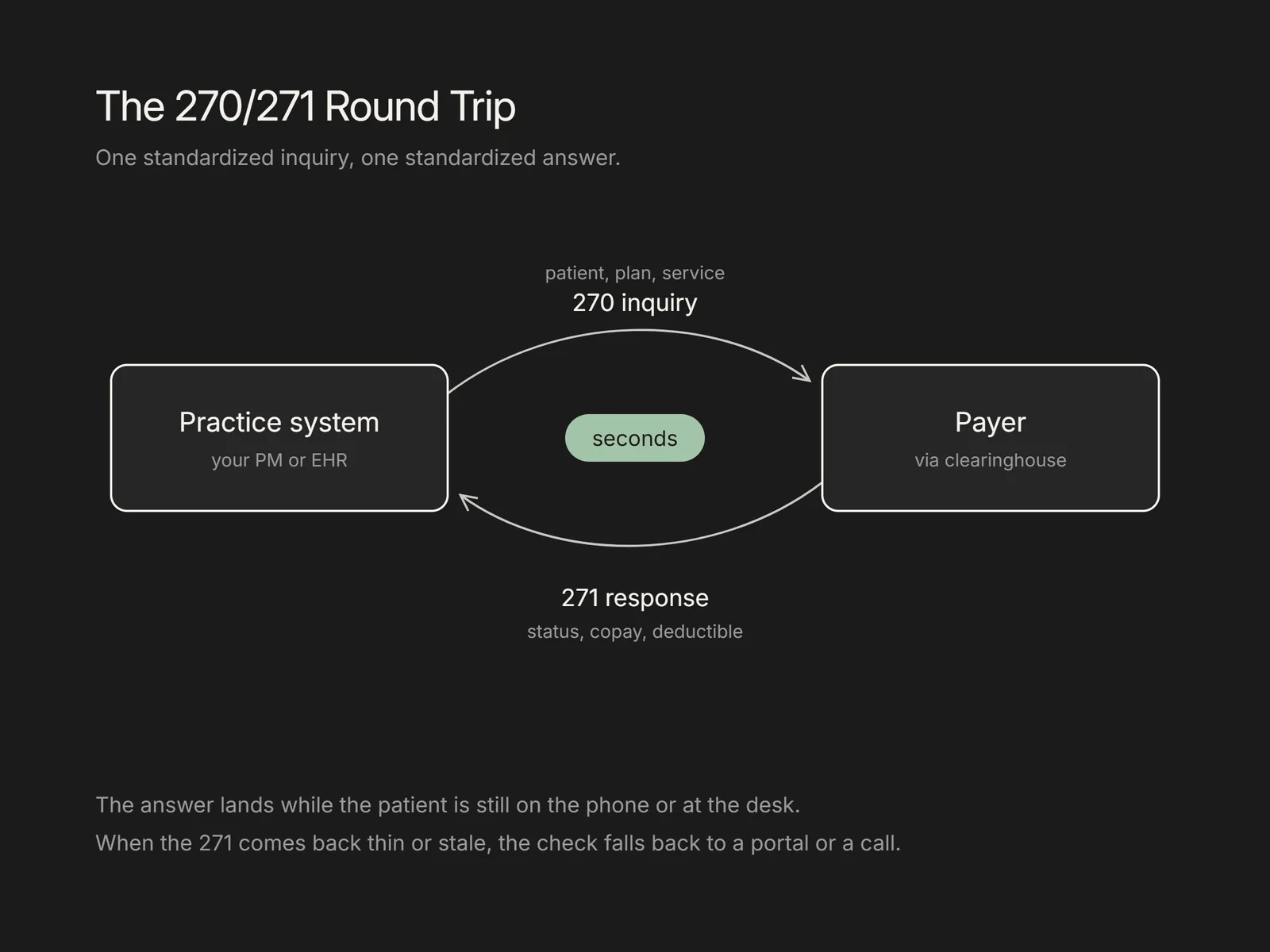
Real-time eligibility verification is an automated check that confirms a patient's insurance coverage and benefits in seconds, before or at the point of service. It runs on the 270/271 transaction: your system sends a standardized eligibility inquiry (the 270) to the payer through a clearinghouse, and the payer returns a coverage response (the 271) while the patient is still on the phone or at the desk. Real-time eligibility, often shortened to RTE, returns whether the plan is active, the member's copay and deductible, and sometimes service-specific benefits. It replaces the batch files and phone calls that used to take minutes each. The 2024 CAQH Index reports that most medical eligibility transactions are already electronic, yet a multi-billion-dollar administrative savings opportunity remains where checks stay manual.
What is real-time eligibility verification?
Real-time eligibility verification is a coverage check that returns an answer in seconds while the patient interaction is still open, rather than in an overnight batch. The practice submits the patient, plan, and service, and the payer responds with active-or-inactive status and benefit details fast enough to use during scheduling or check-in. The term real-time distinguishes it from batch eligibility, where hundreds of inquiries are queued and answered hours later. The value of doing it in real time is that a front-desk or scheduling staffer can correct a wrong member ID, collect the right copay, or flag an authorization requirement before the visit happens instead of discovering the problem after the claim is denied. According to the 2024 CAQH Index, electronic adoption of eligibility and benefit verification is high across medical plans, which is what makes real-time checks practical at scale.
Want this mapped against your own call and claim volume? Book a 30-minute audit
How does real-time eligibility verification work?
Real-time eligibility works through the 270/271 EDI transaction pair. The provider's system builds a 270 (Health Care Eligibility Benefit Inquiry) containing the patient's name, date of birth, member ID, the payer, and often the specific service type, then sends it through a clearinghouse to the payer. The payer looks up the member and returns a 271 (Health Care Eligibility Benefit Response) carrying the coverage status and any benefit details it chooses to include. These are standardized X12 EDI messages, and CMS publishes companion guides that define the exact fields for its own service in the HETS 270/271 companion guide. Because the format is standardized, a system can send one 270 for a walk-in or thousands against tomorrow's schedule and parse every 271 into structured fields. Real time refers to the round trip: the 271 comes back in seconds, so the answer is usable during the same patient interaction.
Real time describes latency, not completeness, and the gap between a fast answer and a usable one is where the manual work lives. Flexbone closes that gap with agents that follow up on a thin response in the portal or on the phone, and it measures which responses are thin before automating the follow-up.
See what AI can run at your facility. In a 30-minute audit we map the calls, eligibility, and follow-ups Flexbone can take off your team first.
Book an auditWhat does a 271 eligibility response return?
A 271 returns the plan's active-or-inactive status plus the benefit details the payer includes, which commonly cover copay, coinsurance, deductible, and out-of-pocket amounts. Under the federally adopted eligibility and claim status operating rules, payers must return patient financial responsibility for a defined set of high-volume service types, so a compliant 271 carries more than a yes-or-no answer. Beyond financials, a 271 can report the plan name, coverage dates, the primary care provider on file, and coordination-of-benefits information when another payer is involved. The depth still varies by payer: some return service-level detail for the exact procedure, while others confirm only that the member is active and leave visit limits or authorization rules out. That variance is why the structured 271 is the starting point for eligibility rather than a guaranteed complete answer.
What are the limits of real-time eligibility verification?
The main limit of real-time eligibility is that the answer is only as complete as the data the payer chooses to return. Some payers send a 271 that is technically valid but thin, confirming the plan is active while omitting visit limits, service-specific copays, or whether the scheduled procedure needs prior authorization. Others carry stale eligibility that has not caught up to a recent plan termination or change, so the electronic answer disagrees with reality on the date of service. A third gap is coverage that no payer returns electronically at all, where the only source is a web portal or a phone call. The 2024 CAQH Index documents that administrative spending on verification kept rising even as electronic adoption grew, a pattern consistent with the manual work that thin and stale responses still create. For the practices we work with, these gaps concentrate in regional Medicaid managed-care plans and some commercial plans.
How Flexbone runs real-time eligibility verification
Flexbone treats the real-time 270/271 as the first channel, not the only one. Our AI agents send the standardized eligibility inquiry and parse the 271 into structured fields, then, when that response is thin or stale, the same workflow falls back to a payer-portal login or a phone check to fill the missing benefit and authorization detail. The reconciled result, including plan status, patient responsibility, and any prior-authorization flags, is written back into your practice management or EHR system so the record has one clean answer before the visit. The approach is audit-first, HIPAA compliant, and SOC 2 aligned, and exceptions are routed to your team rather than trusted blindly. We do not claim to eliminate every manual check; we aim to cover the electronic path fully and handle the portal and phone work that real-time data leaves behind. You can read more on insurance eligibility verification and on automating eligibility: 270/271 vs portals.
See it run against your payer mix and your PM system: book a demo.