Call center agent burnout is chronic exhaustion caused by high contact volume, back-to-back calls with no recovery time, repetitive tier-one work, and low control over the day. It matters because burnt-out agents deliver worse service and then quit, which is expensive to replace. Convoso cites survey data showing a large majority of agents report high workplace stress and a substantial share experience ongoing burnout. The fix is structural, not a wellness poster: lower sustained occupancy, plan shrinkage honestly so agents get real breaks and coaching, and remove the repetitive volume that grinds people down. This post connects the operational metrics (occupancy, shrinkage, attrition) to burnout and lays out what actually reduces it, across BPO, insurance, healthcare, and public-sector queues.
What causes agent burnout?
Burnout is driven by the workload and the environment, not by individual weakness. The common causes are unrelenting call volume, monotonous repetitive contacts, poor tools that force app-switching, hostile or distressed callers, and little say over schedule or breaks. SQM Group reports that job stress and burnout are among the leading reasons agents leave, which places burnout at the center of the attrition problem rather than at its edge. Two of these causes are within an operations manager's direct control: how busy agents are kept, and how much of their day is spent on work a machine could handle. The rest, like caller behavior, can be softened with better routing and support. Naming the cause matters, because coaching cannot fix a workload problem.
Want this mapped against your own call and claim volume? Book a 30-minute audit
How do occupancy and shrinkage feed it?
Occupancy stays high when repetitive calls fill the queue. Flexbone takes those call types, identified from recordings, off the queue, which lowers occupancy and leaves agents the calls that use their judgment. See contact center automation.
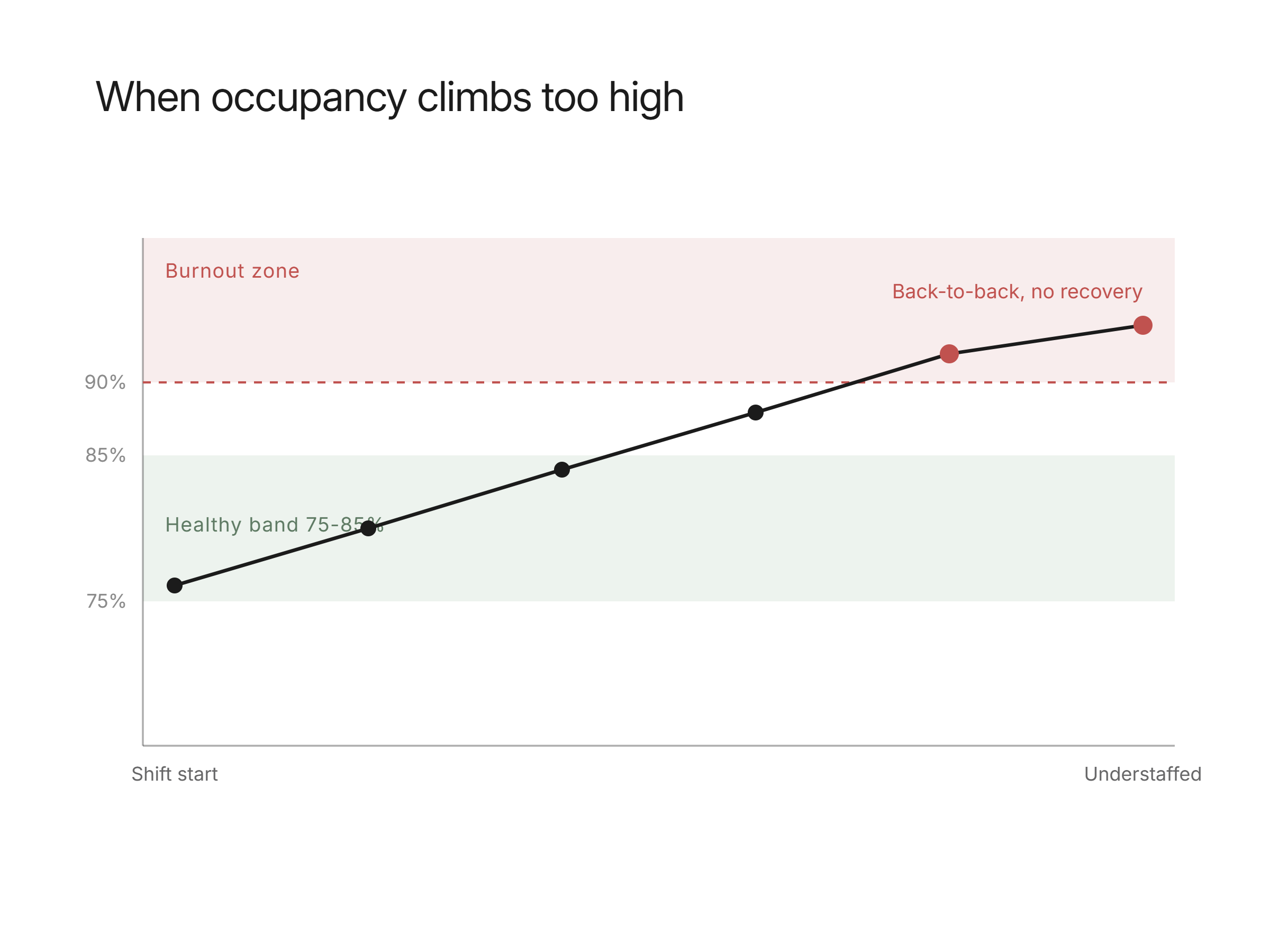
Occupancy and shrinkage are the two dials that decide how hard a day feels. Occupancy is the share of logged-in time an agent spends actually handling contacts. Sprinklr puts a healthy occupancy band around 75 to 85 percent and industry shrinkage around 30 to 35 percent, the paid time agents spend off contacts on breaks, training, and absence. When planners underestimate shrinkage, they schedule too few people, real occupancy climbs past 90 percent, and agents end up in back-to-back calls with no gap to breathe or document. Sustained high occupancy is one of the strongest operational signals of burnout risk. The fix is not to demand more, it is to plan shrinkage accurately so the schedule holds occupancy in the healthy band on normal days.
See what AI can run at your facility. In a 30-minute audit we map the calls, eligibility, and follow-ups Flexbone can take off your team first.
Book an auditHow does burnout drive attrition?
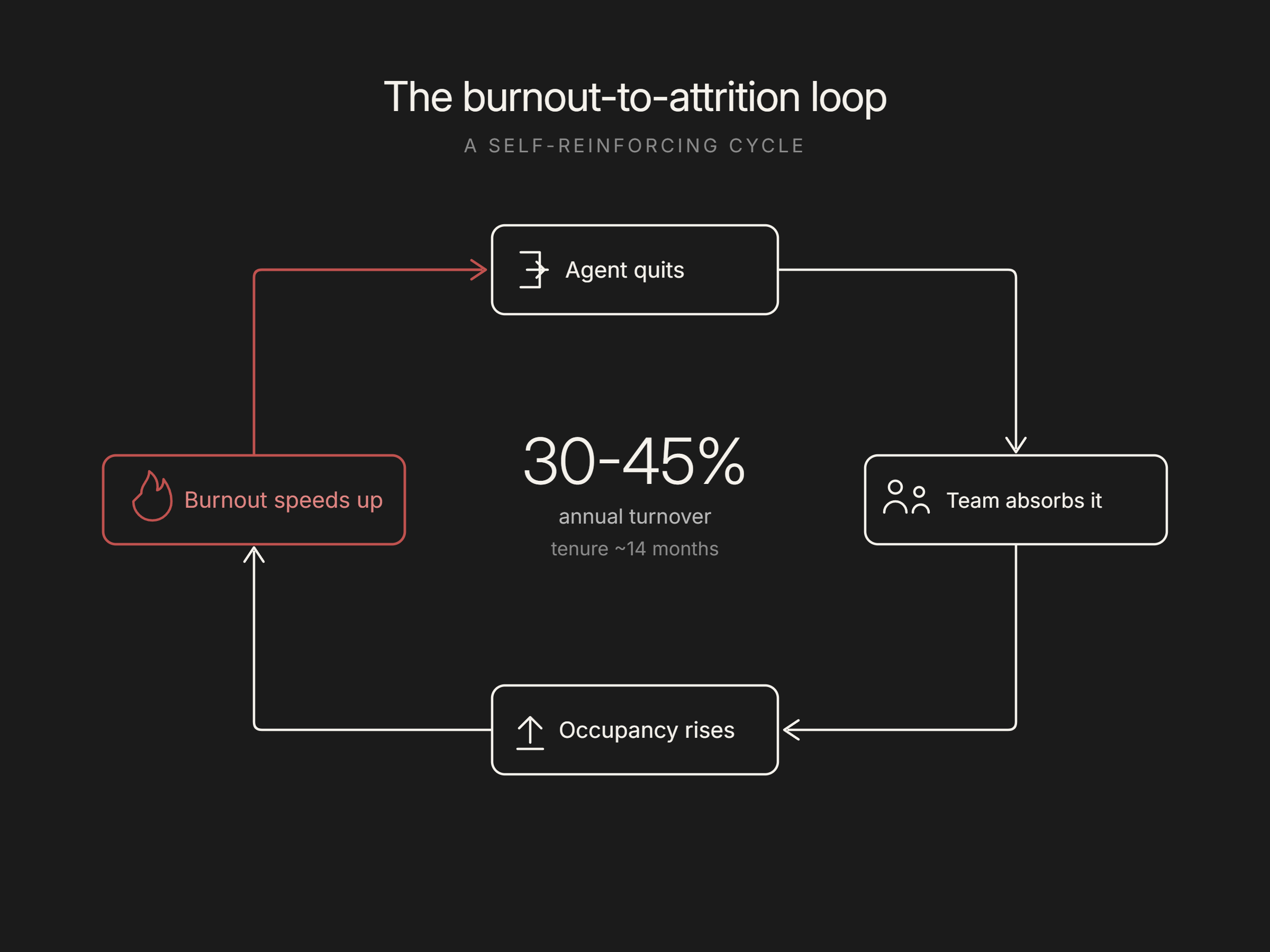
Burnout is the on-ramp to turnover, and turnover in this industry is already high. Insignia Resources reports call-center turnover commonly running in the 30 to 45 percent range, with average agent tenure of roughly 14 to 15 months, and much of the loss concentrated in the first year. Each departure carries recruiting, onboarding, and ramp cost, plus the hidden cost of a partly trained team handling live customers. The loop is self-reinforcing: an agent quits, the remaining team absorbs the volume, their occupancy rises, and the next person burns out faster. Breaking the loop means treating attrition as a symptom of workload design, not just a hiring gap to backfill. Lower the sustained pressure and the tenure curve improves with it.
How do you reduce it?
Reduce burnout by cutting the load and improving the tools, then supporting the people who remain. Practical moves: plan shrinkage honestly so breaks and coaching are protected, cap sustained occupancy below the mid-80s, give agents better systems so they stop hunting across screens, and route distressing or complex contacts to specialists. Then offload the repetitive tier-one volume so human time goes to work that uses judgment. Deloitte Digital found that contact centers deploying generative AI were meaningfully less likely to report agents feeling overwhelmed by the information they juggle during calls. In the engagements we run, removing the monotonous queue is the change agents notice first, because it returns focus to the calls that need a person.
How Flexbone reduces the load on agents
Flexbone builds audit-first AI agents (voice, browser, document, and desktop) that take repetitive tier-one contacts and back-office tasks off the queue in secure, regulated environments. The goal is to shrink the monotonous volume that pushes occupancy into the danger zone, so your planners can hold a healthier schedule and your agents keep the interesting work. The platform is HIPAA compliant and SOC 2-aligned, so it fits BPO, insurance, healthcare, and public-sector teams without new compliance risk. We audit your contact mix first, automate the repetitive segments, and give you back capacity to lower occupancy rather than to cut headcount.
Book a demo: https://www.flexbone.ai/contact