
Schedule adherence measures how closely agents follow their assigned schedules: the login times, break durations, and on-queue windows the workforce plan expects. The formula is (Scheduled time minus non-adherent time) divided by scheduled time, multiplied by 100. If an agent is scheduled for 480 minutes and is off-schedule for 30 of them, adherence is (480 minus 30) / 480 x 100, or about 94 percent. Real-time adherence (RTA) applies the same idea live, so a supervisor can see who is off-schedule at this moment and adjust before service levels slip. According to VoiceSpin, most contact centers set adherence targets between 85 and 95 percent rather than chasing perfect compliance. The sections below cover the formula, the adherence versus conformance distinction, a realistic target, and how to improve it.
What is the schedule-adherence formula?
Schedule adherence tells you what share of scheduled time an agent spent doing the right activity at the right time. The most common version is:
Schedule adherence (%) = (Scheduled time minus non-adherent time) / Scheduled time x 100
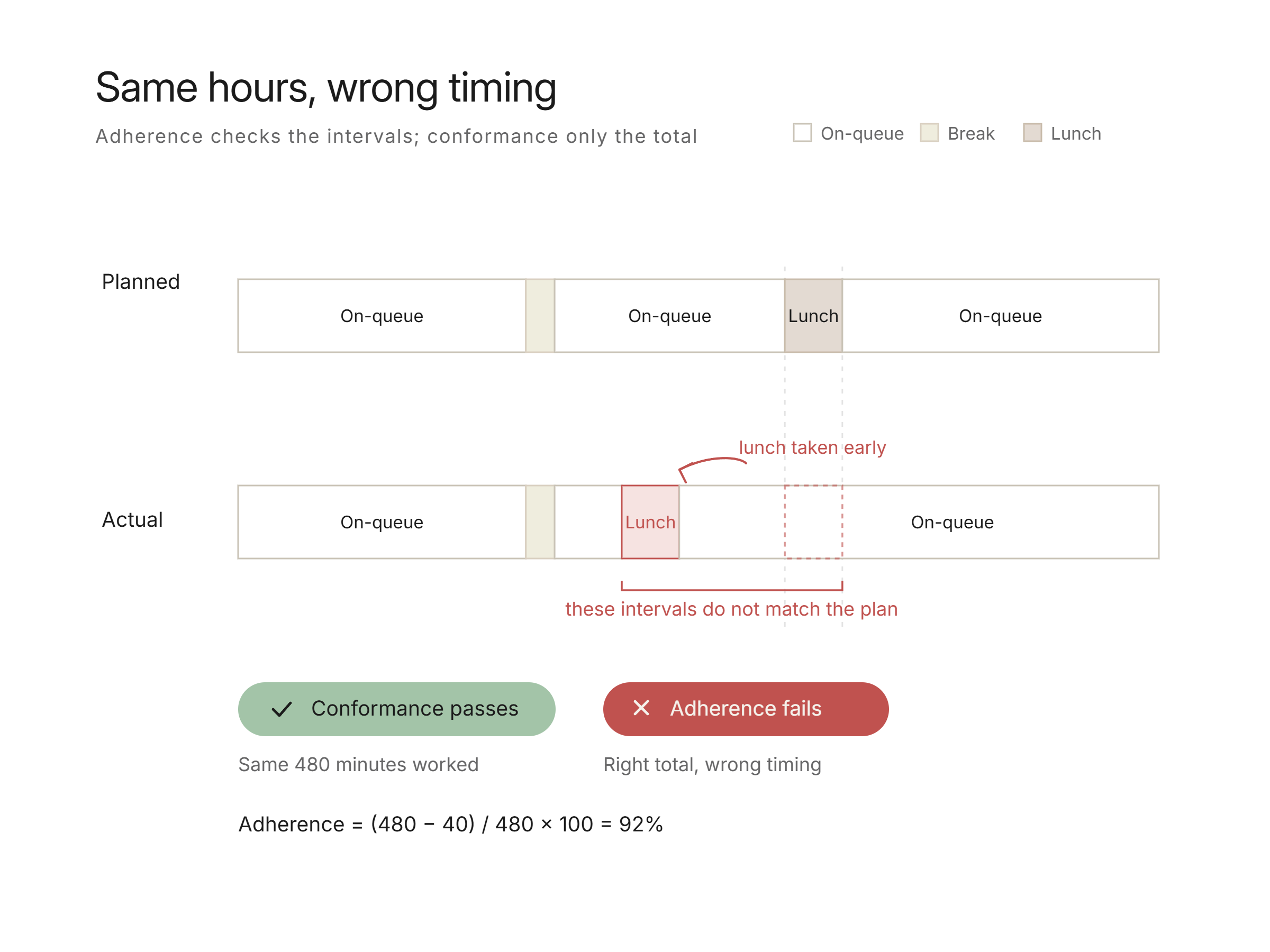
An equivalent form divides the actual time an agent was available for the planned activity by the total scheduled time, then multiplies by 100. Suppose an agent is scheduled for an 8-hour shift, which is 480 minutes, and spends 40 minutes off-schedule (a late return from break, an unplanned personal task). Adherence is (480 minus 40) / 480 x 100, which is roughly 92 percent. According to TechTarget, the metric matters because staffing plans only hold if agents are in their planned states, so small gaps across a team compound into missed service levels.
Want this mapped against your own call and claim volume? Book a 30-minute audit
Adherence vs conformance, what is the difference?
Adherence and conformance sound alike but measure different things. Adherence asks whether an agent was in the right activity at the right time, break by break and interval by interval. Conformance asks a looser question: did the agent work the total number of scheduled hours, regardless of exactly when?
Adherence is hardest to hold when a spike of routine calls pulls agents off breaks and training. Flexbone absorbs those routine calls with voice agents, which protects the schedule instead of asking agents to work around the spike. See contact center automation.
According to UJET, an agent who swaps a shift or shifts a break but still logs the full scheduled hours can pass conformance while failing adherence, because the timing did not match the plan. Adherence is the more granular, real-time view, which is why intraday teams watch it closely. Conformance is the productivity view, useful for checking that total worked time lines up with what was scheduled. Most workforce teams track both: conformance for payroll and capacity, adherence for the interval-level accuracy that keeps queues staffed.
See what AI can run at your facility. In a 30-minute audit we map the calls, eligibility, and follow-ups Flexbone can take off your team first.
Book an auditWhat is a good adherence target?
There is no single correct number, because the right target depends on how much unplanned work and complexity a team absorbs. According to VoiceSpin, a realistic range for most contact centers is 85 to 95 percent. Aiming for 100 percent tends to backfire: it punishes agents for the small, unavoidable variances of real work and pushes them to skip legitimate breaks, which hurts retention.
Where you land in the range should reflect your operation. A high-volume BPO queue with tight service-level agreements might target the upper end, while a team handling long, complex cases (clinical triage, benefits appeals, public-sector claims) can set a lower target because those calls create legitimate off-schedule time. Set the target against your own baseline, then tighten it gradually as process fixes remove the causes of drift rather than as a blunt compliance rule.
How do you improve adherence?
Adherence usually drifts for structural reasons, not because agents are careless, so the fixes are structural too. According to Genesys, real-time adherence and intraday management let workforce teams spot who is off-schedule during the day and act: move breaks, pull agents from another skill, or add coverage before service levels slip.
Practical steps that help:
- Use real-time adherence alerts so supervisors coach in the moment, not a day later.
- Build realistic schedules with enough shrinkage for meetings, coaching, and after-call work, so the plan is achievable.
- Give agents visibility into their own adherence, which turns it into a personal metric rather than a top-down audit.
- Address recurring causes, such as system logins that run long or unclear break rules, instead of flagging the same exception every week.
The goal is a schedule agents can actually follow, then the tools to keep it on track intraday.
How Flexbone helps adherence hold under pressure
Adherence slips hardest when volume spikes and every agent is pulled off-schedule to fight the queue. Flexbone builds AI agents (voice, browser, document, and desktop) that absorb routine contact-center and back-office work, so human agents are not yanked out of their planned states every time intraday volume runs hot. When AI handles the predictable overflow (eligibility checks, status calls, form intake) across BPO, insurance, healthcare, and public-sector operations, your workforce plan has more slack to hold. We audit interaction data before automating, so we buffer the specific intervals and intents that break your adherence rather than guessing. To see how automation can steady your intraday numbers, book a demo at flexbone.ai/contact.