
A timely filing limit is the deadline a payer sets for submitting a claim after the date of service. If a claim arrives after that deadline, the payer issues a timely filing denial and treats the claim as ineligible for payment, regardless of whether the care was covered. Limits vary widely by payer and contract, commonly ranging from about 90 days to a year from the date of service. Missing the limit is one of the harder denials to overturn, because the payer is enforcing a contractual deadline rather than questioning medical necessity or coding. Preventing these denials comes down to submitting clean claims quickly, verifying the correct payer before the visit, and tracking each payer's deadline so a claim never sits long enough to expire.
What is a timely filing limit?
A timely filing limit is a contractual deadline: the number of days a payer allows between the date of service and the date it receives the claim. It exists so payers can close out their liability for a service within a predictable window rather than paying claims submitted years later. The clock generally starts on the date of service, and for an inpatient stay it often starts on the discharge date. What counts as "received" also matters, since many payers measure against the date the claim reaches them or their clearinghouse, not the date you sent it. Because the limit lives in the payer contract and each plan's policy, there is no single national number that applies to every claim. Once the window closes, an otherwise payable claim becomes a denial, so the deadline functions as a hard edge on the revenue cycle.
Want this mapped against your own call and claim volume? Book a 30-minute audit
What are common timely filing limits by payer type?
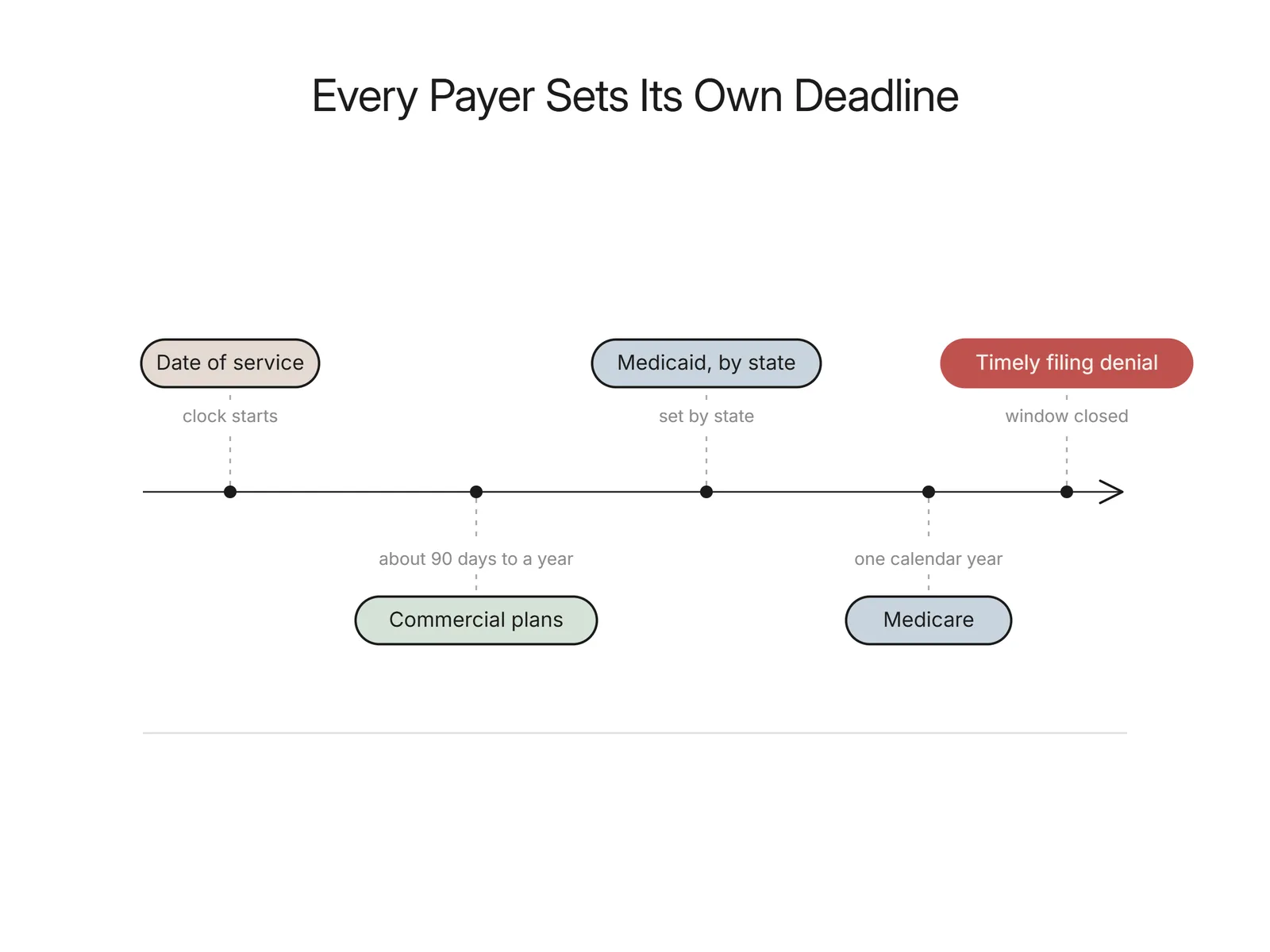
Timely filing limits vary widely by payer and by the specific contract, so the reliable source is the payer's own policy or your contract rather than a general chart. That said, some general patterns hold. Commercial plans commonly set limits somewhere in the range of about 90 days to a year from the date of service, and the exact figure differs from plan to plan and even from contract to contract with the same insurer. Medicaid limits are set at the state level and vary accordingly. Medicare is the most widely cited fixed example: it generally uses a one-calendar-year claim filing window from the date of service. Secondary and tertiary claims add another wrinkle, because the filing clock for the second payer often depends on when the primary payer's remittance arrives. The safe assumption is that limits differ across your payer mix, so a single default deadline is risky and per-payer tracking is the practical approach.
What happens if you miss timely filing?
If a claim arrives after the deadline, the payer denies it for timely filing, and in most contracts that amount cannot be balance-billed to the patient. Unless you can demonstrate the claim was submitted on time or that a recognized exception applies, the denial usually converts directly into a write-off. Denials in general are common enough to matter at the revenue-cycle level: an analysis of federal marketplace data found insurers denied about 20% of in-network claims in 2023, and consumers appealed fewer than 1% of those denials, per KFF's 2023 marketplace denials analysis. Timely filing sits in a particularly frustrating corner of that volume, because the denial is procedural rather than clinical. The payer is not disputing that the care happened or that it was appropriate; it is enforcing a deadline the claim missed, which is why staff often describe these as avoidable losses rather than coverage disputes.
See what AI can run at your facility. In a 30-minute audit we map the calls, eligibility, and follow-ups Flexbone can take off your team first.
Book an auditCan you appeal a timely filing denial?
You can appeal a timely filing denial, but the appeal only works if you can prove one of two things: that the claim was actually submitted within the window, or that a recognized exception applies. The strongest evidence is documentation of timely submission, such as a clearinghouse acceptance report, an electronic claim acknowledgment, or the payer's own claim status response showing the claim was received on a specific date. Exceptions that some payers recognize include retroactive eligibility, coordination-of-benefits situations where the correct primary payer surfaced late, or a documented system outage. Absent that proof, a timely filing appeal rarely succeeds, because the payer is enforcing a contractual term rather than exercising discretion. This is the core reason prevention beats appeal for this denial type: once the deadline has passed and you have no proof of on-time submission, there is usually little left to argue.
How do you prevent timely filing denials?
Prevention ties directly to submitting clean claims quickly and confirming they landed. The first move is fast, accurate submission, so a claim is not sitting in a work queue while the window shrinks. The second is verifying eligibility before the visit, so you bill the correct payer first and avoid burning weeks discovering the primary plan late; strong insurance eligibility verification is the front-end control that keeps a claim from being routed to the wrong payer. The eligibility inquiry itself runs on the standardized 270/271 transaction described in CMS Administrative Simplification. The third is tracking claim status with the 276/277 transaction, which confirms the payer received the claim and surfaces a rejection while there is still time to correct and resubmit inside the window. Clean submission on the front end also reduces rework loops that quietly consume filing days, which is where AI denials management and disciplined prior authorization automation reinforce timely filing rather than competing with it.
How Flexbone reduces timely filing losses
Flexbone is audit-first: before automating anything, we review a sample of your claims to find where timely filing denials are actually coming from, whether that is slow submission, wrong-payer routing, or claims that fail silently and never get resubmitted. Our AI voice and browser agents then work inside your existing EHR, billing system, clearinghouse, and payer portals. Browser agents submit claims quickly and check status through the 276/277 transaction, flagging any claim that has not been acknowledged so it can be corrected before the window closes. Eligibility agents verify coverage before the visit so the correct payer is billed first, and when a timely filing denial does occur, the agents pull the acceptance report and claim status history that a valid appeal depends on. Every action is reviewed by your team, and the workflow is HIPAA compliant and SOC 2-aligned, so automation speeds the work without removing your control.
Want to see which of your timely filing denials are preventable and what an AI agent could take off your claim submission and follow-up? book a call with Flexbone.