Urology billing is the process of coding and submitting claims for the mix of services a urology practice delivers: office visits, in-office procedures such as cystoscopy and prostate biopsy, imaging such as CT urography and prostate MRI, and surgery. It is more involved than single-service specialties because several rules apply at once. Surgical services carry global periods that bundle routine follow-up care into the procedure. Imaging can split into a professional component for the physician read and a technical component for performing the scan. Advanced imaging and specialty drugs frequently require prior authorization. Because a single patient can generate a visit, a procedure, an imaging study, and a surgery that each follow different coding logic, urology claims go wrong in a handful of predictable places. This guide walks through each piece.
What makes urology billing complex?
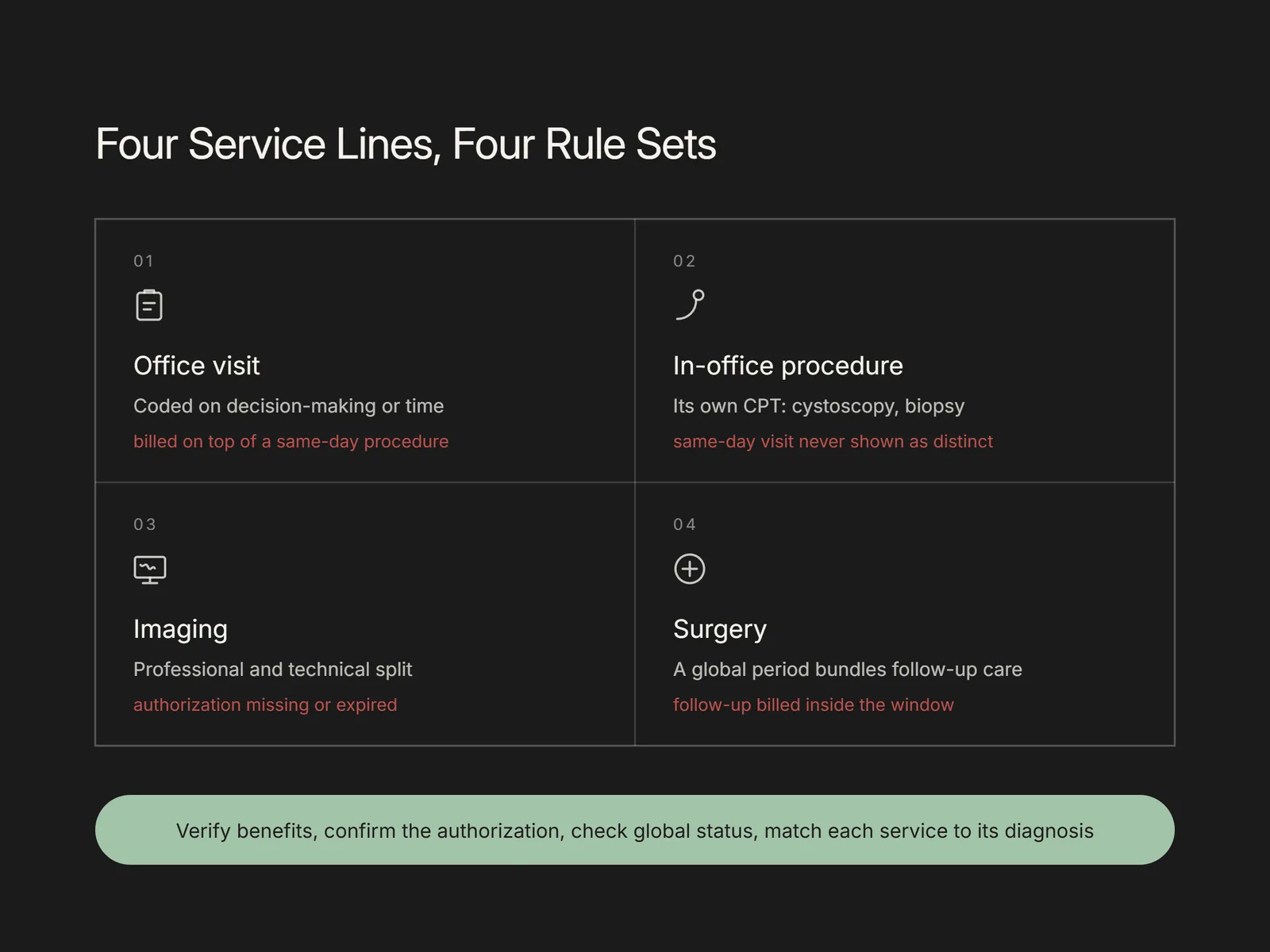
Urology billing is complex because one practice runs several service lines that each follow different rules. A patient may have an office evaluation, an in-office cystoscopy the same day, a prostate MRI, and later surgery, and each of those events is coded differently. Office visits follow evaluation and management rules based on history, exam, and decision-making or time, while in-office procedures are reported with their own CPT codes and a same-day visit has to be judged separate enough to bill on its own. Imaging can divide into professional and technical components, and surgery brings global periods that fold routine follow-up into the operation. Advanced imaging and specialty drugs often need prior authorization, and payers, including Medicare and Medicaid, apply medical-necessity rules that tie each service to a supporting ICD-10 diagnosis. Accurate urology billing depends on knowing which rule set governs each line, not on memorizing one workflow.
Want this mapped against your own call and claim volume? Book a 30-minute audit
How do global surgical periods work?
A global surgical period is the window around a procedure during which the payer considers routine care already included in the payment for the surgery itself. The surgical fee covers the operation plus the ordinary pre-operative and post-operative work that goes with it, so those related visits are not billed again separately. Minor procedures generally carry a shorter global window and major operations a longer one, with the length set by the payer's rules. Inside that window, a routine follow-up visit that relates to the surgery is usually not separately payable, though care that is unrelated to the procedure, or a distinct service that qualifies for an exception, can still be billed when the note shows why it falls outside the global package. In urology this matters constantly, because a patient recovering from surgery may return for an unrelated complaint, and tracking the start date and length of each global period is what tells the practice whether that visit is billable.
How does prior authorization work in urology?
Prior authorization is a payer's requirement that certain services be approved before they are delivered, and in urology it lands most often on advanced imaging and specialty drugs. When a physician orders a prostate MRI or CT urography, many plans route the request through a radiology benefit manager such as eviCore or Carelon, which checks the order against clinical criteria and returns an approval, a denial, or a request for more information. Specialty drugs used in urologic oncology, billed under HCPCS on the medical benefit, frequently carry their own authorization. The practice gathers the clinical rationale, submits it, and confirms the authorization is on file and still valid before the service happens. The administrative weight here is real: the American Medical Association reports that physicians complete about 39 prior authorizations per physician per week, spending roughly 13 hours on them. For how this plays out across the specialty, see our overview of urology and gynecology prior authorization. For how this runs end to end in a urology practice, from scheduling through authorization and appeals, see AI for urology practices.
See what AI can run at your facility. In a 30-minute audit we map the calls, eligibility, and follow-ups Flexbone can take off your team first.
Book an auditHow is in-office procedure billing handled?
Many urology procedures are performed in the office rather than an operating room, and they are billed as procedures on the day they occur. Cystoscopy, a look inside the bladder and urethra with a scope, and prostate biopsy, sampling prostate tissue for pathology, are common examples. When one of these happens on the same day as an office visit, the practice has to determine whether the visit was a separate, significant evaluation or simply the lead-in to the procedure. If it was distinct on its own, it can be reported alongside the procedure with the appropriate indicator that tells the payer the two services were separate; if the encounter was really just the procedure, the visit is not billed on top of it, and the note has to document that distinction. In-office procedures can also generate related charges, such as pathology on a biopsy specimen, that may be billed by the practice or by an outside lab depending on who performs the work. Getting the same-day logic and the ownership of each related charge right keeps these claims from bundling incorrectly.
How does imaging component billing work in urology?
Imaging in urology, such as CT urography for the urinary tract or prostate MRI, can be billed as two parts: a professional component and a technical component. The technical component covers performing the study, meaning the equipment, supplies, and staff time, while the professional component covers the physician work of interpreting the images and producing the report. When the practice both performs and reads the study, it bills the study globally as a single service. When one entity performs the scan and a different physician or group reads it, each bills only its own component so the same study is not paid twice. A group with imaging equipment in-house may bill globally, while a practice that refers the scan out but reads it may bill only the professional component. Mapping which component your practice owns for each study, and confirming the authorization is attached to the order, prevents a large share of imaging denials and duplicate-billing corrections.
Why do urology claims get denied?
Urology claims get denied for a predictable set of reasons, most of which are preventable before the claim goes out. A missing or expired prior authorization on advanced imaging or a specialty drug is a frequent one, since the authorization has to be secured and valid at the time of service. Billing a follow-up visit that falls inside a global surgical period is another, because the payer treats that care as already paid. Coding and diagnosis mismatches that fail medical-necessity rules also draw denials, as do eligibility and benefit errors caught after the visit, such as inactive coverage or a service the plan does not cover as billed. Denials are not a small edge case across the market: the Kaiser Family Foundation found that insurers denied about 20% of in-network HealthCare.gov claims in 2023, and consumers appealed fewer than 1% of them. Verifying coverage up front, confirming every authorization, checking global-period status before billing, and matching each service to its diagnosis removes most urology denials, and a disciplined appeal process recovers a meaningful share of the rest.
AI agents fit the repetitive, rules-driven parts of this work directly. They can verify benefits before the visit, run prior authorization for advanced imaging and specialty drugs including submissions to reviewers like eviCore and Carelon, and work denials by identifying the reason, assembling the documentation, and filing the appeal. If you want to see what this looks like against your own payer mix, book a call with Flexbone and we will run a quick audit of what AI can take off your urology billing, from insurance eligibility verification through AI denials management.