A virtual medical receptionist answers a practice's phones and handles routine front-desk work without sitting at the front desk. In practice it covers two models: a remote person working offsite, or software that answers calls conversationally. Both do the same core jobs. They answer inbound calls, book and reschedule appointments, verify insurance and eligibility, capture new-patient information, and route anything clinical or urgent to a staff member. An AI medical receptionist is the software version of this, working through voice on the phone and often through text and web chat, acting inside the practice management system or EHR. The point is to keep the phones answered when staff are busy, because the phone is still where most patients start. MGMA reports that phones remain a bottleneck that drains practice staff time.
What tasks does a virtual medical receptionist handle?
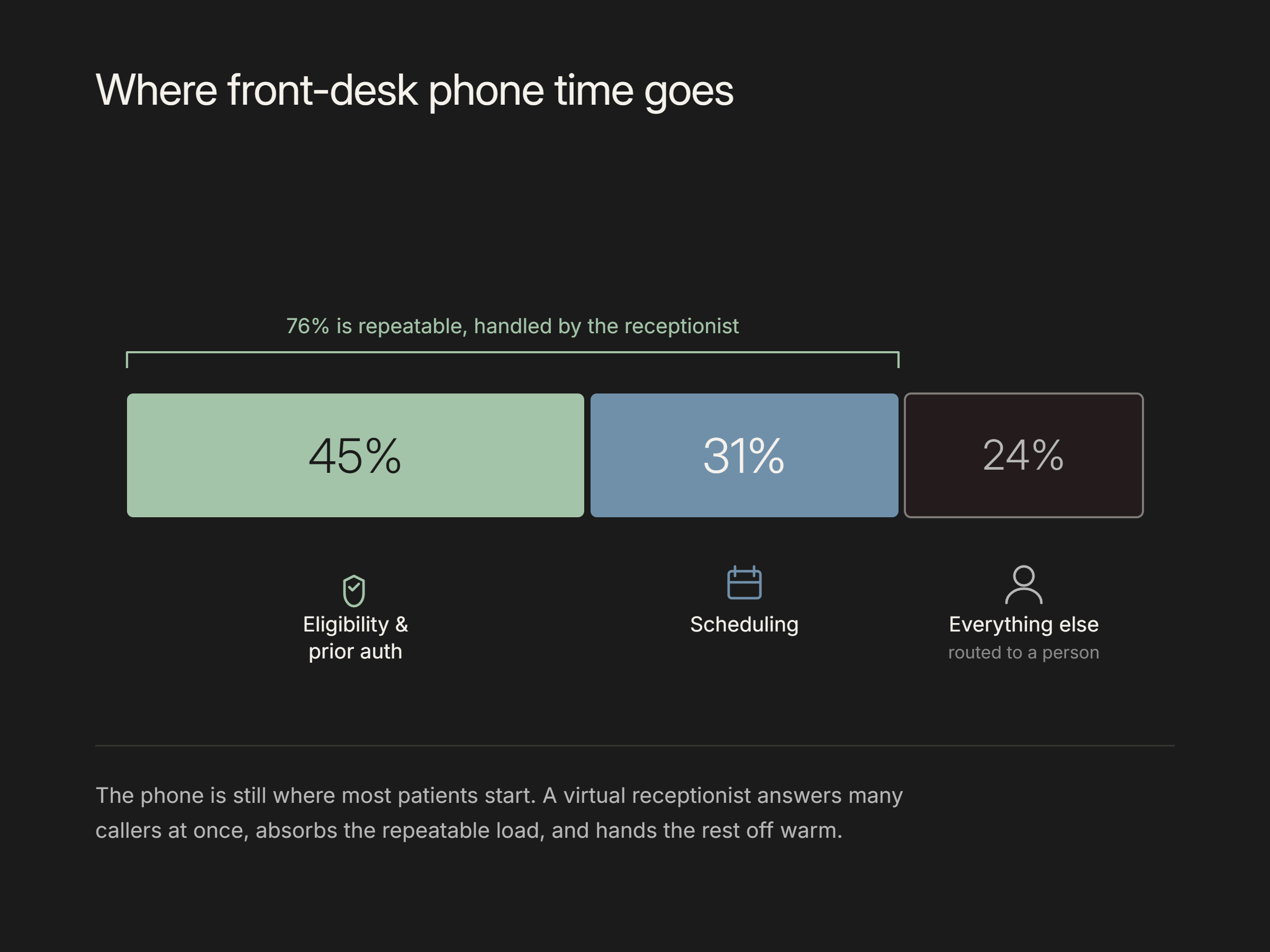
The core tasks are scheduling, rescheduling, and cancellations; appointment reminders and confirmations; insurance and eligibility questions; new-patient intake; prescription-refill and referral routing; and general questions about hours, location, and forms. Scheduling and coverage work dominate the phone load: an MGMA Stat poll found that eligibility and prior authorization accounted for 45 percent of the time practices spend on phones and scheduling for another 31 percent, so a large share of front-desk calls falls into a handful of repeatable categories. A virtual medical receptionist reads live availability, books into the correct provider and visit type, and writes the appointment back to the system of record. It can also run outbound work, such as confirming the next day's schedule or calling a waitlist when a slot opens. Anything outside its defined scope, a clinical question or a billing dispute, goes to a person.
Virtual receptionist vs in-person receptionist: what is the difference?
An in-person receptionist sits at the front desk, greets walk-ins, and handles calls one at a time between other duties. A virtual receptionist for a medical office does the same phone and scheduling work from an offsite location or through software, so it does not need to be physically present. The practical differences are availability and capacity. A single in-person receptionist can hold one call while others go to voicemail; a software-based virtual receptionist answers many callers at once and does not put people on indefinite hold. This matters because patients increasingly expect to reach a practice on their own schedule. MGMA reports that patients want to book on their own time rather than only by phone during office hours. An in-person receptionist still has one advantage the virtual model does not: face-to-face contact for patients who are physically in the office.
See what AI can run at your facility. In a 30-minute audit we map the calls, eligibility, and follow-ups Flexbone can take off your team first.
Book an auditIs a virtual medical receptionist HIPAA compliant?
It can be, but compliance is a property of the specific deployment, not a badge the software carries by default. Because a virtual medical receptionist handles protected health information, the vendor is a business associate under HIPAA and must sign a business associate agreement with the practice. HHS explains that this contract must establish the permitted uses of protected health information and require appropriate safeguards, reporting, and termination terms. A signed agreement is the floor, not the ceiling. Ask the vendor to show encryption in transit and at rest, role-based access controls, audit logging of every interaction, and defined data-retention policies. If a vendor cannot produce a business associate agreement and describe these controls, do not route patient calls to it.
Does a virtual medical receptionist replace front-desk staff?
No. It is built to absorb the routine first-line volume and to route the rest to a person, not to remove the front desk. The work it takes on is the repeatable phone load: scheduling, reminders, coverage checks, and common questions. The work it hands off is anything that needs judgment: a clinical or urgent question, a complex billing dispute, or a caller who asks for a human. In the engagements we run, practices use it to cover overflow, after-hours, and peak call times, so staff spend their attention on in-office patients and difficult conversations instead of a ringing phone. The handoff should be warm, meaning the staff member receives the call context and transcript so the patient does not repeat themselves. Treat any vendor claim of full replacement with caution; front desks still need people for triage and sensitive calls.
How much does a virtual medical receptionist cost?
Pricing depends on the model. Remote human receptionists are usually billed per hour or per seat, so cost scales with staffing hours. An AI medical receptionist is typically billed per month, per call, or per minute of talk time, so cost scales with call volume rather than headcount. The right comparison is not the quoted price against zero, but the quoted price against the cost of unanswered calls. Missed calls and no-shows already carry a real cost: the MGMA analysis of practice phone workflows cites an industry estimate that missed calls and no-shows cost healthcare around 150 billion dollars a year. When you evaluate a quote, ask what share of current calls go unanswered, what a filled versus empty slot is worth to the practice, and whether the vendor charges for transferred or failed calls.
How does Flexbone run an AI front desk?
Flexbone runs the software model of a virtual medical receptionist using voice, browser, and document agents. The voice agent answers calls in natural language, books and reschedules appointments, and verifies coverage; the browser agent works inside the EHR and payer portals the way a staff member would; and the document agent reads and files the paperwork that follows. The design is audit-first, so each call is transcribed and logged for the team to review, and the agents escalate on three triggers: a clinical or urgent question, low confidence in what the caller wants, or an explicit request for a person. When an agent transfers a call, the handoff is warm and carries the transcript, so the patient does not start over. Flexbone signs a business associate agreement, encrypts data in transit and at rest, and runs on infrastructure aligned with SOC 2 controls. For a closer look at how the software model works, see our guide to the automated healthcare receptionist. To see it handle your own call flows, book a demo.