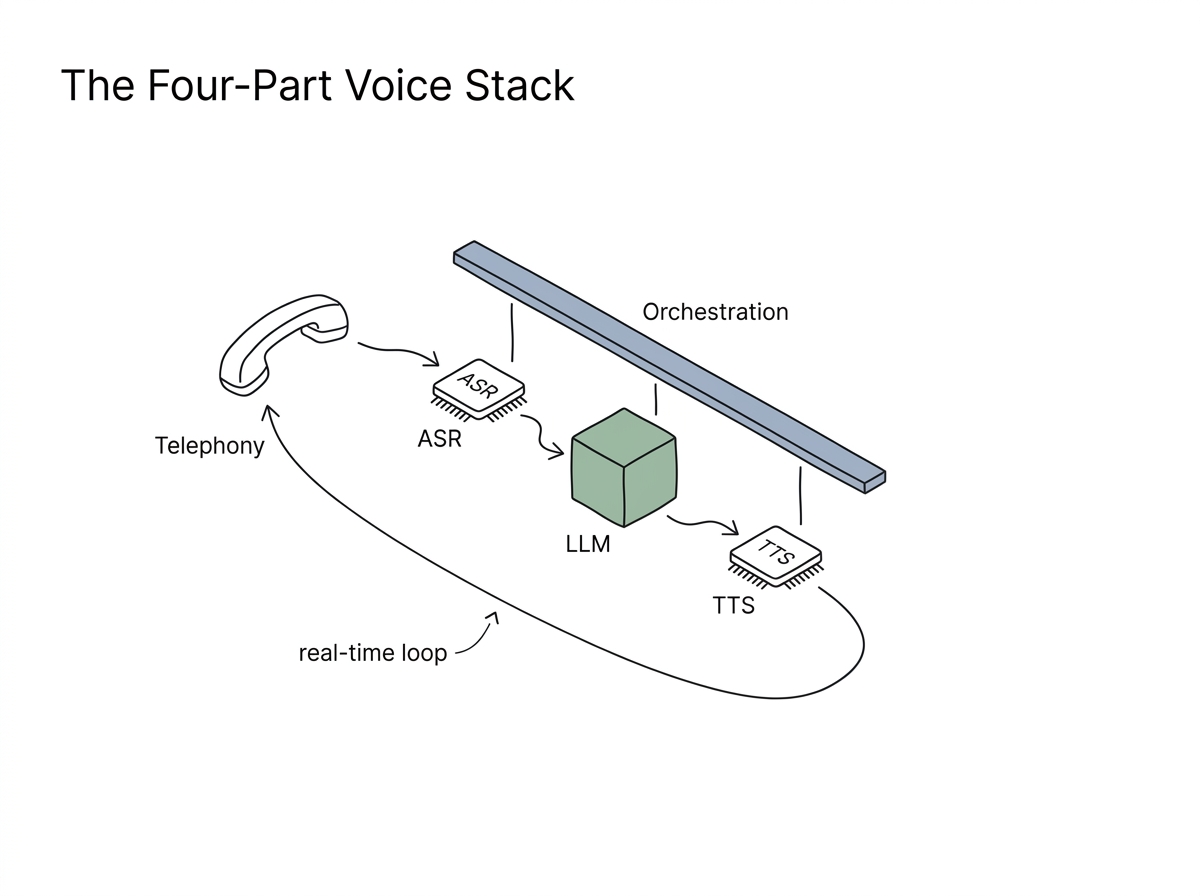
A voice AI agent is a system that holds a spoken phone conversation and takes action on it, using AI to understand what a caller says and respond in natural speech. It is built from four connected parts: automatic speech recognition (ASR) turns the caller's audio into text, a large language model (LLM) interprets that text and decides what to say or do, text-to-speech (TTS) turns the response back into audio, and a telephony layer connects the whole thing to the phone line. This ASR to LLM to TTS pipeline, coordinated by an orchestration layer that manages timing and turn-taking, is the most common design for real-time voice agents today (AssemblyAI). Unlike a recording or a menu, a voice agent understands open-ended speech and can complete tasks like scheduling, verification, and lookups during the call.
What is a voice AI agent?
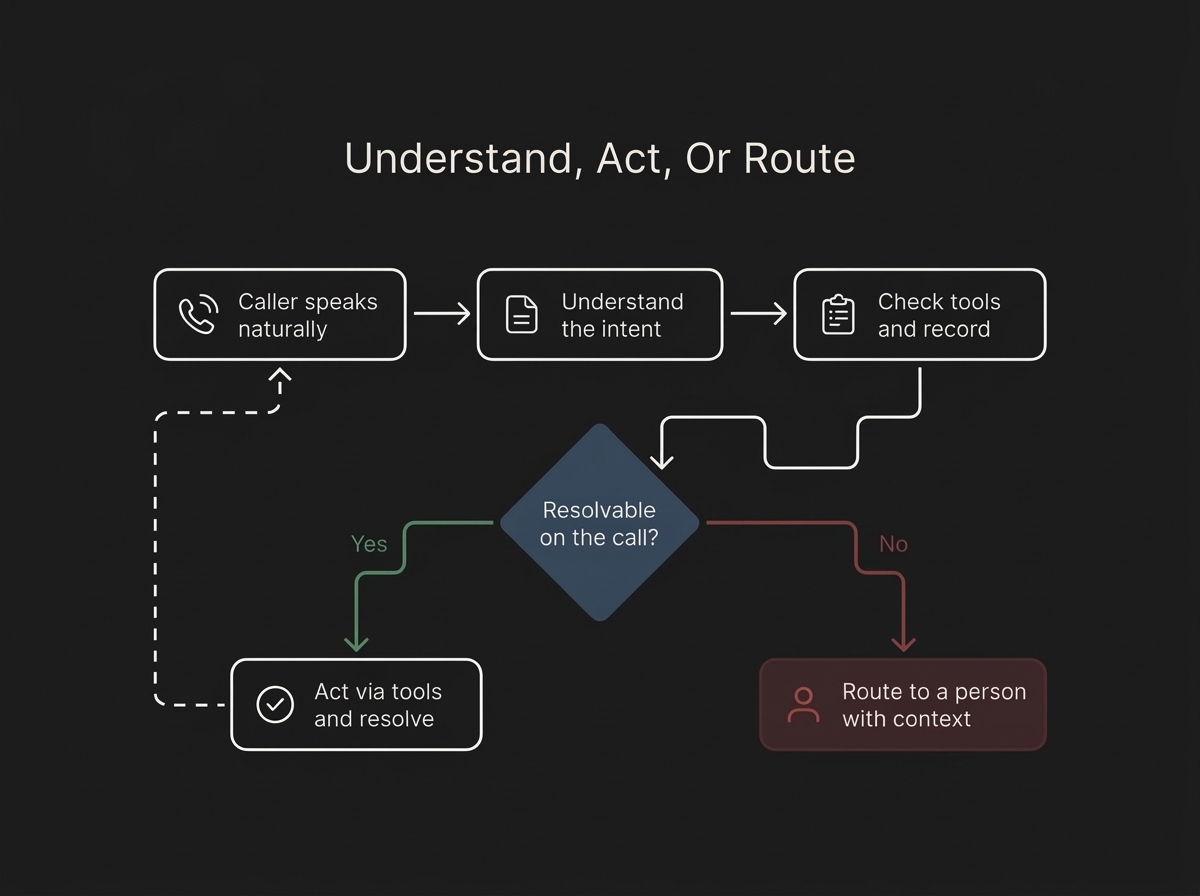
A voice AI agent is software that answers or places phone calls and carries on a real conversation, rather than reading a fixed script or playing a menu. The caller speaks naturally, the agent understands intent, and it responds in a synthesized voice while performing the underlying work, such as booking an appointment or checking a status. The distinguishing feature is that a voice agent is built as a stack of specialized components working in real time, not a single model (AssemblyAI). It listens, reasons, speaks, and acts within the same call. Because the reasoning is handled by a language model rather than a decision tree, the agent can follow the twists of a real conversation, ask clarifying questions, and handle requests that were not anticipated word for word.
Want this mapped against your own call and claim volume? Book a 30-minute audit
What is the ASR, LLM, TTS, and telephony stack?
The stack has four layers plus an orchestrator. Telephony connects the agent to the phone network through SIP trunking or WebRTC and streams audio in both directions. ASR, also called speech-to-text, transcribes the caller's audio into text in real time. The LLM reads that text, keeps track of the conversation, decides the response, and calls tools or APIs when it needs to take an action. TTS converts the response text back into natural-sounding speech. An orchestration layer sits across all of them, managing turn-taking, interruptions, and session state so the exchange feels like a conversation rather than a series of disconnected steps (Deepgram). Latency is the hard constraint, because each layer adds delay, and the orchestrator has to keep the total low enough that replies feel natural.
The stack is the easy part to describe; the harder part is deciding which calls it should take. Flexbone makes that decision from a practice's recorded calls before configuring anything. See AI voice agents.
See what AI can run at your facility. In a 30-minute audit we map the calls, eligibility, and follow-ups Flexbone can take off your team first.
Book an auditWhat can a voice agent do?
A voice agent can handle both inbound and outbound calls end to end. On inbound, it can answer, understand why the person is calling, and resolve the request: schedule or reschedule an appointment, verify an identity, answer a common question, or route a complex case to a person with full context. On outbound, it can place reminder calls, confirm details, and follow up. The key is that the agent does not just talk; it takes actions through connected tools, updating a record or triggering a workflow while the call is still live (AssemblyAI). In a healthcare setting that means a call about scheduling can end with the calendar actually updated, and a benefits question can be answered from a real lookup rather than a generic recording, all without a staff member on the line.
How is a voice agent different from an IVR?
An IVR (interactive voice response) is a menu-driven system that routes callers with keypad presses or narrow speech recognition, moving them through fixed paths like "press 1 for billing." It follows a decision tree and cannot handle anything outside its predefined options. A voice agent uses natural language understanding to grasp what the caller means, even when they phrase it in an unexpected way, and it responds conversationally instead of forcing the caller through menus (3CLogic). The practical result is that an IVR makes the caller adapt to the system, while a voice agent adapts to the caller. An IVR can only route or play recordings; a voice agent can understand, reason, act, and resolve the request within the same call.
How Flexbone builds voice agents for healthcare
Flexbone builds voice agents for secure and regulated environments, with deep use in healthcare patient access. We are audit-first: before deploying, we study the actual call patterns, the systems the agent must touch, and the failure modes, then design the flow with human handoff on anything sensitive. Our agents connect to the tools that matter, so a scheduling call updates the system of record and a coverage question runs a real lookup, not a canned reply. The platform is HIPAA compliant and SOC 2-aligned, which is essential when an agent discusses patient information over the phone. See how this works for patient-facing calls on our healthcare calls page, then book a demo to hear a voice agent handle your call types.