
Accounts receivable (A/R) in medical billing is the money a practice is owed for services it has already delivered but has not yet been paid for. It comes from two sources: balances due from insurance payers on submitted claims, and balances due from patients for copays, coinsurance, and deductibles. A/R sits on the back end of the revenue cycle, after a claim is billed and before the payment posts. Managing it means working those open claims and balances by aging bucket and payer so cash is not lost to denials, timely-filing limits, or simple neglect. The core discipline is triage: sort every unpaid account by how old it is and who owes it, then work the oldest and largest balances first, because a claim that is denied, ignored, or left past a filing deadline can become a permanent write-off.
What is accounts receivable in healthcare?
Accounts receivable in healthcare is the total value of care a provider has delivered but not yet collected payment for. It is a standard accounting term, receivables owed to the business, applied to the specific way healthcare gets paid: a claim goes to a payer, the payer adjudicates it, and the patient owes whatever the plan does not cover. Until each of those balances is resolved, it sits in A/R. What makes healthcare A/R distinct is that a single service is often split between the payer and the patient, and the payer portion can be denied, underpaid, or delayed for reasons unrelated to whether the patient will eventually pay. That is why healthcare organizations track A/R as an active workload, not just a number on a balance sheet.
Want this mapped against your own call and claim volume? Book a 30-minute audit
What is A/R aging?
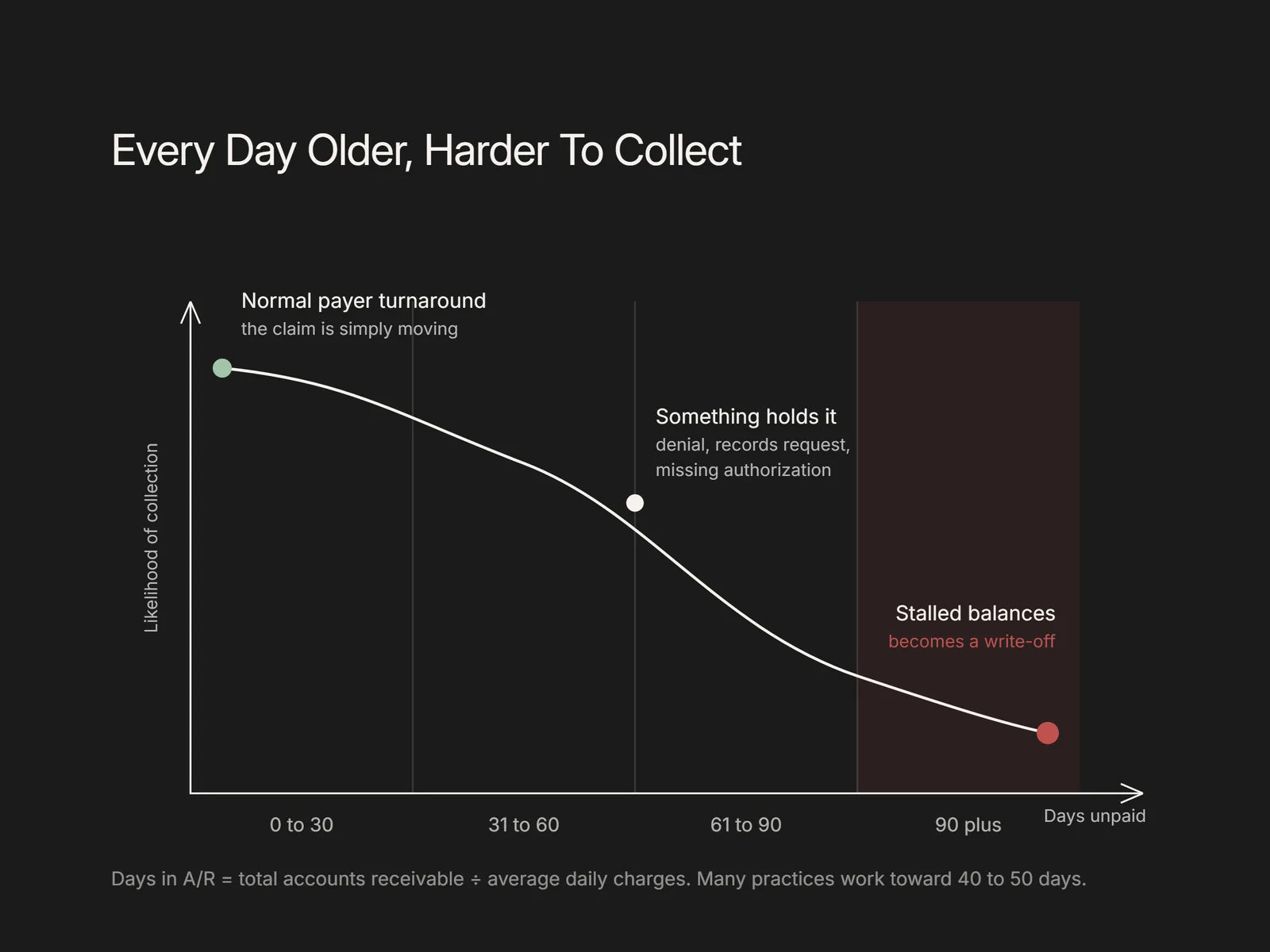
A/R aging sorts every unpaid claim and patient balance by how long it has gone unpaid. The balances are grouped into aging buckets, most commonly 0-30, 31-60, 61-90, and 90-plus days, counted from either the date of service or the date the claim was billed. The result is an aging report, the single most useful view a billing team has. A balance in the 0-30 bucket is usually just moving through normal payer turnaround. A balance in the 90-plus bucket has stalled for a reason: a denial, a request for records, a missing prior authorization, or an account no one has worked. The buckets exist because the probability of collection falls as a balance ages, so the report tells the team where to spend its time. A well-run A/R keeps a small share of its total dollars in the oldest bucket.
What is days in A/R?
Days in accounts receivable estimates how long, on average, it takes a practice to get paid after delivering care. The standard formula divides total accounts receivable by average daily charges, where average daily charges is total gross charges over a period, usually the trailing 90 or 365 days, divided by the days in that period. If a practice carries $300,000 in A/R and averages $10,000 in charges per day, its days in A/R is 30. The metric matters as a leading indicator: when it climbs, cash is arriving more slowly, and the cause is typically upstream, in denials, slow payer response, or a follow-up backlog. Tracking it monthly, alongside the aging report, shows whether the A/R workload is staying current or quietly falling behind.
See what AI can run at your facility. In a 30-minute audit we map the calls, eligibility, and follow-ups Flexbone can take off your team first.
Book an auditWhat is a good days in A/R?
A days-in-A/R figure under 40 to 50 days is a target many practices work toward, but the right number depends heavily on specialty, payer mix, and how much of the balance is patient responsibility, so it is best treated as a common benchmark rather than a universal standard. A practice with a large Medicaid share or heavy patient-pay balances will run higher than one paid mostly by fast commercial payers, and neither is automatically doing worse work. A more reliable read than the average alone is the distribution: what percentage of A/R dollars sits in the 90-plus bucket. Two practices can report the same days in A/R while one has a clean aging curve and the other has a growing pile of stalled old claims, so the healthy signal is a low, stable share of dollars past 90 days.
How do you reduce A/R and prevent write-offs?
Reducing A/R happens in two places: preventing avoidable balances on the front end, and working the open ones on the back end. On the front end, confirming coverage and benefits before the visit stops a large class of denials before a claim is ever sent. Denials are a major reason A/R ages: in HealthCare.gov marketplace plans, insurers denied 20% of in-network claims in 2023, and consumers appealed fewer than 1% of those denials, according to KFF. A missing prior authorization is another driver, and the work to obtain them is heavy on its own, averaging about 39 requests per physician each week and roughly 13 hours of staff time, per the AMA. On the back end, the discipline is consistent follow-up: run claim-status checks, work the aging report oldest and largest first, appeal denials with documentation, and resolve accounts before they hit timely-filing deadlines. This is where insurance eligibility verification prevents the problem, prior authorization automation removes a common denial cause, and AI denials management reworks the claims that still get rejected.
What is the difference between A/R and denials management?
Accounts receivable and denials management are related but describe different things. A/R is the full population of money owed to the practice, every open claim and patient balance regardless of why it is unpaid. Denials management is the specific work of investigating, correcting, and appealing claims a payer has rejected or underpaid. A denied claim is one reason a balance sits in A/R, but not the only one: a claim can be aging because the payer has not adjudicated it yet, or because a patient statement is outstanding. The two overlap heavily, since denials are one of the biggest reasons A/R ages into the older buckets. Working A/R well means separating them: which aged balances are stuck on denials that need appeals, and which are just awaiting payment and need a claim-status check and a nudge.
AI agents can take a real slice of this workload directly: voice and browser agents run claim-status checks with payers and place A/R follow-up calls, so aged accounts get worked and their status recorded in the systems your team already uses, rather than waiting in a backlog. To see how much of your A/R follow-up an AI agent could take on, book a call with Flexbone to run a quick audit of where your aging is concentrated and which of it is a fit to automate.