
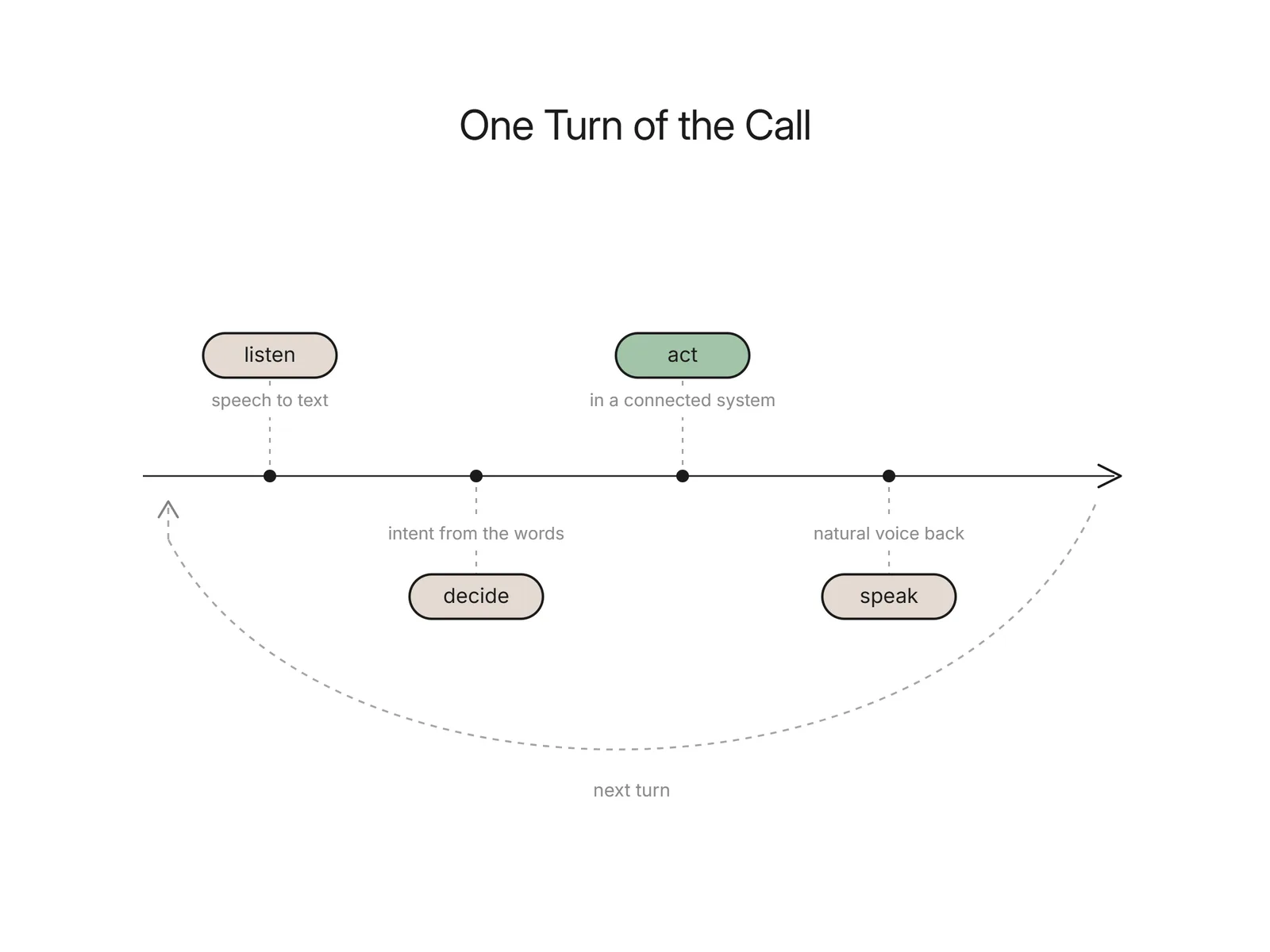
An AI voice agent is software that answers or places phone calls, understands what a caller says in natural speech, and completes a task rather than only taking a message. It runs a listen, decide, act loop: it converts the caller's speech to text, works out what they want, takes an action in a connected system, and speaks a response back in a natural voice. This is different from an interactive voice response (IVR) phone tree, where the caller navigates a fixed menu by pressing keys, and different from a text chatbot, which handles typed messages rather than a live phone conversation. The point of an AI voice agent is resolution instead of routing: it finishes the request on the call, and escalates to a person when the request needs human judgment. The sections below explain how the loop works, where it fits, and how to think about security.
How does an AI voice agent work?
An AI voice agent works as a loop with four steps that repeat through the call. First it listens, converting the caller's speech to text with automatic speech recognition. Second it decides, using a language model to read the transcribed text and work out the intent behind it, such as booking an appointment or checking a status. Third it acts, calling into a connected system to do the actual work, for example querying a schedule, looking up a record, or submitting a request through an application programming interface (API). Fourth it speaks, turning its response into audio with text to speech so the caller hears a natural answer. Because each turn feeds the next, the agent can ask a follow-up question, confirm a detail, or correct a misunderstanding, which is what makes it feel like a conversation rather than a menu. When the task is done, the agent records the outcome so the result lands in the system of record rather than in a voicemail someone has to clear later. Our AI voice agents page walks through each stage of this loop and the systems it connects to in more depth.
Want this mapped against your own call and claim volume? Book a 30-minute audit
What is the difference between an AI voice agent and an IVR?
The difference is what happens after the caller speaks. An IVR presents a fixed menu and routes the call based on the key the caller presses or a short spoken keyword it is trained to recognize. It is good at directing traffic and poor at resolving anything, because the logic is a decision tree, not an understanding of the request. An AI voice agent understands full sentences, holds a back and forth, and can complete the task itself instead of handing it off. Put simply, an IVR routes and a voice agent resolves. That distinction matters because so much call volume is repetitive work that a menu cannot finish. Phones remain a real backlog for practices: an MGMA Stat poll found that 45% of practice leaders named eligibility and authorization work, and 31% named scheduling, as their most time-consuming phone tasks. An IVR can send those calls to a queue, but a voice agent can take them off the queue by handling them end to end.
What can AI voice agents do?
An AI voice agent can answer inbound calls and place outbound calls, and within a scope you define it can verify details, complete transactions, and write the result back to a system of record. On an inbound call it can greet the caller, identify the reason for the call, and either resolve it or route it. On an outbound call it can dial a number, work through a phone menu on the other end, and carry out a task such as confirming an appointment or checking on a request. The common thread is that the agent does the work in a connected system rather than reading a script, so the outcome is a booked slot, a verified answer, or a submitted request, not just a message. It can also recognize its own limits: when a caller asks something outside its defined tasks, it escalates to a person and passes along the context so the handoff is clean. You can see the tasks we configure agents for on the Flexbone features page.
See what AI can run at your facility. In a 30-minute audit we map the calls, eligibility, and follow-ups Flexbone can take off your team first.
Book an auditWhere are AI voice agents used?
AI voice agents are used wherever a large share of phone work is repetitive and rule-bound. In healthcare, that covers front-desk and revenue-cycle calls: appointment scheduling and rescheduling, insurance eligibility and benefits verification, and outbound status calls to payers such as Medicare, Aetna, or a Blue Cross plan, with the outcome written back to the electronic health record (EHR). Eligibility often runs through the 270/271 transaction over a clearinghouse like Availity, but many benefit and authorization questions still require a live call the agent can place. Clinical calls, such as symptom questions or urgent triage, are escalated to staff rather than handled by the agent. The same listen, decide, act technology applies outside healthcare, because the mechanics of a phone call do not change with the industry. In logistics, an agent can place outbound calls to confirm a pickup or delivery window and update a dispatch system with the answer. In insurance, it can verify a policy detail or check the status of a claim over the phone. What stays constant across these settings is the split between routine calls the agent resolves and judgment calls it routes to a person. Our healthcare calls page describes how this plays out for a clinic in practice.
Are AI voice agents secure and compliant?
Whether an AI voice agent is secure and compliant depends on how it is deployed, not on the label attached to it. When an agent handles protected health information on a covered entity's behalf, the vendor is a business associate under HIPAA and must sign a business associate agreement, then back it with access controls, encryption in transit and at rest, and audit logging. Beyond the paperwork, the practical safeguard is visibility: when calls are transcribed and logged, you can review what the agent said and did before you widen its scope, rather than trusting it blindly. That audit-first approach lets a team start the agent on a narrow set of low-risk calls, confirm it behaves as expected, and expand only once the record supports it. Compliance obligations vary by industry, so an agent that verifies insurance details in a non-clinical setting carries a different, though still real, set of privacy and consent requirements. The constant is that security has to be designed into the deployment from the start, not added afterward. The questions worth putting to any vendor on this are covered in our AI voice agents overview.
Do AI voice agents replace people?
An AI voice agent is built to take the routine, high-volume calls and hand the rest to a person, so it changes the mix of work more than it removes the people. The design principle is resolution first, with an open path to a person: the agent finishes the calls it is scoped to handle and routes anything that needs judgment to staff, with the call context attached so the person does not start from a blank message. In a clinic, that means the front desk spends less time on scheduling and eligibility loops and more time on the calls that genuinely need a human, such as a worried patient or a complex billing question. The measure of a good deployment is not how many calls the agent takes over, but how cleanly it separates the calls it should handle from the calls it should pass along.
If you want to map where an AI voice agent could run at your organization, book a call with Flexbone and we will walk through your inbound and outbound call types, which ones an agent could resolve, and where the handoffs to your team should sit.