
An email agent is an AI system that reads inbound email, works out what each message is asking for, and either drafts a reply or completes the task behind it. Unlike a keyword filter, it uses a language model to understand context, so it can tell a routine status question apart from an escalation that needs a person. Anthropic draws a useful line here: in its guidance on building effective agents, a workflow follows predefined code paths, while an agent lets the model decide what to do next and which tools to use. An email agent sits on that spectrum. Simple versions classify and route; fuller versions read the thread, pull data from connected systems, draft a grounded reply, and hand anything uncertain to a human. This guide covers how it triages, what it can safely automate, and the guardrails it needs.
What is an email agent?
An email agent is software that monitors a mailbox, reads each message, and acts on it: labeling, routing, drafting a response, or completing the underlying request by touching another system. The distinction from a rule is comprehension. A filter matches text; an agent interprets intent, so an email from a manager about "the project" reads as different from a newsletter that happens to use the same word. Forbes describes these agents as tools that sort, prioritize, and draft responses by understanding context rather than matching keywords. In back-office settings such as healthcare revenue cycle, the mailbox is often the system of record for payer correspondence, patient requests, and document exchange, which is exactly the high-volume, repetitive work an agent is suited to read first and route or draft against.
Want this mapped against your own call and claim volume? Book a 30-minute audit
How does an email agent triage and draft?
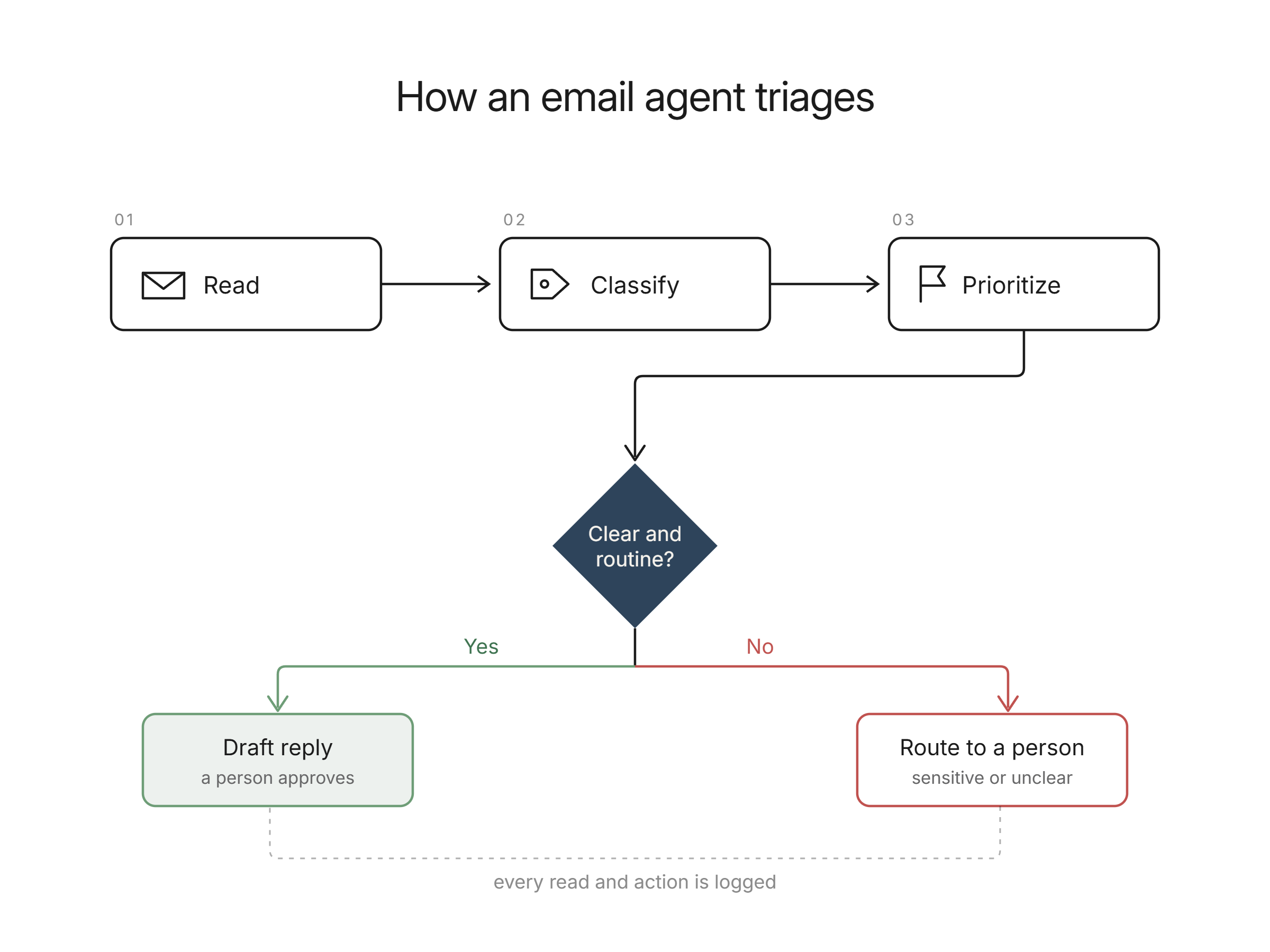
Triage runs as a short pipeline: read the message, classify its intent and urgency, prioritize against your service levels, route it to the right owner or queue, then draft a response grounded in connected data. Drafting is where a language model earns its keep, because it can assemble a specific, on-policy reply instead of a template. The volume that makes this worth doing is large. McKinsey's research on the social economy found interaction workers spend about 28 percent of the workday reading and answering email, roughly a day and a half each week. An agent does not remove that work so much as pre-process it: it reads everything, handles the clear cases, and presents the rest with a draft and the context a person needs to decide, which shortens the human step considerably.
Flexbone applies the same triage logic to the faxes and documents that reach a practice: classify each item, extract what matters, and file or draft the result, with anything ambiguous left for a person. See features.
See what AI can run at your facility. In a 30-minute audit we map the calls, eligibility, and follow-ups Flexbone can take off your team first.
Book an auditWhat can it safely automate?
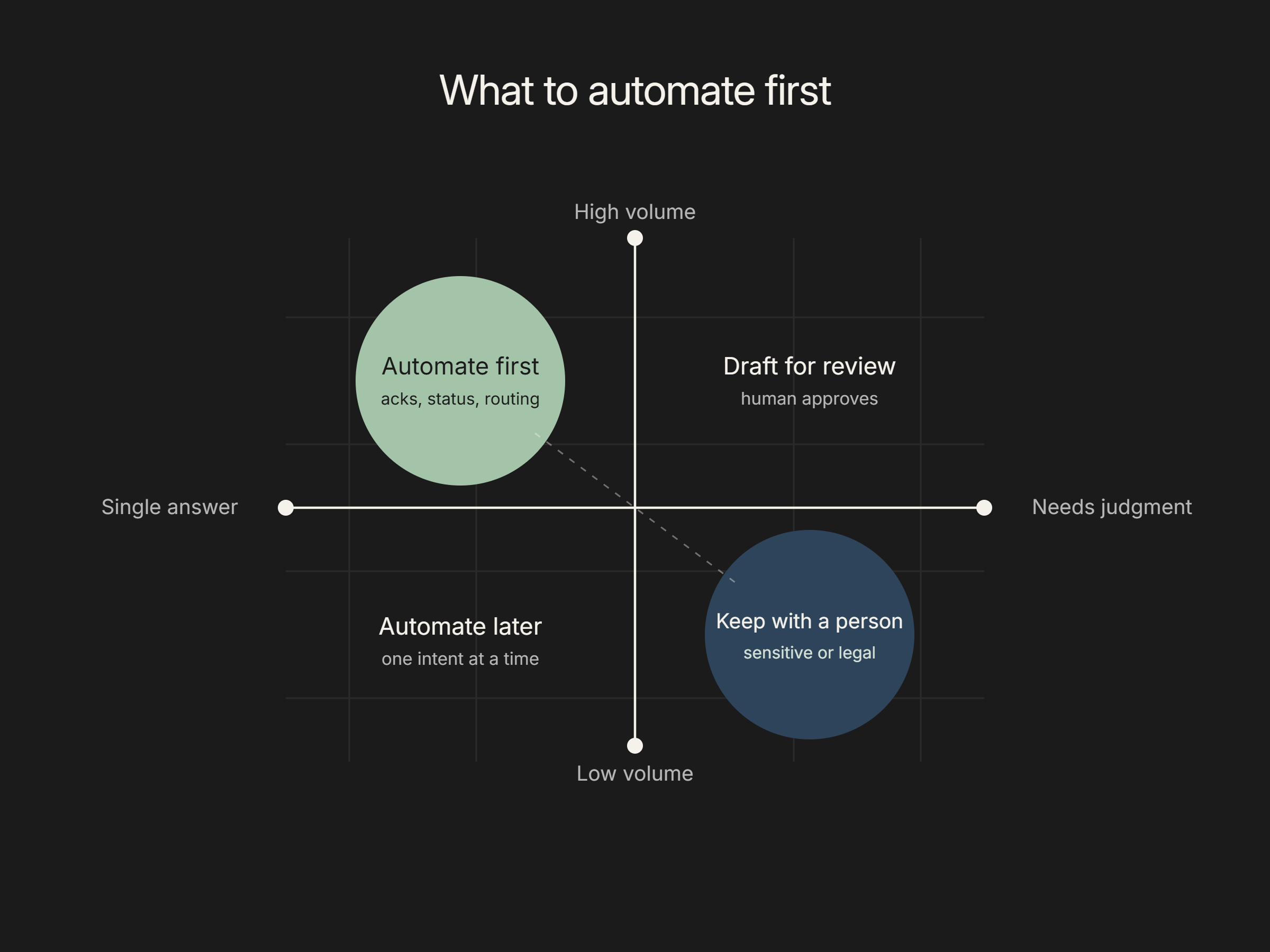
Automate the email tasks that are high-volume, repetitive, and have a single correct answer before anything ambiguous or sensitive. Good early candidates are acknowledgements, status updates, routing to the correct department, appointment or records requests, and structured data entry from an attached form into another system. McKinsey's analysis of the economic potential of generative AI points to customer operations, including correspondence handling, as one of the functions where the technology can raise productivity the most, though the gain depends on scoping the work carefully rather than pointing an agent at the whole inbox. Keep nuanced, high-emotion, or legally sensitive threads with a person, at least until the agent has a measured track record on the narrow cases you started with. The safe pattern is to expand one intent type at a time.
What guardrails does an email agent need?
An email agent needs a human-in-the-loop step for anything it sends externally, plus scoped permissions, grounded drafting, and a full audit trail. The most important control is approval: for regulated or customer-facing replies, a wrong auto-response is worse than a slow one, so a person reviews the draft before it goes out until confidence is proven. Grounding matters too, because a reply should cite the record it came from rather than a guess. The NIST AI Risk Management Framework organizes this thinking into four functions, Govern, Map, Measure, and Manage, and names the traits of trustworthy AI, including that systems be secure, accountable, transparent, and privacy-enhanced. In practice that means least-privilege access to mailboxes and connected systems, logging of every read and action, and a clear escalation path so uncertainty routes to a human instead of a confident mistake.
How Flexbone builds email agents for regulated inboxes
Flexbone builds audit-first AI agents, including document and browser agents that work the mailboxes behind contact-center and back-office operations. In healthcare revenue cycle, that mailbox carries payer correspondence, eligibility responses, records requests, and patient messages, so an agent has to read accurately, draft from the actual record, and keep a person in the loop on anything it sends. Because the platform is HIPAA compliant and SOC 2-aligned, teams can put an agent on protected health information with least-privilege access and a complete audit trail rather than accepting new compliance risk. We start from an audit of your current inbox mix, put the agent on one high-volume intent with human approval, and expand from measured results. See how we handle insurance eligibility verification as a related workflow.
Book a demo: https://www.flexbone.ai/contact