
An ERA, short for electronic remittance advice, is the electronic document a payer sends a provider to explain how a claim was adjudicated: what was billed, what was allowed, what was paid, and what was adjusted or denied, and why. It is carried by the HIPAA-adopted 835 transaction, the standard EDI format for remittance and payment data. For every service line on a claim, the ERA reports the amounts and attaches standard reason codes, CARC and RARC, that explain any dollar that differs from what was billed. It is the provider-side counterpart to the patient's explanation of benefits (EOB), and billers use it to post payments to each claim and to work denials. Because the 835 format is standardized across payers, one billing system can read remittances from many plans and post them the same way.
What is an ERA?
An ERA is the remittance a payer sends back after it processes a claim, delivered electronically instead of on paper. It answers three questions for each service line: how much the payer allowed, how much it paid, and how much it adjusted or denied. Where an amount was reduced or not paid, the ERA carries reason codes that explain why, so a biller can act on it without calling the payer. The ERA is what billing teams use to post payments and to identify denials that need follow-up, and it typically arrives alongside or references an electronic funds transfer (EFT) so the money and the explanation can be reconciled. In short, the ERA is the record that tells a practice exactly what happened to a claim.
Want this mapped against your own call and claim volume? Book a 30-minute audit
What is the 835 transaction?
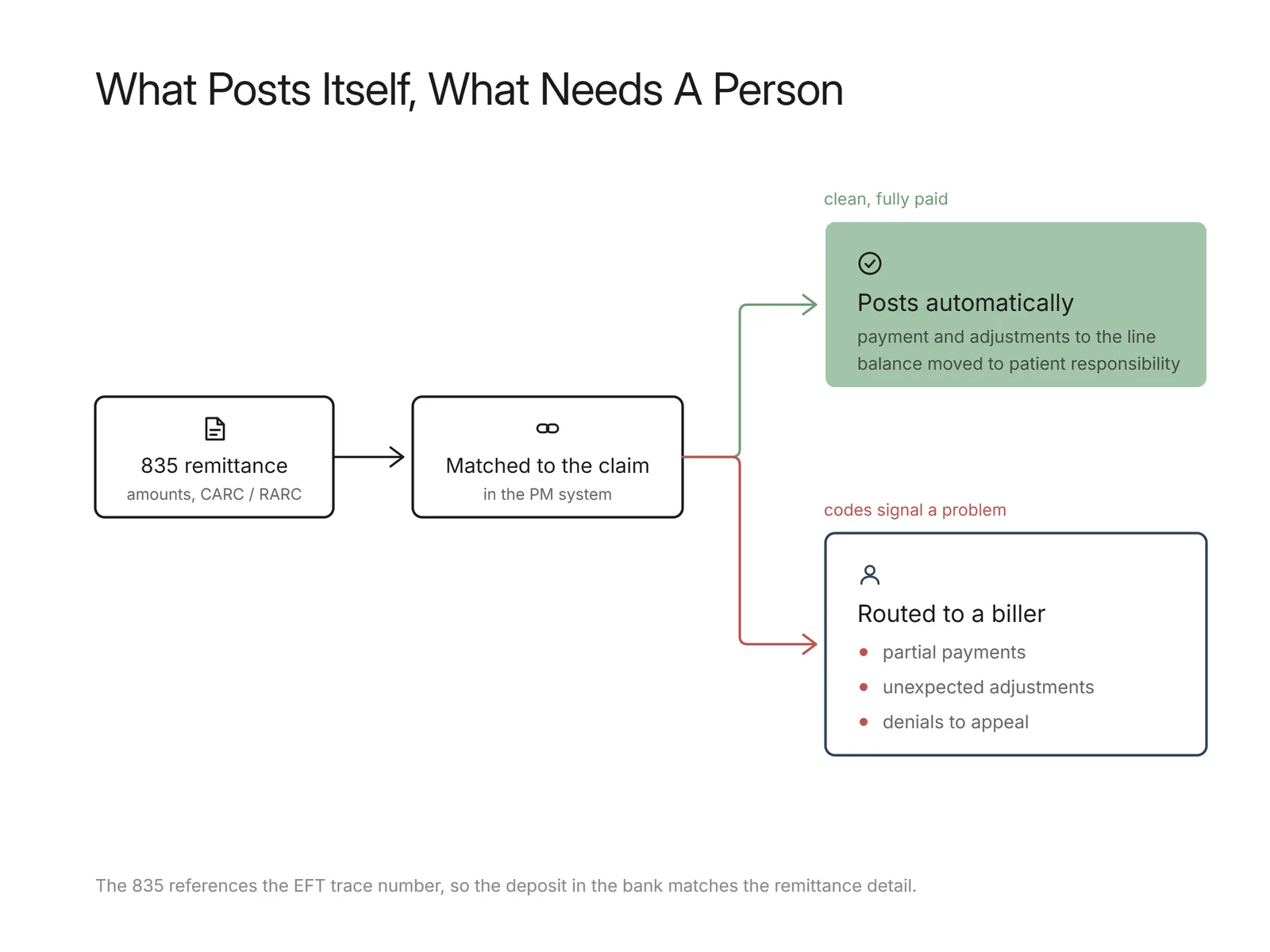
The 835 is the X12 EDI transaction that carries the ERA. It is the HIPAA-mandated standard format payers use to transmit remittance and payment information to providers, part of the same Administrative Simplification framework that standardized the 270/271 eligibility inquiry and response. A single 835 groups the claims paid in one remittance and, for each claim and service line, reports the billed amount, the allowed amount, the paid amount, patient responsibility, and the adjustment codes. It can also reference the EFT trace number so a provider can match the deposit in the bank to the remittance detail. Because every compliant payer sends the same structure, a clearinghouse or billing system can parse one payer's 835 the same way it parses another's.
See what AI can run at your facility. In a 30-minute audit we map the calls, eligibility, and follow-ups Flexbone can take off your team first.
Book an auditWhat is the difference between an ERA and an EOB?
The difference is the audience and the purpose. An ERA goes to the provider; an EOB, the explanation of benefits, goes to the patient. Both describe how a claim was processed, but they serve different work. The EOB is a human-readable statement that tells the member what the plan covered and what they may owe. The ERA is a structured electronic file, the 835, that a billing system reads to post payments and adjustments automatically and to surface denials for follow-up. An EOB has no reason codes a machine can act on and does not drive payment posting; the ERA does both. Practices sometimes still receive a paper remittance called an SPR (standard paper remittance) when no 835 is available, but the electronic ERA is what supports automation.
How do you read an ERA?
Reading an ERA means walking each claim from the billed amount down to what was actually paid, then explaining the gap with the reason codes. For each service line, compare the billed charge, the payer's allowed amount, the contractual adjustment, the amount applied to patient responsibility (deductible, coinsurance, or copay), and the paid amount. The adjustments are explained by two code sets. A CARC (Claim Adjustment Reason Code) states why the payer adjusted a payment, for example that a service was applied to the deductible, was not covered, or was bundled into another service. A RARC (Remittance Advice Remark Code) adds supplemental detail to a CARC, often pointing to the specific policy or the next step required. Group codes such as CO (contractual obligation) or PR (patient responsibility) tell you who owns each adjustment. Read together, these fields tell a biller whether a line was paid correctly, needs a patient bill, or needs an appeal.
How does auto-posting from an ERA work?
Auto-posting is the process of reading the 835 file and writing each payment and adjustment to the matching claim in the practice management system, without a biller keying it by hand. The software matches the remittance to the open claim, posts the paid amount, records the CARC and RARC adjustments against the correct service lines, and moves the balance to patient responsibility or to a denial queue as the codes indicate. Clean, fully paid claims post automatically. The exceptions, partial payments, unexpected adjustments, and denials, route to a person to review, because those are the lines that need judgment or an appeal. Auto-posting handles volume; a biller handles the cases where the codes signal a problem. The value of an ERA is highest when the routine posting is automated and staff time concentrates on the denials.
How Flexbone works the 835 and the denials behind it
Flexbone deploys AI document and browser agents that read the 835, post payments and adjustments to each claim, and route denials by their CARC and RARC codes into the right work queue, with anything ambiguous handed to your team. The same agents extend upstream and downstream: they run insurance eligibility verification before the visit, handle prior authorization automation, and support AI denials management once a remittance shows a denial. The approach is audit-first, HIPAA compliant, and SOC 2-aligned, so payment posting stays accurate and traceable.
If you want to see what an agent can take off your remittance and denial work, book a call with Flexbone and we will run a quick audit of your 835 posting and denial volume to scope what AI can handle and what should stay with your team.