
An explanation of benefits, or EOB, is a statement your health plan sends after it processes a claim from a provider. It is not a bill. It explains how the plan handled the claim: what the provider charged, what the plan allowed under its contract, how much the plan paid, and how much may fall to you as the patient. Most EOBs print "this is not a bill" near the top for that reason. The document lets you check that a claim was processed correctly before any bill arrives. The provider sends the actual bill separately, and the two should agree; if they do not, the EOB is where you catch the problem. One distinction matters up front: the patient receives the EOB, while the provider receives a parallel document called the electronic remittance advice (ERA).
What is an EOB?
An EOB is a summary a health plan produces each time it adjudicates a claim, meaning each time it decides how much of a billed service its contract covers. For a single visit you may receive one EOB covering several line items, one per service or procedure code. Each line shows the billed amount, the allowed amount the plan recognizes under its negotiated rate, the portion the plan paid, and the portion attributed to you, with reason and remark codes explaining any reduction. An EOB is generated whether or not you owe anything, so receiving one does not by itself mean a payment is due.
Want this mapped against your own call and claim volume? Book a 30-minute audit
Is an EOB a bill?
No. This is the most common point of confusion, and it is why plans stamp "this is not a bill" on the document. An EOB reports what already happened to a claim; a bill requests payment. The EOB may list an amount under "patient responsibility" or "you may owe," but that figure is an estimate of what the provider can charge you, not an invoice from the plan. You pay the provider, not the plan, and only after the provider sends a bill. Paying directly off an EOB is a common mistake, because the provider may still adjust the charge or bill a secondary insurer first. Wait for the provider's bill, then confirm it matches the EOB.
What is the difference between an EOB and a medical bill?
The difference is direction and purpose. An EOB comes from your health plan and explains how a claim was processed; a medical bill comes from your provider and requests the balance you owe after insurance. The EOB's patient-responsibility figure and the provider's bill should match, and comparing them line by line is the single most useful check a patient can run. The two arrive at different times, the EOB usually first, which is why an EOB can feel like a bill before the real one shows up. Reading it matters: insurers denied 20 percent of in-network claims on HealthCare.gov in 2023, yet consumers appealed fewer than 1 percent of those denials, according to KFF's analysis of ACA marketplace claims. A denied line on an EOB is often the first place a patient could catch a billing error, before the bill lands.
See what AI can run at your facility. In a 30-minute audit we map the calls, eligibility, and follow-ups Flexbone can take off your team first.
Book an auditWhat is the difference between an EOB and an ERA?
An EOB and an ERA carry overlapping information but serve different readers. The EOB is the human-readable statement sent to the patient. The ERA, short for electronic remittance advice, is the standardized X12 835 transaction the plan transmits to the provider so their billing system can automatically post the payment, the contractual adjustments, and any patient responsibility. In practice, the patient gets the EOB and the provider's revenue cycle team works from the 835. Both describe the same adjudication decision, one formatted for a person to read and one for software to process. The same family of federally adopted transactions also covers eligibility: the X12 270/271 eligibility inquiry and response, adopted under HIPAA Administrative Simplification, lets a provider confirm coverage before the visit rather than learning about a gap from an EOB afterward. Verifying coverage up front, through insurance eligibility verification, is how many of those surprises are prevented.
How do you read an EOB?
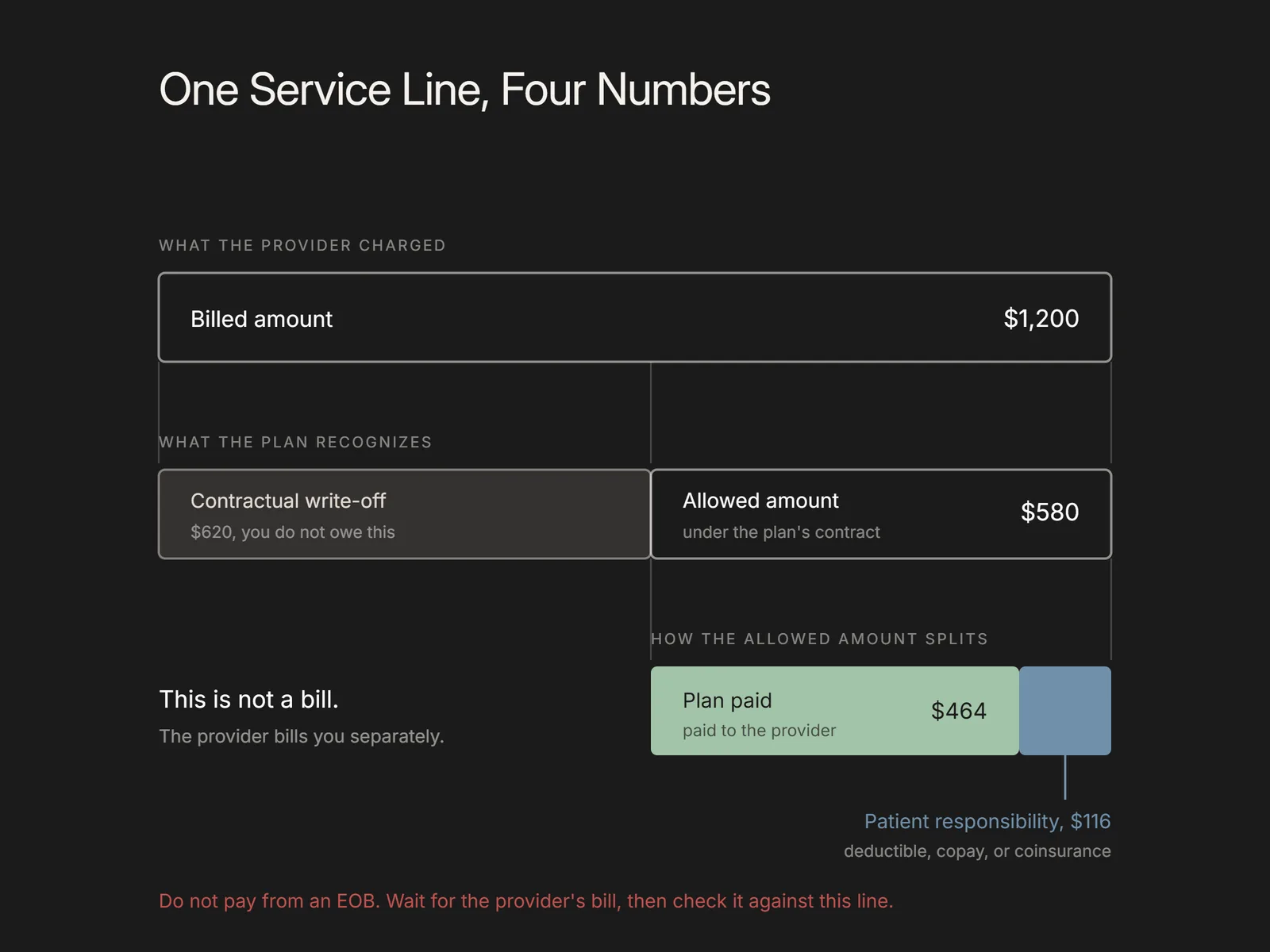
Read an EOB one line at a time, and reconcile four numbers per service: the billed amount, the allowed amount, the amount the plan paid, and the patient responsibility. Start by confirming the header details match your visit: the member name and ID, the provider, and the dates of service. The billed amount is what the provider charged, the allowed amount is what the plan recognizes under contract, and the difference is usually a contractual write-off you do not owe. What remains is split between the plan's payment and your share, which the plan attributes to a deductible, copay, or coinsurance. Then read the reason and remark codes, which explain any reduction or denial in shorthand the plan defines in a legend on the statement. If a service was denied, the code tells you why, whether it was a missing prior authorization, a coding issue, or a coverage exclusion.
What should you do if your EOB is wrong?
If an EOB looks wrong, do not pay against it. First, compare it with your own records and, once it arrives, the provider's bill; a mismatch between the EOB's patient responsibility and the billed balance is a clear flag. Next, call the plan's member services line with the claim number and ask specifically why a service was denied or reduced. Many disputes trace to fixable causes: an incorrect member ID, out-of-date coordination of benefits between two plans, or a code the provider needs to resubmit. If the denial is genuinely an error, the plan can reprocess the claim and the provider can resend it. If the plan upholds a denial you believe is wrong, you have the right to file a formal appeal. Given that patients appeal fewer than 1 percent of denials, reading the EOB and questioning a bad line is often the only check between an error and an unnecessary payment. When the issue is a prior-authorization denial, our guides to AI denials management and prior authorization automation cover how those cases get worked.
AI agents can shrink the number of EOB surprises by moving the work earlier and making the reconciliation automatic. Before a visit, they verify coverage and benefits so the patient responsibility is known up front rather than discovered on a statement. After a claim is adjudicated, they read payer responses, match the 835 remittance against the expected amount, and flag the denials and short-pays a person would otherwise miss. If eligibility checks, remittance posting, and denial follow-up are eating your team's time, book a call with Flexbone and we will run a quick audit of what AI can take off your eligibility and billing work.