
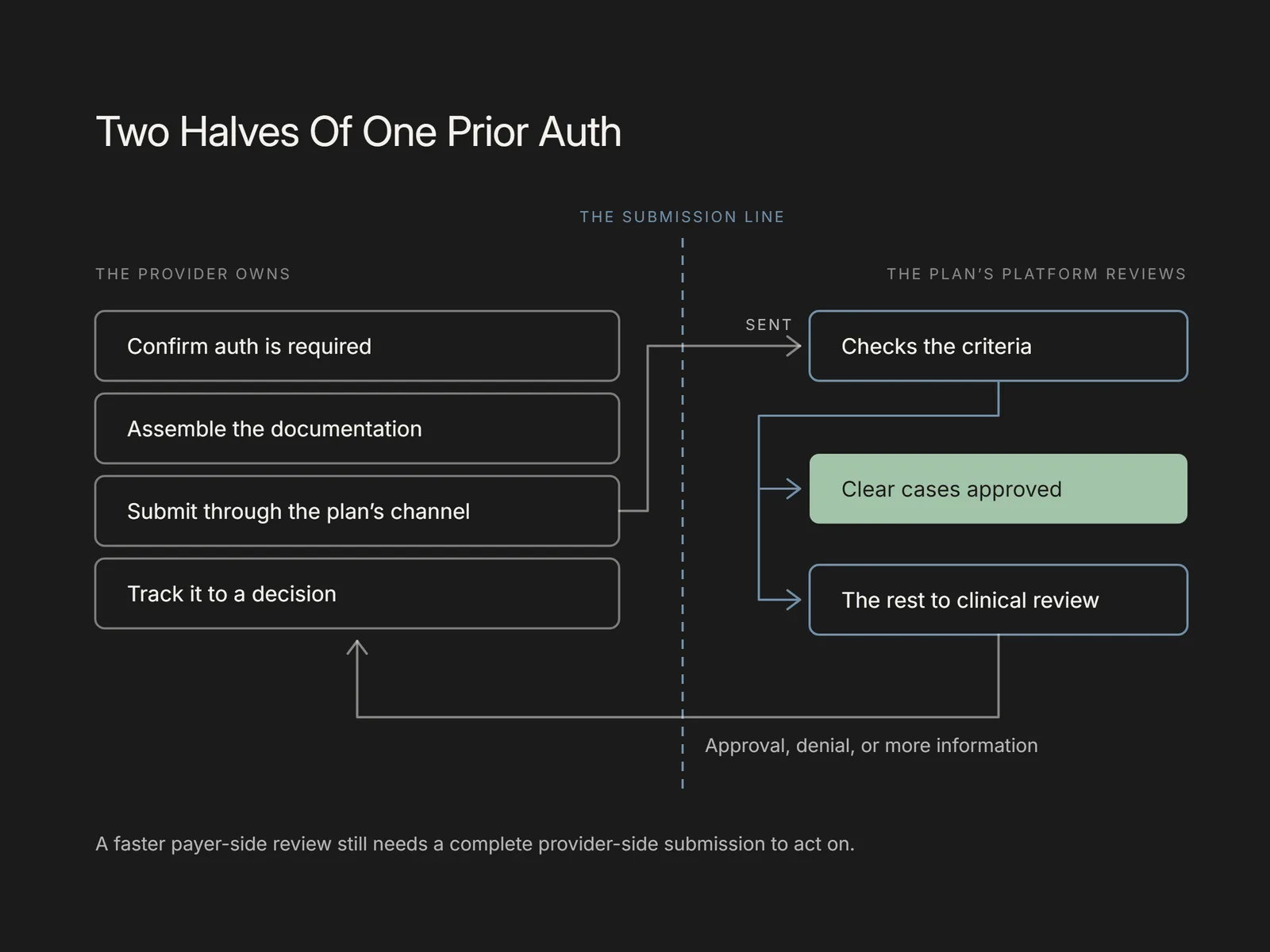
Cohere Health is a healthcare technology company that provides prior authorization and utilization management software to health plans. Its platform takes in authorization requests, applies clinical criteria, and returns determinations, with the stated aim of approving straightforward requests faster and routing the rest to clinical review. Because Cohere sells to payers rather than provider practices, a provider encounters it as the utilization management layer that certain plans use to review authorizations. This is an important distinction: Cohere sits on the payer side of the prior authorization transaction. The provider still owns the work of determining whether authorization is required, assembling the clinical documentation, submitting the request, and tracking it to a decision. Which utilization management vendor a plan uses changes how the review runs, not whether the provider has to prepare and file the request.
What does Cohere Health do?
Cohere Health builds and operates a prior authorization and utilization management platform that health plans use to review requests for services that require approval. In practice, an authorization request submitted for a plan that uses Cohere is evaluated by that platform: it checks the request against the plan's clinical criteria, can approve requests that clearly meet the rules, and escalates the rest for clinical review by a nurse or physician reviewer. The company positions this as intelligent prior authorization, meaning review is automated where criteria are clear and human where they are not. From the provider's chair, the effect is on the review side of the transaction. The determination that comes back, an approval, a denial, or a request for more information, is generated through Cohere's system on the plan's behalf.
Want this mapped against your own call and claim volume? Book a 30-minute audit
Does Cohere Health serve payers or providers?
Cohere Health primarily serves payers. Its direct customer is the health plan that licenses the platform to manage its authorization volume, not the individual practice or hospital submitting requests. Providers interact with it indirectly, as the utilization management gate that a given plan's authorizations route through. This matters when you are deciding who is responsible for what. The plan owns the review policy and the criteria, Cohere provides the technology that applies them, and the provider owns the submission. So a practice does not adopt Cohere the way it adopts an EHR such as Epic or athenahealth. Instead, it works with Cohere's review process for the payers that have contracted with the company, while handling every other payer through those payers' own channels. The mix of utilization management vendors a practice deals with is set by its payer contracts, not by any single vendor.
How does Cohere Health affect a provider's prior authorization?
For the plans that use it, Cohere Health is where the utilization management review happens, so it can affect how quickly a determination comes back and which criteria are applied to a request. What it does not change is the provider's own workload. The provider still has to confirm that a service requires authorization for that member's plan, gather the documentation and CPT or ICD-10 codes that support medical necessity, submit the request, and follow up until a decision is recorded. That is a recurring burden regardless of the review vendor, and it looks similar across Medicare, Medicaid, and commercial plans. The American Medical Association reports that physicians handle roughly 39 prior authorizations each week, at about 13 hours of staff and physician time. A more automated payer-side review may shorten the wait for an answer, but the steps that produce a complete request still fall on the practice. Reducing that burden is where prior authorization automation on the provider side does its work.
From the practice's side this changes where the work sits rather than how much of it there is. Someone still assembles the clinical documentation the platform asks for, submits it, and tracks what comes back. Flexbone treats that as the automatable half: a browser agent completes and follows up on the request in whichever portal the plan routes it to, and a voice agent holds the payer queue when a pending case needs a person on the phone. What gets handed to an agent is decided by classifying the actual requests, because the assembly step is predictable and the clinical call is not.
See what AI can run at your facility. In a 30-minute audit we map the calls, eligibility, and follow-ups Flexbone can take off your team first.
Book an auditWhat is intelligent prior authorization?
Intelligent prior authorization refers to using automation and structured clinical rules to review authorization requests faster and more consistently than fully manual review. On a payer-side platform, that typically means auto-approving requests whose documentation clearly meets the plan's criteria and directing the ambiguous ones to a human clinical reviewer, rather than sending everything to a person. The goal is to compress turnaround time on routine requests and concentrate reviewer attention on the cases that need judgment. It is worth being precise about what this does for a provider. It can speed the answer and make the criteria more transparent, but it operates on the request the provider submits. If the documentation is incomplete or the wrong information is attached, an intelligent review will still return a denial or a request for more information. The completeness of the submission remains the input that determines the outcome.
How can a provider work efficiently with a Cohere-managed authorization?
Working efficiently with any utilization management platform, Cohere included, comes down to submitting a complete, correct request the first time and tracking it to a decision. Start by verifying coverage and the authorization requirement for the specific service and plan before care, so you are not filing requests that are not needed or missing ones that are. Standardized eligibility checks help here: the CMS 270/271 eligibility transaction, part of the HIPAA X12 standard, confirms a member's benefits and requirements electronically. Next, assemble the documentation the plan's criteria call for and submit it through the plan's designated channel, whether a portal, fax, or phone line. Then track the reference number and follow up before the decision window closes. When a determination comes back as a denial, route it into a defined appeals process rather than letting it age. Our guides on insurance eligibility verification and AI denials management cover the front and back ends of that workflow.
Cohere on the payer side, Flexbone on the provider side
It helps to hold the two sides of prior authorization apart. Cohere Health operates on the payer and utilization management side: it is the technology a plan uses to review and decide on the requests it receives. Flexbone operates on the provider side: our AI voice and browser agents handle the work a practice still owns no matter which review vendor a plan uses, from determining whether a service requires authorization to assembling documentation, submitting the request, and tracking it to a decision. The two are complementary rather than competing, because a faster payer-side review still needs a complete provider-side submission to act on.
On the provider side of prior authorization, Flexbone's AI agents check eligibility and the authorization requirement, assemble the documentation a payer needs, submit the request through the payer's portal, fax, or phone line, and track each request to a decision inside your existing systems, with your team reviewing before anything goes out. If you want to see how much of that work AI can take off your plate, book a call with Flexbone and we will run a quick audit of your prior authorization workload.