CoverMyMeds is an electronic prior authorization (ePA) platform for prescription medications. It connects the parties involved in a drug prior authorization, the prescriber's office, the pharmacy, the health plan, and the pharmacy benefit manager, so a medication prior authorization can be started and completed electronically instead of by fax or phone. When a plan requires review before it covers a drug, the office starts a request in CoverMyMeds, the plan or benefit manager returns the specific clinical questions it needs answered, and a decision comes back through the same platform. It is widely used across prescribers and pharmacies and is generally free for providers. CoverMyMeds handles prior authorization on the pharmacy benefit, the drugs a patient picks up at a pharmacy, which is a different channel from the medical prior authorization a health plan runs through its provider portal.
What is CoverMyMeds used for?
CoverMyMeds is used to run prior authorization for prescription medications electronically, from the first request through the plan's decision. When a prescriber writes for a drug that the patient's plan requires review on, the office opens a request in CoverMyMeds, and the platform routes it to the correct plan or pharmacy benefit manager. The plan sends back a set of clinical questions specific to that drug and that patient, the office answers them and attaches supporting documentation, and the decision returns through the same channel, replacing the fax and phone loop a medication prior authorization used to require. Prior authorization is a heavy administrative load in its own right: the American Medical Association reports that physicians complete about 39 prior authorizations per physician per week, taking roughly 13 hours of practice time, per the AMA.
Want this mapped against your own call and claim volume? Book a 30-minute audit
How does CoverMyMeds work?
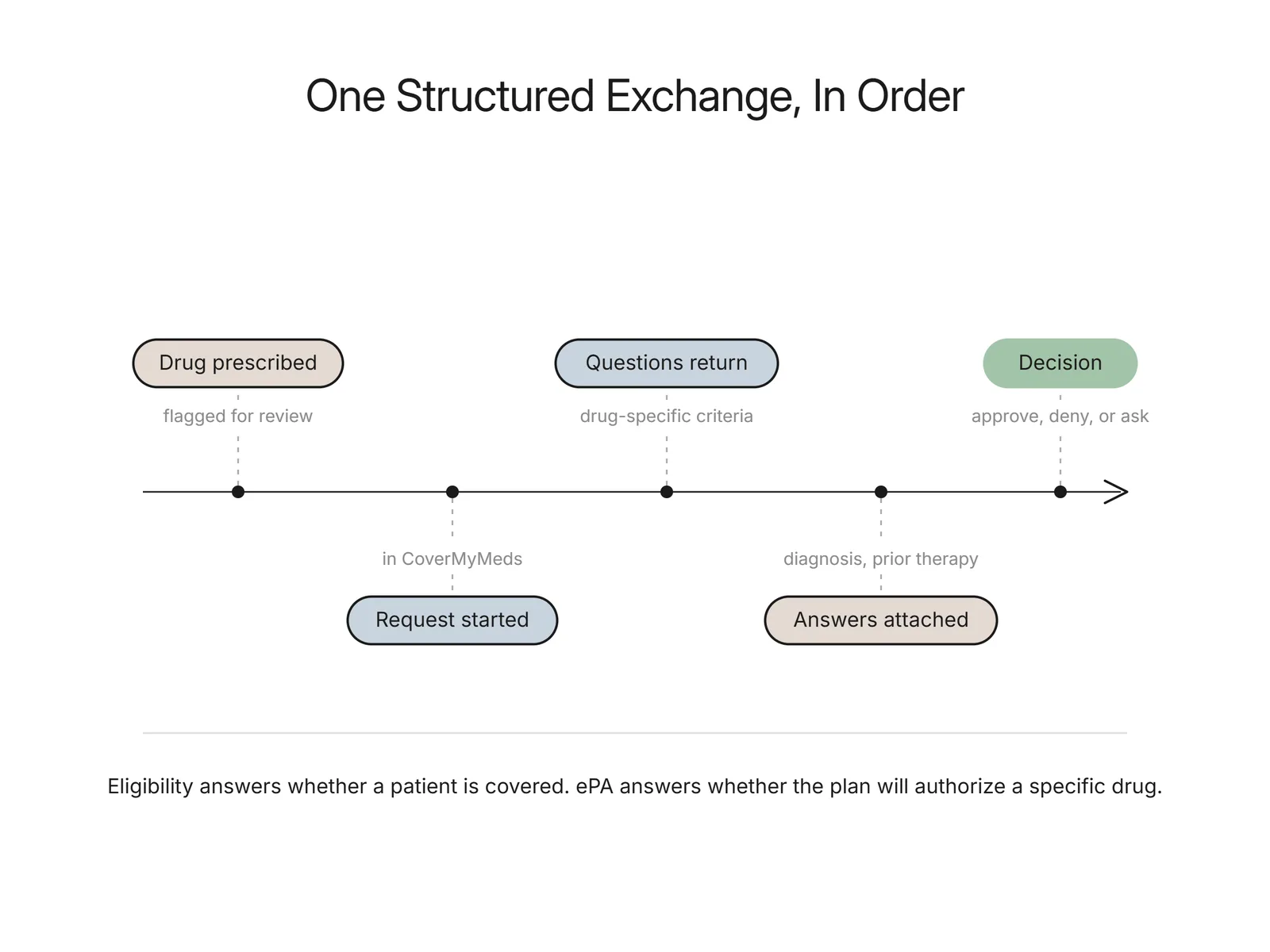
CoverMyMeds works by sitting in the middle of the medication prior authorization network and passing a structured request between the prescriber, the plan, and the pharmacy benefit manager. The workflow runs in a set order. A drug is prescribed, and either the office or the pharmacy identifies that the plan requires prior authorization for it. The office starts a request in CoverMyMeds, which identifies the patient's plan and the correct review path. The plan or benefit manager returns the specific clinical questions and criteria for that drug, the office completes them and attaches documentation such as the diagnosis and prior therapy, and the request is submitted. The reviewer checks it against the plan's criteria and returns an approval, a denial with a stated reason, or a request for more information. Because the exchange is structured, the office sees the plan's questions up front rather than discovering a missing field after a faxed form comes back. When a request is denied, the stated reason tells the office what a resubmission or appeal must address; working those systematically is the focus of our overview of AI denials management.
See what AI can run at your facility. In a 30-minute audit we map the calls, eligibility, and follow-ups Flexbone can take off your team first.
Book an auditIs CoverMyMeds free?
CoverMyMeds is generally free for prescribers and pharmacies to use for electronic prior authorization. The network is funded on the payer and pharmacy side rather than by charging the ordering office a fee per request, which is part of why it became widely adopted for medication prior authorization. An individual office should confirm the current terms that apply to its own account, but the standard ePA workflow, starting a request, answering the plan's questions, and receiving a decision, does not carry a per-request charge for the provider. The cost the platform is meant to reduce is staff time on requests that used to take multiple touches by fax and phone.
What is electronic prior authorization (ePA)?
Electronic prior authorization, or ePA, is the process of submitting and completing a medication prior authorization through a connected software network instead of by fax or phone. In an ePA workflow, the prescriber sends the request, the plan or pharmacy benefit manager returns the exact clinical questions it needs answered for that drug, and the decision comes back through the same channel, all as structured data rather than a scanned form. CoverMyMeds is one of the platforms that runs this workflow for pharmacy-benefit drugs. ePA is distinct from the eligibility check that happens earlier in the process. Confirming that a patient is covered uses the standard 270 and 271 eligibility transactions defined for Medicare, Medicaid, and commercial plans, as defined by CMS, and our guide to insurance eligibility verification covers how that check works. Eligibility answers whether a patient is covered; ePA answers whether the plan will authorize a specific drug.
How is CoverMyMeds different from a medical prior authorization?
CoverMyMeds handles prior authorization for drugs billed under the pharmacy benefit, the medications a patient picks up at a retail or specialty pharmacy. A medical prior authorization covers services and drugs billed under the medical benefit, such as advanced imaging, surgeries, durable medical equipment, and clinician-administered infusions given in a clinic or hospital. Those medical requests usually run through the health plan's provider portal, or through a benefit manager the plan uses, rather than through CoverMyMeds. A medical request is typically identified by a procedure or HCPCS code and an ICD-10 diagnosis under the rendering provider's NPI, while a pharmacy request in CoverMyMeds is keyed to the drug and the patient's pharmacy plan. The two paths use different channels, different criteria, and often different staff, which is why the same office can be working a pharmacy-benefit drug PA in CoverMyMeds and a medical PA in a payer portal at once. The broader mechanics of both paths are covered in our guide to prior authorization automation.
How does Flexbone help with medication and medical prior authorization?
Flexbone runs voice and browser agents that carry the repetitive parts of prior authorization on both benefits, working the same tools staff already use. On the pharmacy side, a browser agent can start and complete a medication prior authorization in an ePA platform such as CoverMyMeds: it opens the request, answers the plan's clinical questions from the chart, attaches the documentation, and writes the status back to the EHR. On the medical side, the agent submits and follows up on prior authorizations in the health plan's provider portal the way a person would, and a voice agent can hold on a payer's phone queue to check or expedite a pending request. Each call and submission is logged, so a person can review what the agent did. We do not decide medical necessity or override a plan's clinical criteria; the agent gathers and moves information, and clinical judgment stays with the practice. To map what AI can run across your medication and medical prior authorization, book a call with Flexbone.