
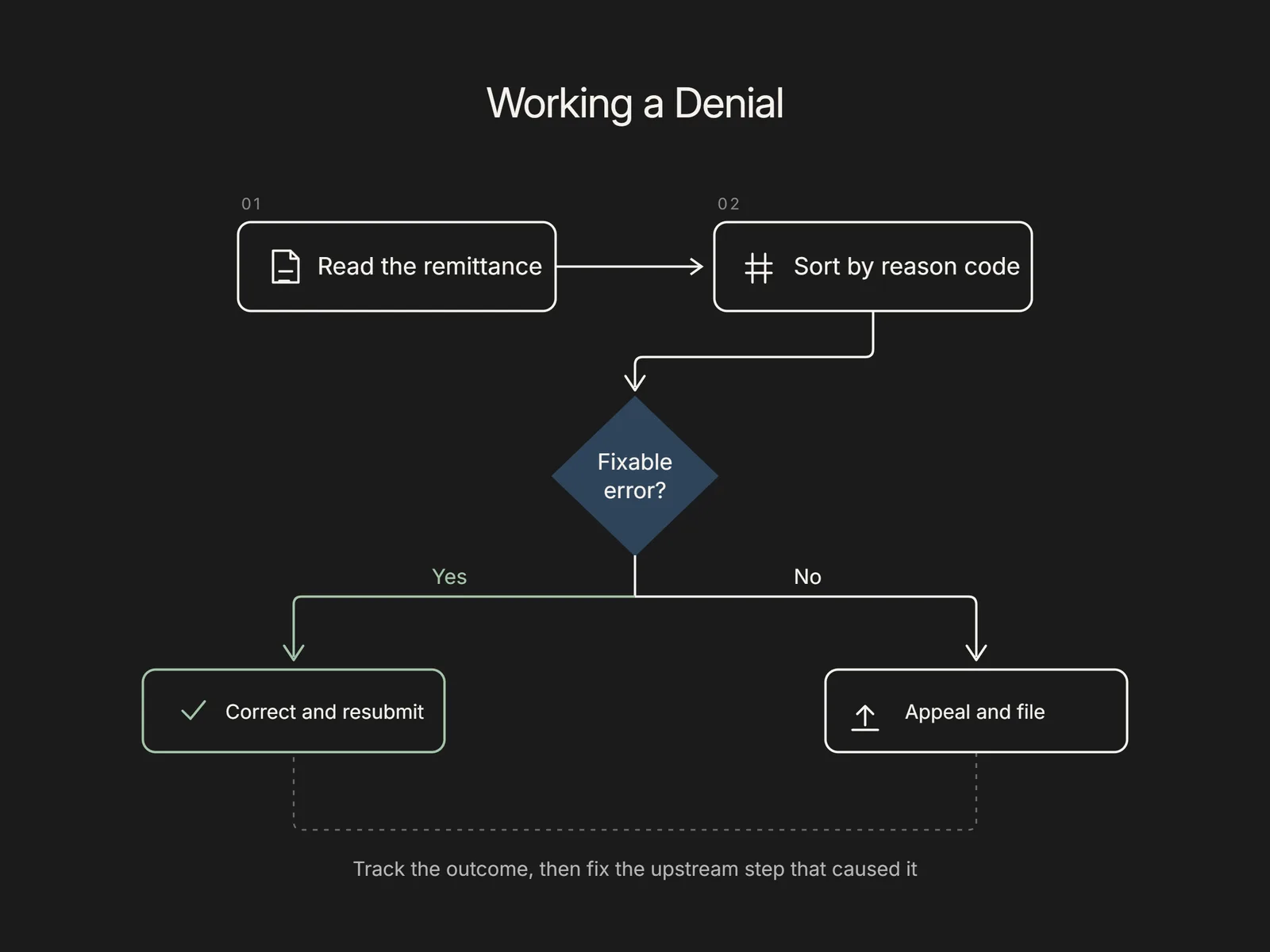
Denial management in medical billing is the process of identifying, categorizing, correcting, appealing, and preventing claims that a payer refuses to pay. It spans two connected halves: working the denials you already have, and preventing the ones you would otherwise get. On the working side, a team reads the denial from the payer remittance, sorts it by reason code, then either corrects and resubmits the claim or builds and files an appeal, and tracks the result. On the prevention side, the team traces each denial back to its upstream cause and fixes that step so the same denial stops recurring. The scale of the problem is real: insurers denied about 20 percent of in-network claims on HealthCare.gov plans in 2023, yet consumers appealed fewer than 1 percent of them, according to KFF.
What are the steps in the denial management process?
The denial management process runs in a consistent order:
- Identify. Pull the denial from the payer's remittance advice or 835 file as soon as it posts, so you stay inside filing and appeal windows.
- Categorize. Sort the denial by its CARC and RARC codes into a reason category, such as eligibility, authorization, coding, or timely filing.
- Correct or appeal. If the denial came from a fixable error, correct the claim. If the payer's decision itself is wrong, assemble an appeal with the supporting documentation and payer policy.
- Resubmit or file. Send the corrected claim or the appeal packet through the payer's portal or clearinghouse.
- Track. Follow the claim to resolution, place status-check calls when the payer goes quiet, and record the outcome by reason code.
- Prevent. Use the reason-code data to fix the upstream step that produced the denial, so the volume in that category falls.
The last step is what separates denial management from denial firefighting. Without it, the same eligibility and authorization denials return every month.
Want this mapped against your own call and claim volume? Book a 30-minute audit
What is the difference between a rejection and a denial?
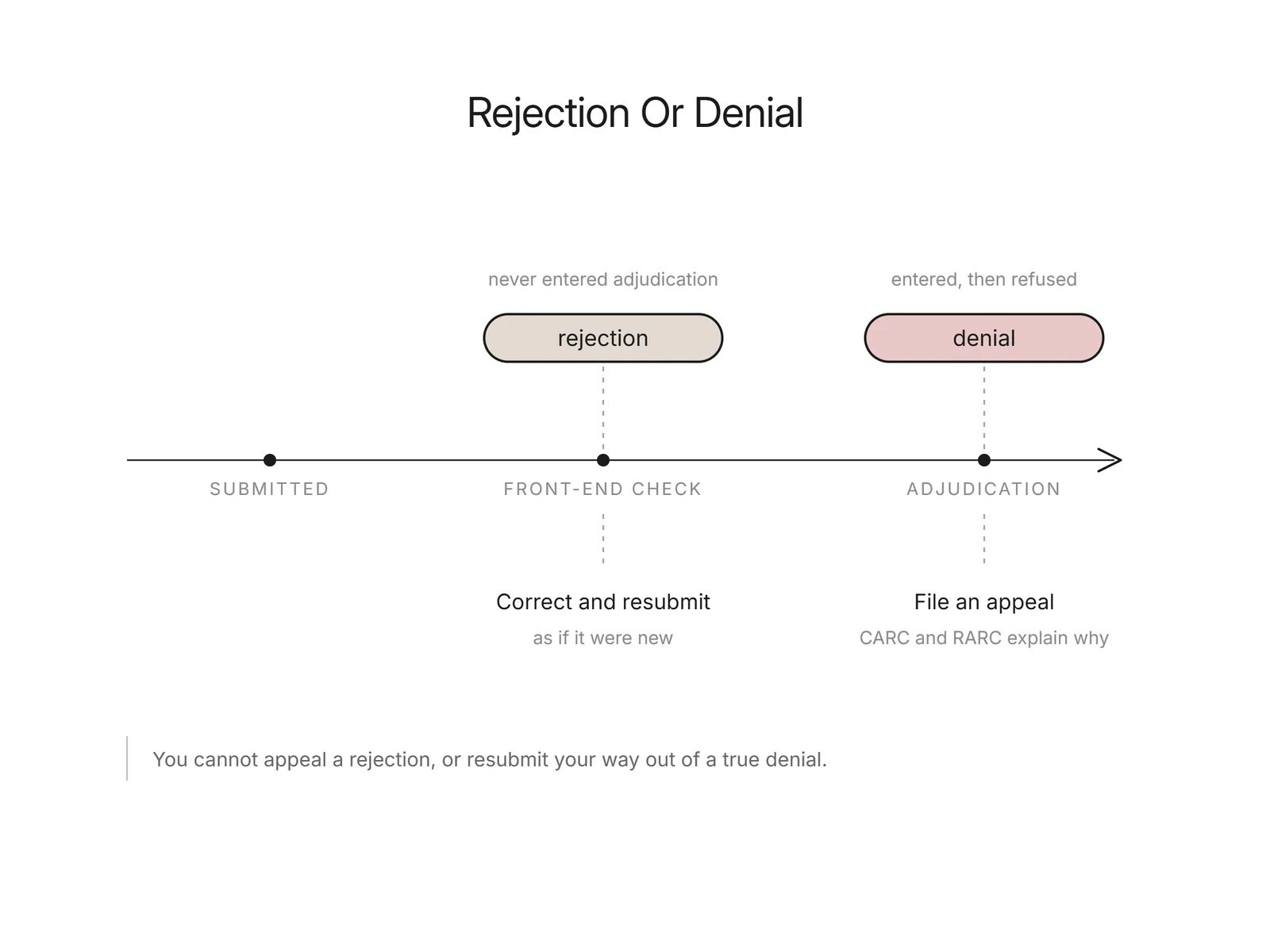
A rejection and a denial happen at different points and require different responses. A rejection is a claim the payer or clearinghouse never accepted into adjudication. It failed a front-end check, often a formatting error, a missing field, an invalid member ID, or an eligibility mismatch, and it bounced before the payer's system ever evaluated the service. Because a rejected claim was never on record, you correct the error and resubmit it as if it were new, with no appeal involved. A denial, by contrast, is a claim that did enter adjudication and was then refused. It comes back with CARC and RARC codes explaining the decision, and reversing it usually means filing an appeal rather than simply resubmitting. Confusing the two wastes time, because you cannot appeal a rejection or resubmit your way out of a true denial.
What are CARC and RARC codes?
CARC and RARC codes are the standardized language payers use to explain what happened to a claim. A CARC, or Claim Adjustment Reason Code, states the primary reason a payer adjusted or denied a line, for example that a service is not covered, that prior authorization was absent, or that the filing deadline passed. A RARC, or Remittance Advice Remark Code, adds supplemental detail that qualifies the CARC, such as pointing to the specific policy or documentation the payer expected. Both appear on the remittance advice, and reading them correctly is the hinge of the whole process: the code pair tells you which reason category the denial belongs to, and therefore whether the right action is a correction, an appeal, or a write-off.
See what AI can run at your facility. In a 30-minute audit we map the calls, eligibility, and follow-ups Flexbone can take off your team first.
Book an auditWhat are the most common claim denials?
Most denials cluster into a handful of categories, and each has a typical upstream cause:
- Eligibility and coverage. The patient was not active, the plan did not cover the service, or the coverage details were wrong at registration.
- Missing or invalid prior authorization. A service that required authorization was performed without one, or with one that did not match the claim.
- Coding. A diagnosis, procedure, or modifier was incorrect, unsupported, or inconsistent with payer policy.
- Timely filing. The claim arrived after the payer's submission deadline.
- Coordination of benefits. The payer order was wrong, or another plan should have been billed first.
Prior authorization deserves special attention because the burden feeding it is heavy: physicians reported completing about 39 prior authorizations each per week, spending roughly 13 hours on them, in an AMA survey. When that volume is handled under time pressure, authorization denials follow.
How do you prevent claim denials?
Prevention happens before the claim is ever filed, at the points where most denials originate. Verify eligibility and benefits at registration so coverage problems surface before the visit, not after the remittance. Confirm that any required prior authorization is on file and matches what will be billed. Code accurately against the specific payer's policy, and submit inside the timely filing window. None of this is new, but doing it consistently at volume is the hard part. The mechanism that makes prevention durable is measurement: when you track denials by reason code, the data shows which upstream step fails most, so you fix that step instead of appealing the symptom. In the engagements we run, the categories that dominate a denial log are usually the same few.
Where AI agents fit into denial management
Denial management is a mix of repetitive lookups and judgment work, and the two split cleanly. The repetitive half, checking claim status on payer portals, placing follow-up calls, reading remittances, and pulling codes into a worklist, is high-volume and rule-shaped, which is where automation helps. AI voice and browser agents can place the status-check calls, sit through payer hold queues, and categorize denials by CARC and RARC code without a person doing it by hand. The judgment half, deciding whether a denial is worth appealing, writing the medical-necessity argument, and confirming the clinical facts, stays with your billers and coders, and a person reviews every draft before it reaches the payer. This is the same division that applies to insurance eligibility verification, where agents run the checks and staff handle the exceptions. For the appeals side, our AI denials management page covers how document, browser, and voice agents assemble packets and file them, and our roundup of revenue cycle management companies puts the automation options in context.
If you want to see what AI can take off your denial management workload, book a call with Flexbone. We start by reviewing a sample of your denials, then map which of the repetitive steps, status checks, follow-up calls, and code categorization, agents can handle so your team spends its time on the appeals that recover the most revenue.