
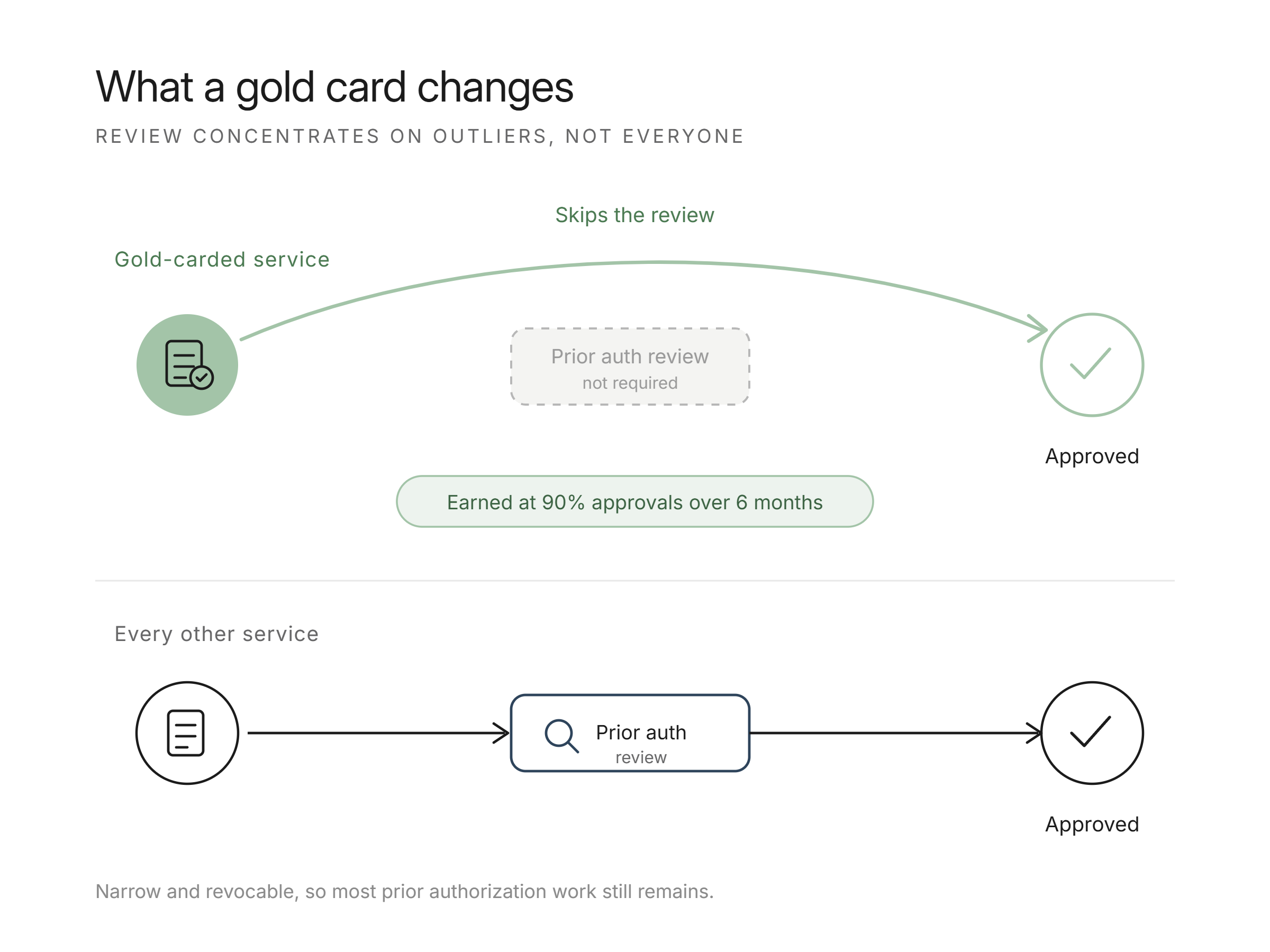
Gold carding prior authorization is a policy that exempts a physician from prior authorization on specific services once they have shown a consistent record of approvals. The idea behind a prior authorization gold card is simple: if a payer approves nearly everything a physician requests for a given service, the review step adds cost and delay without changing the outcome, so the physician earns a pass on that service. Texas passed the first gold-carding law in 2021, setting the threshold at a 90 percent approval rate over a six-month period, according to the AMA. Several states have since adopted their own gold-carding provisions. The exemption is narrow and service-specific, and payers can revoke it, so it reduces the authorization burden rather than removing it.
What does gold carding mean in prior authorization?
Gold carding means a payer waives prior authorization for a physician on defined services after that physician meets an approval-rate threshold over a lookback period. The name comes from the idea of a "gold card" that lets the holder skip a step others still complete. The AMA describes gold-carding programs as a way to restrict utilization-management review to "outlier" physicians whose ordering patterns differ from their peers, rather than applying the same review to everyone, as it explains in its reform coverage. In practice that inverts the default: instead of every request facing review, review concentrates on the small share of cases where prior authorization changes a decision. The card is tied to a specific physician and a specific set of services, so it does not transfer across a practice or across service lines.
Want this mapped against your own call and claim volume? Book a 30-minute audit
How do gold carding programs work?
A gold-carding program measures a physician's prior authorization approval rate on a service over a set window, then grants an exemption if the rate clears a threshold. The Texas model set that threshold at a 90 percent approval rate over a rolling six-month period, and the law took effect on September 1, 2021, per the AMA. Once a physician earns the card, they submit requests for that service without the usual review for a defined term, often at least a year. The payer continues to monitor performance and can re-evaluate at the end of the term or remove the exemption if approvals fall below the threshold. Because the mechanics, thresholds, and covered plans differ by state and payer, a physician can hold a gold card with one plan and still face full review with another for the same service.
Gold carding rewards an approval history, so the documentation quality on today's requests decides tomorrow's exemption. Flexbone assembles complete packets for every request, the part of the approval rate a practice controls, and tracks which services are exempt so staff stop filing what is no longer required. See prior authorization automation.
See what AI can run at your facility. In a 30-minute audit we map the calls, eligibility, and follow-ups Flexbone can take off your team first.
Book an auditWho qualifies for a prior authorization gold card?
Qualification depends on a physician's own approval history for a specific service, not on specialty or practice size alone. A physician qualifies when their approval rate on that service meets the program's threshold across the measurement window, so the physicians most likely to earn cards are those whose requests already align closely with payer criteria. The exemption is granted per physician and per service, which means a clinician can hold a card for one procedure and still submit full requests for another. State laws also define which plans are in scope. Texas gold-carding provisions apply to state-regulated commercial plans rather than federal programs, according to the AMA, so eligibility turns on both the physician's record and the plan type.
Which states have gold carding laws?
Texas enacted the first gold-carding law in the United States, and it went into effect on September 1, 2021, the AMA reports. Since then, prior authorization reform has moved through many state legislatures, with gold carding as one recurring feature. The AMA has tracked bills introduced across dozens of states and a set of states that passed reforms in a single year, in its legislative coverage. Programs differ in the threshold they set, the lookback period, and which plans they govern, and some cover services while excluding medications. Because the details vary and the landscape keeps changing, confirm the current statute in your state and read how each payer contract implements it before assuming an exemption applies.
Why does gold carding matter for practices?
Gold carding matters because prior authorization is a heavy administrative load and a source of care delays, and the policy targets the cases where review adds the least value. Denials remain common and are rarely contested: insurers denied about 19 percent of in-network claims on the ACA marketplace in 2024, yet consumers appealed fewer than 1 percent of denials, per KFF. Gold carding sits upstream of that problem by removing the review step for physicians whose requests are approved at consistently high rates, which frees staff time and shortens time to treatment for those services. The limit is that the exemption is narrow. It covers only qualifying physicians and services, and only while approval rates stay high, so most of a practice's prior authorization work continues even after some services are gold carded.
How Flexbone helps with the prior authorization burden
Gold carding relieves part of the prior authorization burden, but it leaves the rest in place: new services, new payers, and physicians who have not yet earned a card all still require full submissions and follow-up. Flexbone automates the prior authorization work that remains, from submitting requests to checking status, so staff spend less time on hold and on payer portals. We start audit-first, mapping your current authorization volume, approval rates, and where time is lost before we automate anything, which also surfaces the services where a gold card may already be within reach. Our platform is HIPAA compliant and our controls are aligned to SOC 2. We do not replace clinical judgment or a payer's medical-necessity decision; we handle the repetitive submission and status work around it. You can read more on our prior authorization automation page and in our guide on how to automate prior authorization.
Want to reduce the authorization work that gold carding does not cover? book a demo.