Optum is a large health-services business and one of the two main segments of UnitedHealth Group. It spans several areas: OptumRx handles pharmacy benefits as a pharmacy benefit manager, OptumHealth focuses on care delivery, and OptumInsight provides health data, technology, and revenue cycle services, which include the former Change Healthcare clearinghouse and revenue cycle technology. Providers encounter Optum in more than one way. Most often they meet it as a technology and services vendor through OptumInsight, and, through OptumRx, as the pharmacy benefit manager that administers prescription drug benefits. Understanding how Optum is organized helps explain where it sits relative to UnitedHealthcare, the insurance side of the same parent company, and where it touches claims, eligibility, and the administrative transactions a practice runs every day.
What does Optum do?
Optum operates across three broad parts of the health system: pharmacy, care delivery, and data and technology. On the pharmacy side, it manages prescription drug benefits. On the care-delivery side, it runs physician groups and outpatient care. On the data and technology side, it provides analytics, software, and revenue cycle services that health plans, providers, and government programs use to run administrative work. This is a different role from insuring patients. Optum sells services and technology and, in some cases, delivers care directly, rather than acting as the health plan that collects premiums and pays claims. For a provider, that means Optum shows up as a vendor or a partner in the background of billing, pharmacy, and data workflows more often than as the insurer named on a patient's card.
Want this mapped against your own call and claim volume? Book a 30-minute audit
What are OptumRx, OptumHealth, and OptumInsight?
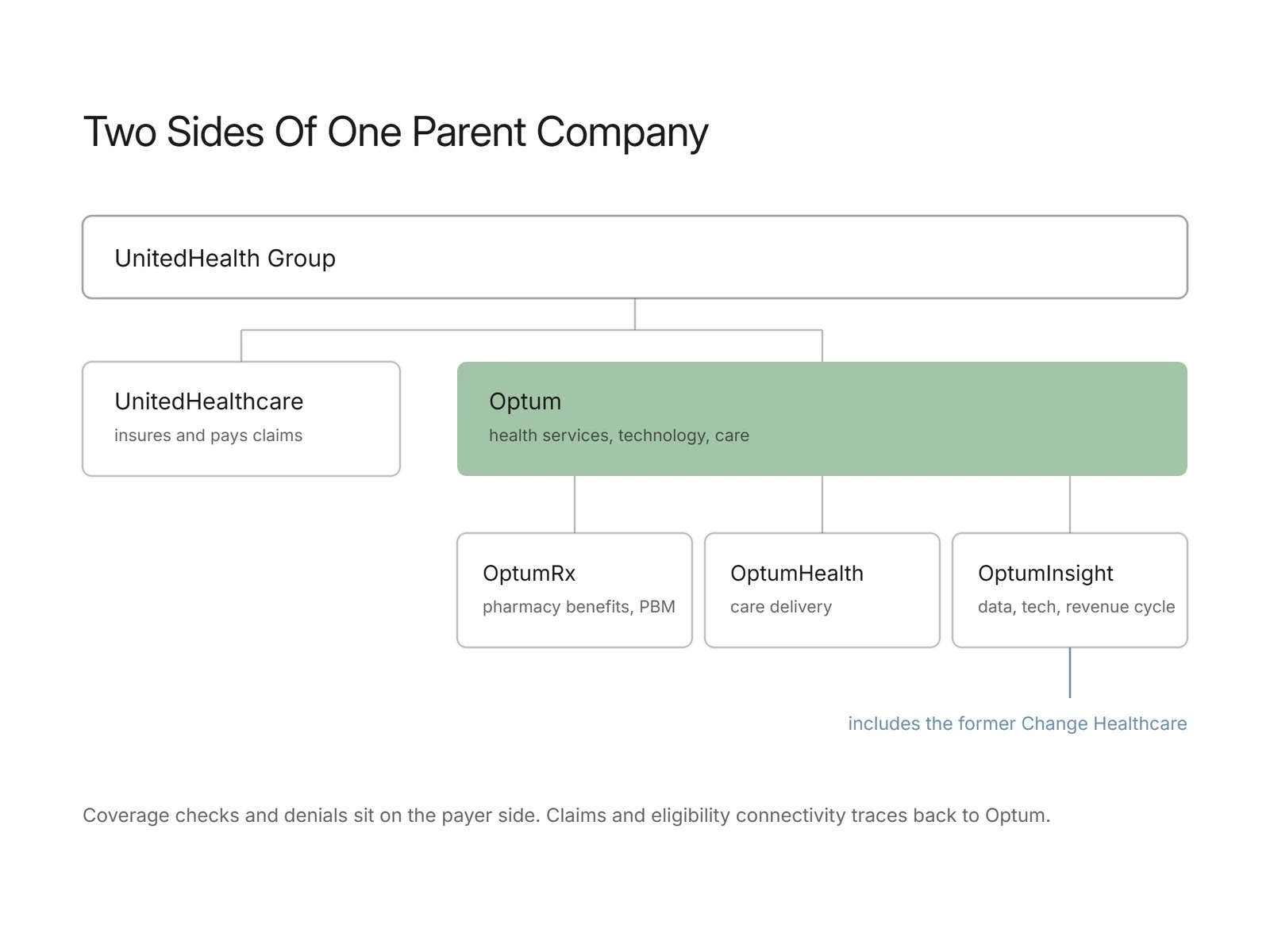
Optum is organized into three business segments, each with a distinct focus. OptumRx is a pharmacy benefit manager (PBM). It administers prescription drug benefits, which can include managing formularies, processing pharmacy claims, and running mail-order and specialty pharmacy services. OptumHealth is the care-delivery segment. It includes physician groups, outpatient and ambulatory care, and related services that treat patients directly rather than only paying for their care. OptumInsight is the data, technology, and services segment. It provides analytics, software, and revenue cycle services to providers, health plans, and government agencies, and it includes the former Change Healthcare business. Keeping the three straight matters because a provider's relationship with Optum depends entirely on which segment is involved: a pharmacy question routes to OptumRx, a claims-connectivity question to OptumInsight, and a care arrangement to OptumHealth.
How does Optum relate to UnitedHealthcare?
Optum and UnitedHealthcare are the two main businesses under the same parent, UnitedHealth Group, and they play different roles. UnitedHealthcare is the insurance side. It offers health plans, enrolls members, and pays claims as a payer. Optum is the health-services side. It provides pharmacy benefits, care delivery, and data and technology services. The simplest way to hold the distinction is that UnitedHealthcare insures, while Optum delivers services and technology. For a provider, this affects who you are actually dealing with in a given interaction. When you check a patient's coverage or appeal a denial for a UnitedHealthcare plan, you are working with the payer side. When you route a claim through connectivity that traces back to the former Change Healthcare, or coordinate a pharmacy benefit, you are working with Optum. Both sit under one corporate roof, but the function is not the same.
For a provider, the practical consequence is that claims and authorizations pass through a layer the practice does not control. The work left on the practice side is checking status, re-keying what a portal returns, and following up on what stalled. Flexbone automates that side, with browser agents on the portals staff already use and results written back to the EHR. See prior authorization automation.
See what AI can run at your facility. In a 30-minute audit we map the calls, eligibility, and follow-ups Flexbone can take off your team first.
Book an auditWhat is Optum's role in revenue cycle and clearinghouse services?
Within OptumInsight, Optum provides revenue cycle technology and services, and it operates clearinghouse connectivity through the former Change Healthcare business. A clearinghouse is an intermediary that scrubs and routes claims and other administrative transactions between providers and payers, translating them into the standard formats payers require. That connectivity carries transactions such as claims and eligibility inquiries. Eligibility uses the standardized 270/271 pair, the electronic inquiry a provider sends to ask whether a patient is covered and the response the plan returns, which HHS adopted under HIPAA Administrative Simplification, per CMS. Because Change Healthcare's clearinghouse and revenue cycle tools are widely used, many practices touch Optum through this layer without necessarily labeling it as Optum. The role here is infrastructure and services: moving, translating, and reporting on transactions, and supporting the revenue cycle around them, rather than deciding coverage.
How do providers work with Optum?
Providers work with Optum through whichever segment fits the task, and often through more than one at once. A billing team may submit claims and check claim status using OptumInsight technology, including the former Change Healthcare clearinghouse. A pharmacy team may coordinate drug benefits with OptumRx as the pharmacy benefit manager. An operations or finance team may use OptumInsight analytics or revenue cycle services. Some provider organizations also have care-delivery relationships that involve OptumHealth. In practice, this means a single organization can hold vendor, service, and PBM relationships with Optum simultaneously, each governed by its own contracts and support channels. The practical takeaway for a revenue cycle team is to know which Optum segment owns a given workflow, because that determines where you go for connectivity, for pharmacy, or for the underlying data and reporting.
How Flexbone works alongside the clearinghouse and payer layer
Flexbone deploys AI voice and browser agents that work alongside the clearinghouse and payer-portal layer, including Optum and Change Healthcare connectivity, by handling the tasks that sit around it. The clearinghouse routes electronic transactions well, but a share of work still lands on staff: payer phone calls, portal lookups, and denial follow-up that no 270/271 or 276/277 transaction fully resolves. For insurance eligibility verification, the agents run electronic checks where a data path exists and fall back to a payer portal or a phone call when it does not, then write structured results back into the systems the billing team already uses. The same approach covers claim status and prior authorization follow-up, which reduces the manual reconciliation behind AI denials management, and it covers the healthcare calls that still have to happen by phone. The work is audit-first: every action an agent takes is logged, so a person can review what was checked, where, and what came back. The agents collect and record what Optum's systems return; they do not make coverage determinations.
AI agents can sit beside your existing clearinghouse and payer connectivity, whether that runs through Optum, Change Healthcare, or another vendor, and take on the payer calls, portal tasks, and denial follow-up that surround it. If you want to see what that could remove from your team's day, book a call with Flexbone to run a quick audit of what AI can take off your revenue cycle.