Patient access in healthcare is the set of front-end functions that prepare a patient and their coverage before care is delivered. Patient access services cover appointment scheduling, patient registration, insurance eligibility verification, prior authorization, and financial clearance, which includes cost estimates and point-of-service collections. The patient access department sits at the front of the revenue cycle, so the data it captures (demographics, insurance, authorization) determines whether a claim is paid or denied later. HFMA groups these activities under its Patient Access MAP Keys, a standard set of revenue cycle benchmarks. This guide explains what patient access covers, where it fits in the revenue cycle, how it is measured, and where AI agents can take repetitive work off the team.
What is patient access in healthcare?
Patient access in healthcare refers to the pre-service and point-of-service steps that establish who the patient is, what their insurance plan covers, and what they owe before care happens. It is the first stage of the revenue cycle, and it is where the account is set up correctly or not. When a phone number is mistyped, a plan is unverified, or an authorization is missed, the error usually surfaces later as a denied claim or an unexpected patient bill. Because of that, patient access is treated less as a clerical step and more as a financial control point. The registration and verification data captured here flows into billing, so front-end accuracy is one of the strongest predictors of a clean claim.
Want this mapped against your own call and claim volume? Book a 30-minute audit
What do patient access services include?
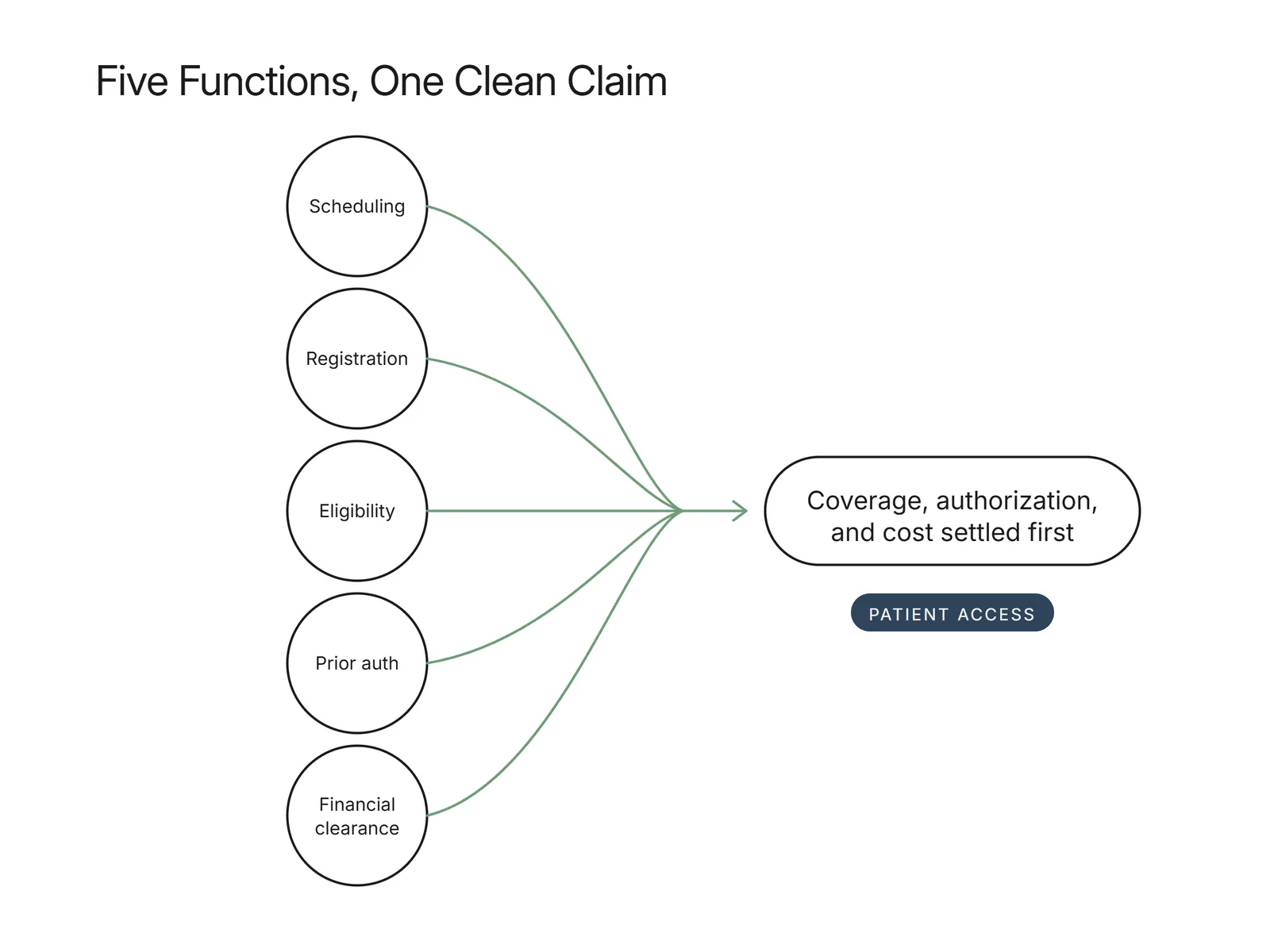
Patient access services group into five recurring functions. Scheduling books the visit and matches it to the right provider, location, and visit type. Registration captures and confirms demographics, guarantor, and insurance details, either before arrival (pre-registration) or at check-in. Eligibility verification confirms the plan is active and returns benefit details such as copay, deductible, and coverage for the scheduled service. Prior authorization obtains payer approval for services that require it before they are delivered. Financial clearance ties these together with cost estimates and point-of-service collection of the patient's expected responsibility. HFMA's MAP Keys formalize several of these as measurable steps, including pre-registration, insurance verification, and service authorization, which is why many teams organize their front end around them.
Where does the patient access department sit in the revenue cycle?
The patient access department is the front end of the revenue cycle, positioned before charge capture, coding, and claim submission. A useful way to see it is as three stages: front end (patient access), middle (clinical documentation and coding), and back end (billing, payment, and denial management). Everything downstream depends on the account the front end builds. If eligibility is wrong or an authorization is missing, the claim can be denied after the service is already delivered, when it is more expensive to fix. This is why organizations invest in front-end accuracy: catching a coverage or authorization problem at scheduling is far cheaper than appealing a denial weeks later. Patient access is the point where most preventable denials are either avoided or created.
See what AI can run at your facility. In a 30-minute audit we map the calls, eligibility, and follow-ups Flexbone can take off your team first.
Book an auditWhat KPIs measure patient access performance?
Patient access is measured with front-end key performance indicators, and HFMA's MAP Keys are the widely referenced standard. The patient access group includes pre-registration rate (accounts with demographic and insurance data completed before service), insurance verification rate (encounters verified prior to or at service), service authorization rate (encounters with required payer approval obtained), and point-of-service collections (patient cash collected before, at, or shortly after service). Teams also watch registration error rate and the share of denials traced to front-end causes such as eligibility or authorization. Read together, these metrics link the quality of front-end work to downstream cash and denial rates, which is what makes patient access a financial function rather than a purely administrative one.
Why is prior authorization such a large part of patient access?
Prior authorization has become one of the heaviest workloads inside patient access because payers require approval for a growing list of services and the process is largely manual. In MGMA's 2025 prior authorization survey, 92 percent of surveyed medical group practices reported hiring or reassigning staff solely to handle the growing volume of prior authorization requests, and prior authorization remained the top administrative burden reported by those practices. Regulation is shifting some of this to electronic exchange: the CMS Interoperability and Prior Authorization Final Rule (CMS-0057-F) requires impacted payers to build a Prior Authorization API and add prior authorization data to the Patient Access API, with compliance dates generally beginning January 1, 2027. Until those APIs are broadly live, most authorization work still runs through portals, faxes, and phone calls that patient access teams manage by hand.
How does Flexbone help patient access?
Flexbone builds AI voice and workflow agents that run the repetitive patient access tasks and write the results back into the EHR. An AI patient coordinator can handle inbound and outbound scheduling calls, collect and confirm registration details, run insurance eligibility verification through EDI and payer portals, and submit or check the status of prior authorizations. Each action posts to the patient record as structured data, not a screenshot a biller has to interpret. The approach is audit-first: each call and transaction is logged so staff can review what the agent did and why. Deployments are HIPAA compliant and SOC 2 aligned, and a person stays in the loop for exceptions and anything ambiguous. The aim is to remove routine work from the front desk, not to remove the judgment that patient access still requires.
Where should you start?
A practical starting point is to measure your current front end against the patient access MAP Keys, find the step with the most denials or manual hours (often eligibility or prior authorization), and automate that one function before expanding. If you want to see how AI agents run scheduling, registration, eligibility, and prior authorization against a live EHR, book a demo.