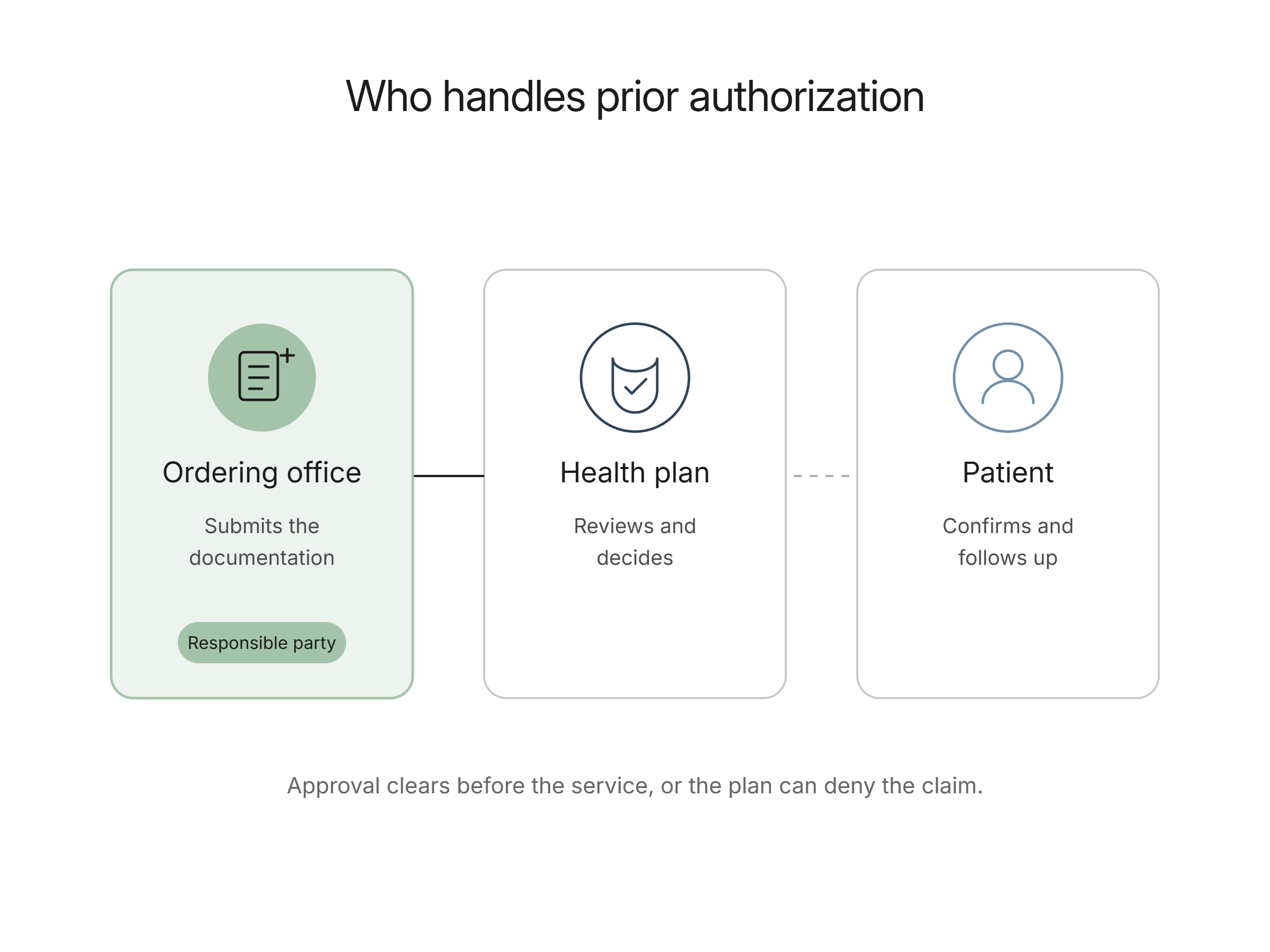
Prior authorization means a health plan requires approval before it will cover a specific service, procedure, or drug, and the ordering provider's office is usually responsible for getting it, not the patient. The practice submits clinical documentation to the payer, and the payer decides whether the service meets its coverage and medical-necessity rules before the care is delivered. Under Medicare's process, the provider or supplier submits the request and receives the decision before the service is rendered, per CMS. Patients can confirm their own plan requirements, but the paperwork sits with the practice. If the approval is missing, the plan can deny payment even when the care is appropriate, which is why understanding what prior authorization means matters for both the office and the patient.
What does prior authorization mean?
Prior authorization (sometimes called pre-authorization, precertification, or prior approval) is a payer requirement that a service be approved before it is covered. The plan uses it to check that a requested item or service complies with its coverage, coding, and payment rules before the service is furnished, rather than after the claim arrives. CMS describes the mechanism plainly: the provider or supplier submits the request with supporting documentation and gets an affirmed or non-affirmed decision before rendering the service, according to CMS. It does not create new coverage; it moves the same medical-necessity review earlier in the process. The practical effect is a gate: no approval, and the payer can decline to pay.
Want this mapped against your own call and claim volume? Book a 30-minute audit
Who is responsible for getting prior authorization, the provider or the patient?
The ordering provider's office is responsible for initiating and submitting prior authorization in most cases, because the request depends on clinical documentation only the practice holds. In Medicare's process, the provider or supplier submits the request and receives the decision before the service is rendered, per CMS. A referring physician, a specialist, a hospital, a pharmacy, or a durable medical equipment supplier can each be the party that files, depending on who orders the service. The patient's role is smaller but useful: confirming that their plan requires authorization, checking their benefits, and following up on status. When a patient is surprised by a denial, the gap is usually a submission or documentation step inside the practice, not something the patient failed to do.
Because the ordering provider carries the obligation, the work falls on the practice's staff, and most of it is administrative: checking the requirement, filing, and following up. Flexbone automates those administrative steps and leaves the clinical justification with the clinician. See prior authorization automation.
What services usually require prior authorization?
Prior authorization is concentrated on higher-cost services rather than routine care. In Medicare Advantage, prior authorization is most common for inpatient hospital stays, skilled nursing facility stays, and expensive drugs such as chemotherapy, while preventive services rarely require it, and virtually all (99 percent) of enrollees are in plans that require it for some services, according to KFF. Commercial plans follow a similar pattern: advanced imaging (MRI, CT, PET), specialty and infused drugs, elective surgeries, some outpatient procedures, and durable medical equipment are common triggers. Because requirements vary by payer and plan, the same CPT code can need authorization under one contract and not another, so the requirement is checked against the patient's specific plan, not assumed from the service alone.
See what AI can run at your facility. In a 30-minute audit we map the calls, eligibility, and follow-ups Flexbone can take off your team first.
Book an auditWhat happens if prior authorization is not obtained?
If a service that required prior authorization is performed without it, the plan can deny the claim and refuse payment. That leaves the practice unpaid or, depending on the contract and state rules, the patient holding a bill for care they expected to be covered. Some payers offer a retroactive review or an expedited pathway for urgent and emergency situations, but a retroactive approval is not guaranteed and the appeal takes time. The volume of these decisions is large: Medicare Advantage insurers processed nearly 53 million prior authorization determinations in 2024, per KFF, so a single missed step scales into real revenue risk across a practice. This is the reason offices verify requirements and secure approval before scheduling, and it is closely tied to how long prior authorization takes.
How do you check whether a service needs prior authorization?
To check whether a service needs prior authorization, confirm the patient's active plan, then match the specific procedure or drug code against that plan's authorization list. Most payers publish a prior authorization requirement lookup or code list on their provider portal, and many can also be reached by phone for a coverage determination. The reliable inputs are the member ID, the plan type, the CPT or HCPCS code, and the place of service, since the answer can change with any of them. Because the same service can require authorization under one plan and not another, checking against the actual plan, rather than a general rule, is what prevents a surprise denial. Practices that automate this step run the code-level check on every order instead of relying on staff memory of payer rules.
How Flexbone handles prior authorization
Flexbone automates the operational work around prior authorization while keeping a person in control of clinical decisions. We are audit-first: we start by reviewing a sample of your recent authorizations to find where requests stall or slip before we automate anything. Our AI voice agents and browser agents then determine whether a given code requires authorization for the patient's plan, submit the request with the documentation from your system, place the follow-up calls to check status, and write the decision back into the EHR so the record stays current. The agents work inside your existing systems and on payer portals, the workflow is HIPAA compliant and SOC 2 aligned, and anything outside a clear rule (a documentation gap, an ambiguous payer response, a peer-to-peer request) is escalated to your team rather than guessed. You can see how the pieces fit together on our prior authorization automation page.
Does prior authorization guarantee the service will be covered?
An approved prior authorization is not a guarantee of payment. It confirms the payer agreed the service was medically necessary at the time of review, but coverage still depends on the member's eligibility on the date of service, their remaining benefits, and a correctly coded claim. Authorizations also carry expiration windows, so an approval obtained too early can lapse before the procedure happens. The high rate at which denials are reversed on appeal (more than 80 percent of appealed Medicare Advantage denials were overturned in 2024, according to KFF) shows that the initial decision is a checkpoint, not a final coverage verdict. Treat an approval as one required condition among several, and confirm eligibility and benefits alongside it.
Want to see code-level authorization checks and status follow-up run against your own payers? book a demo.