
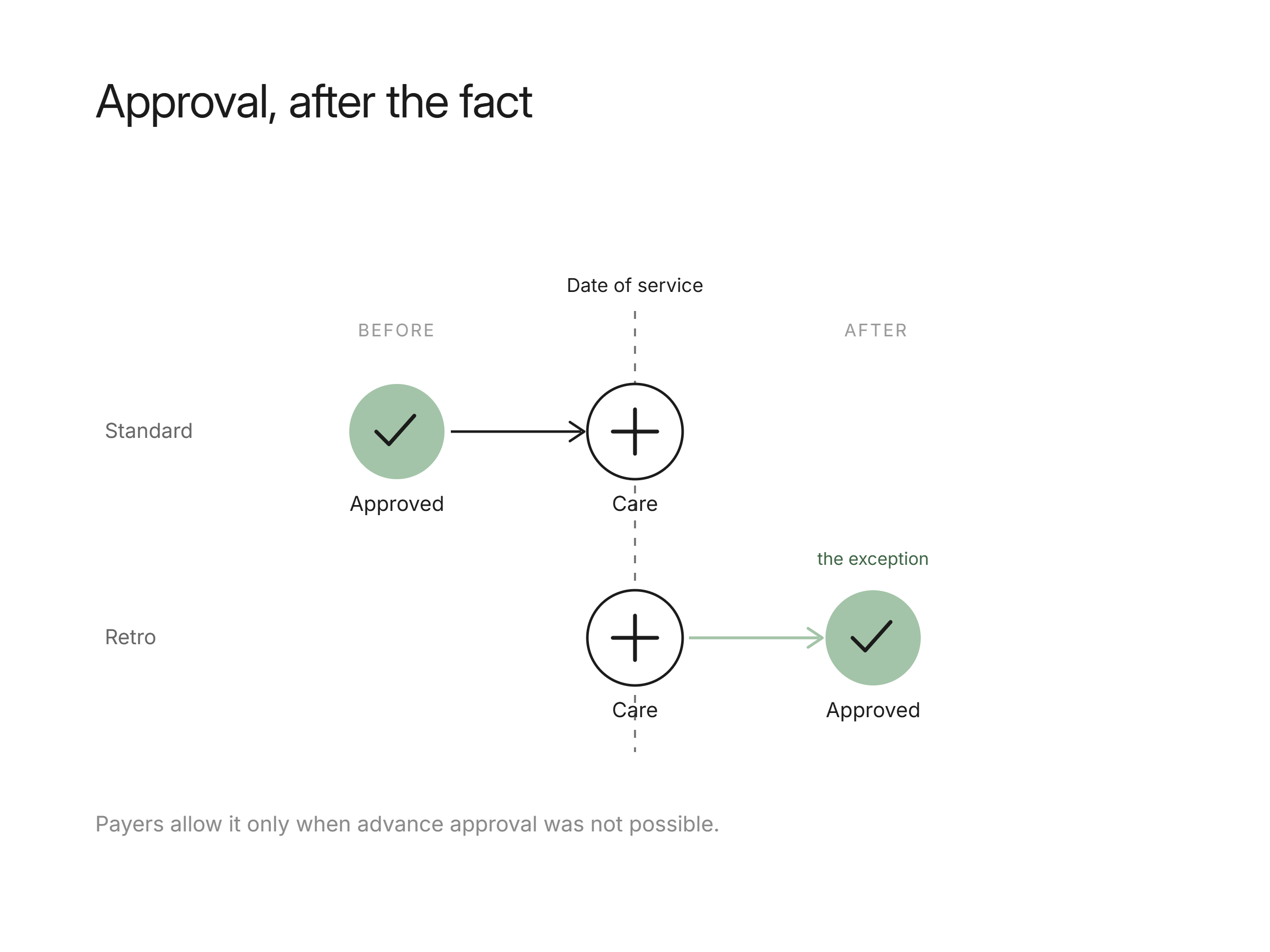
Retro authorization, also called retrospective authorization or retroactive prior authorization, is approval a payer grants after a service has already been delivered. Standard prior authorization happens before care. Retro authorization is the exception a payer allows when getting approval in advance was not possible, most often after emergency treatment or when a patient's coverage is discovered late. The provider submits the clinical records and a reason the request is late, and the payer decides whether to authorize the claim retroactively. Not every payer offers it, and those that do set tight submission windows, commonly a few business days to a few weeks from the date of service. Because a retro authorization is discretionary, approval is never guaranteed, so it works best as a backstop rather than a routine substitute for prospective review.
What is retro authorization in medical billing?
Retro authorization is a request for payer approval submitted after the service date, rather than before it. In routine billing, prior authorization confirms that a payer considers a procedure medically necessary and agrees to cover it before the patient receives care. A retrospective authorization reverses that sequence: the care has happened, and the provider asks the payer to review the documentation and authorize the claim after the fact. Payers treat it as an exception, not a standard path, because it removes their chance to review medical necessity in advance. You will also see it called retroactive prior authorization or a retro auth. The mechanics resemble a standard request, but the added burden of explaining why the request is late falls on the provider.
Want this mapped against your own call and claim volume? Book a 30-minute audit
When does retro authorization apply?
Retro authorization applies in a narrow set of situations where prospective approval was not feasible. The clearest is emergency or urgent care: when a patient arrives in cardiac arrest or acute trauma, stabilizing them takes priority over calling the insurer, so payers generally accept an authorization request after the patient is stable. A second common case is retroactive eligibility, where a patient's coverage is established or discovered after the service. Medicaid is the frequent example, since federal policy lets states cover services up to three months before the month of application when the person would have been eligible at the time, per the Medicaid eligibility policy. Other triggers include a plan change the provider did not know about, or a coordination-of-benefits situation where the correct primary payer surfaces late. In each case, the common thread is that approval in advance was genuinely not an option.
The cheaper fix is not needing one: a retro request usually traces back to a requirement nobody checked at scheduling. Flexbone runs that check as an agent task when the visit is booked, which is where the cases that end in a retro request begin. See prior authorization automation.
See what AI can run at your facility. In a 30-minute audit we map the calls, eligibility, and follow-ups Flexbone can take off your team first.
Book an auditHow do you request a retroactive prior authorization?
Start by confirming the payer accepts retro requests and reading its specific policy, because the rules and forms differ by plan. Gather the clinical documentation that supports medical necessity: the history, the treatment provided, and the reason authorization could not be obtained beforehand. Submit the request through the payer's usual authorization channel, which may be a portal, fax, or phone line, and attach a clear explanation of the delay, such as the emergency nature of the visit or the date coverage was confirmed. Track the reference number and the decision deadline. If the payer denies the request, the next step is often an appeal or a peer-to-peer in medical billing, where the treating physician discusses the case with the payer's medical director. Filing quickly matters more here than in most billing work, because retro windows are short and rarely extended.
What are typical payer windows for retro authorization?
Retro authorization windows vary by payer and plan, so the specific number comes from the payer's policy rather than a general rule. In practice, many payers accept retro requests for a limited period after the date of service, often ranging from a few business days to a few weeks, with emergency admissions sometimes measured from the date the patient stabilizes or is discharged. Medicaid retroactive eligibility is broader, reaching up to three months before the application month under federal policy, though some states have narrowed this. Separately, federal rules under CMS-0057-F now require many payers to return standard prior authorization decisions within seven calendar days and expedited ones within 72 hours starting in 2026, which shapes how quickly you learn the outcome once a request is filed. Missing the submission window usually converts an authorizable claim into a write-off, so tracking each payer's deadline is the practical priority.
How Flexbone helps file retro authorization requests
Flexbone is audit-first: before automating anything, we review a sample of your claims to find where late eligibility and missed authorizations are causing write-offs. Our AI agents then work inside your existing EHR, billing system, and payer portals. Eligibility agents flag when a patient's coverage was established or discovered after the service, voice and browser agents assemble the documentation and file the retro authorization request through the payer's channel, and the agents track each payer's window and follow up on the decision. Every request is reviewed by your team before it goes out, and the workflow is HIPAA compliant and SOC 2-aligned. This sits alongside our broader prior authorization automation, which handles the prospective approvals that prevent most retro situations in the first place.
Does a retro authorization guarantee payment?
No. A retro authorization is discretionary, so a payer can decline the request even when the care was appropriate, particularly if the submission window has passed or the documentation does not establish that advance approval was impossible. Approval of the authorization is also not the same as payment: the claim still has to meet the plan's coverage, coding, and timely-filing rules. Treat retro authorization as a recovery step for the narrow cases where prospective review was not possible, not as a substitute for it. The most reliable revenue outcome remains getting authorization before care whenever the situation allows.
Ready to reduce write-offs from late eligibility and missed authorizations? book a demo