
Revenue cycle management (RCM) is the set of administrative and financial processes a healthcare organization uses to track patient care from the first appointment through the final payment. It runs from scheduling, registration, and insurance verification on the front end, through charge capture, coding, and claim submission, to payment posting, denial follow-up, and patient collections on the back end. HFMA describes it as the process used to track revenue from a patient's initial encounter to their final payment of balance, per HFMA. RCM in healthcare matters because a single missed eligibility check or coding error early in the cycle can become a denied claim weeks later, after the service has already been delivered. Managing the cycle well means catching those problems before a claim goes out, not after.
What is revenue cycle management?
Revenue cycle management is the end-to-end process that connects a clinical encounter to the payment for that encounter. It begins when a patient schedules a visit and ends when the balance, from both the payer and the patient, is fully resolved. Along the way it touches patient access, insurance verification, prior authorization, charge capture, medical coding, claim submission, payment posting, denial management, and collections. HFMA defines it as the process used to track revenue from a patient's initial appointment or encounter through their final payment of balance, according to HFMA. The point of managing the cycle, rather than just running its individual steps, is that the stages are linked: what happens at registration determines whether a claim pays cleanly two weeks later. RCM is the discipline of keeping that chain accurate from one end to the other.
Want this mapped against your own call and claim volume? Book a 30-minute audit
What are the steps in the revenue cycle management process?
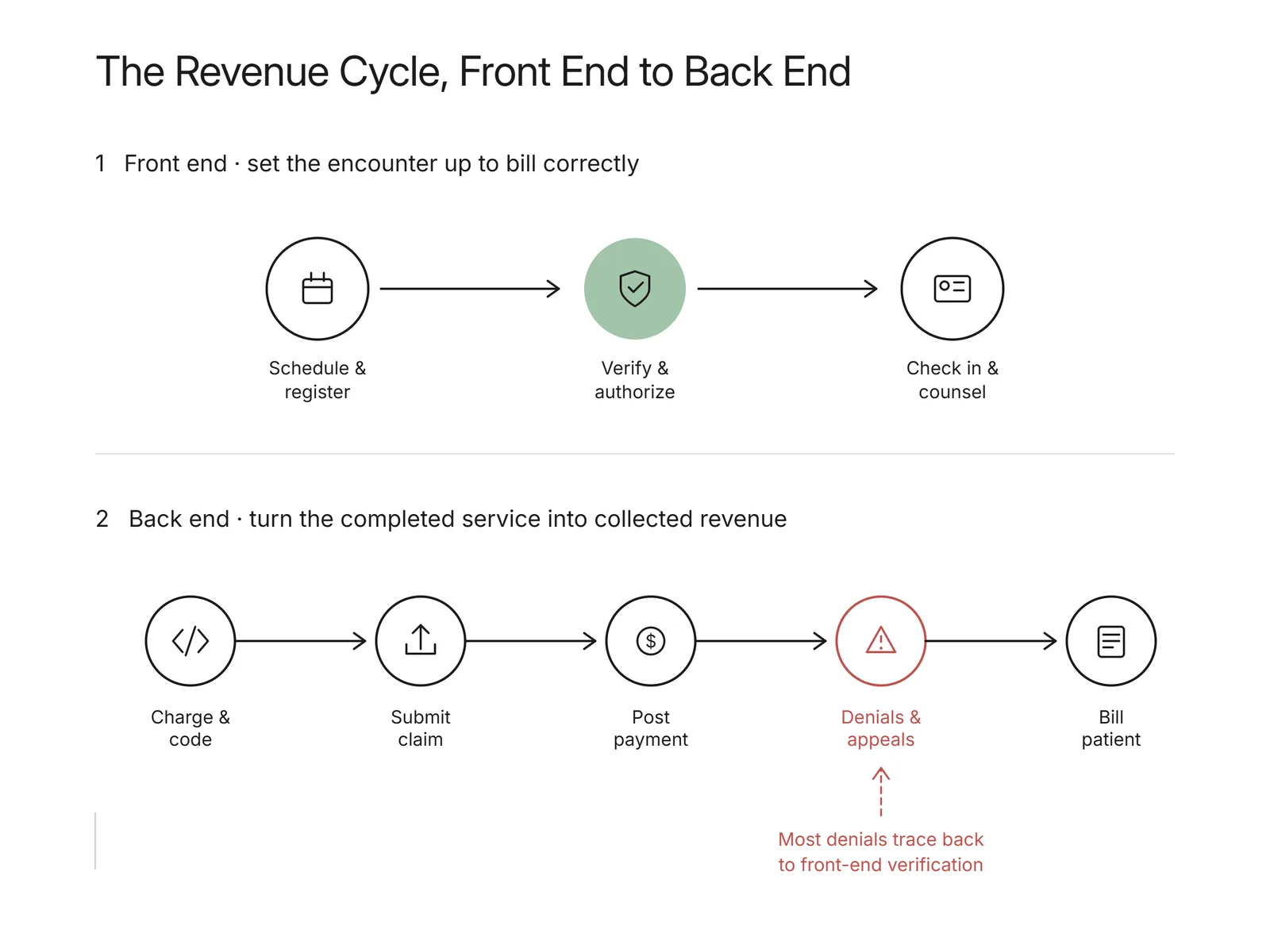
The revenue cycle moves through a repeatable sequence of steps, from scheduling to final payment. The main stages are:
- Scheduling and pre-registration. Capture patient demographics and insurance details before the visit.
- Insurance verification and prior authorization. Confirm the patient is covered for the planned service and obtain any required approval.
- Patient check-in and financial counseling. Confirm identity, collect any copay, and explain expected costs.
- Charge capture and coding. Translate the care delivered into billable procedure and diagnosis codes.
- Claim submission. Send the claim to the payer in the standard electronic format.
- Payment posting and reconciliation. Record what the payer paid and why.
- Denial management and appeals. Investigate and rework claims the payer rejected.
- Patient billing and collections. Bill the patient for the remaining balance and resolve it.
Claim submission relies on standardized electronic formats. Under HIPAA's Administrative Simplification rules, providers and payers exchange claims, eligibility, and remittance data using adopted national standards, according to CMS. Each step feeds the next, so an error introduced early travels downstream until a payer or a patient catches it.
See what AI can run at your facility. In a 30-minute audit we map the calls, eligibility, and follow-ups Flexbone can take off your team first.
Book an auditWhat is the difference between front-end and back-end revenue cycle management?
The revenue cycle is commonly split into a front end and a back end, divided roughly by the point of service. The front end covers everything that happens before and around the visit: scheduling, registration, insurance verification, prior authorization, and financial counseling. Its job is to make sure the encounter is set up to bill correctly. The back end covers everything after the service: charge capture, coding, claim submission, payment posting, denial management, appeals, and patient collections. Its job is to turn the completed service into collected revenue. The split matters because the two halves have different owners and different failure modes, but they are tightly coupled. A front-end task such as confirming coverage through an eligibility (270/271) transaction, which CMS specifies under Administrative Simplification, prevents a back-end denial later, per CMS. Most avoidable rework originates on the front end and only becomes visible on the back end.
Where does the revenue cycle break down, and where does automation help most?
The revenue cycle tends to break down where accurate data has to be captured under time pressure, and where staff have to chase information from payers. Common failure points include registering a patient under an expired or wrong plan, skipping or mistiming a prior authorization, and coding a service in a way the payer will not accept. These are hard to see until the claim is denied. The scale of the problem is real: in HealthCare.gov marketplace plans, insurers denied 20% of in-network claims in 2023, and consumers appealed fewer than 1% of those denials, according to KFF. Automation helps most on the repetitive, rules-based tasks that sit in front of those denials: eligibility and benefit checks, prior authorization status, and claim status follow-up. Prior authorization alone consumes real staff time, with practices completing an average of 39 requests per physician each week and spending about 13 hours on them, per the AMA. Handling that work early and consistently prevents denials rather than reworking them.
How Flexbone helps across the revenue cycle
Flexbone's AI agents handle the repetitive front-end access work and payer communication that feed the rest of the cycle, then write structured results back into the EHR the team already uses. For insurance eligibility verification, the agents run electronic eligibility checks where a data path exists and fall back to a payer portal or a phone call when it does not, so coverage is confirmed before the claim goes out. The same agents follow up on prior authorization and claim status, which reduces the manual chasing that sits behind AI denials management on the back end. The work is audit-first: every action an agent takes is logged, so a person can review what was checked, where, and what came back before anything is finalized. Flexbone is HIPAA compliant and SOC 2 aligned, and the agents are built to gather, record, and hand off, not to make coverage or payment decisions on their own.
Is revenue cycle management the same as medical billing?
Revenue cycle management and medical billing are related but not the same. Medical billing is the stage that prepares and submits claims and posts the payments that come back. Revenue cycle management is the wider process around it, including patient access, eligibility verification, prior authorization, coding, denial management, and collections. Put simply, billing is one link in the chain, while RCM is the management of the whole chain from scheduling to final payment. Treating billing as the entire revenue cycle is a common mistake, because it puts attention on claim submission while the errors that cause denials usually happen earlier, during registration and verification. If you want to see how AI agents can take on the front-end access and payer follow-up work across your revenue cycle, book a demo.