
Waystar is a cloud-based revenue cycle technology platform and clearinghouse that healthcare providers use to run administrative and financial transactions with payers. It supports claim submission and claim status, eligibility verification, remittance, denial and appeal management, and patient payment collection. In practice, it sits between providers and payers and moves the standardized transactions that healthcare billing depends on, validating and translating each one and carrying the payer's response back. It does not adjudicate claims or replace an EHR or practice management system. Instead, it connects those systems to the many payers a provider bills, so a revenue cycle team manages one platform rather than a separate link to each plan. Understanding what Waystar does helps explain where it fits for claims, for eligibility checks, and for the back-end work of denials and patient payments.
What is Waystar used for?
Waystar is used to run the electronic transactions that connect a provider to its payers across the revenue cycle. On the front end, it supports eligibility verification, which confirms whether a patient is covered and for what before a service is delivered. In the middle of the cycle, it submits claims, tracks their status, and returns remittance information that explains what a payer paid and why. On the back end, it supports denial and appeal management and patient payment collection. The common thread is that these are administrative and financial transactions between a provider and its payers, and the platform's job is to move them accurately and return the responses in a form the provider's systems can read. It is a platform for the revenue cycle, not a clinical system.
Want this mapped against your own call and claim volume? Book a 30-minute audit
Is Waystar a clearinghouse?
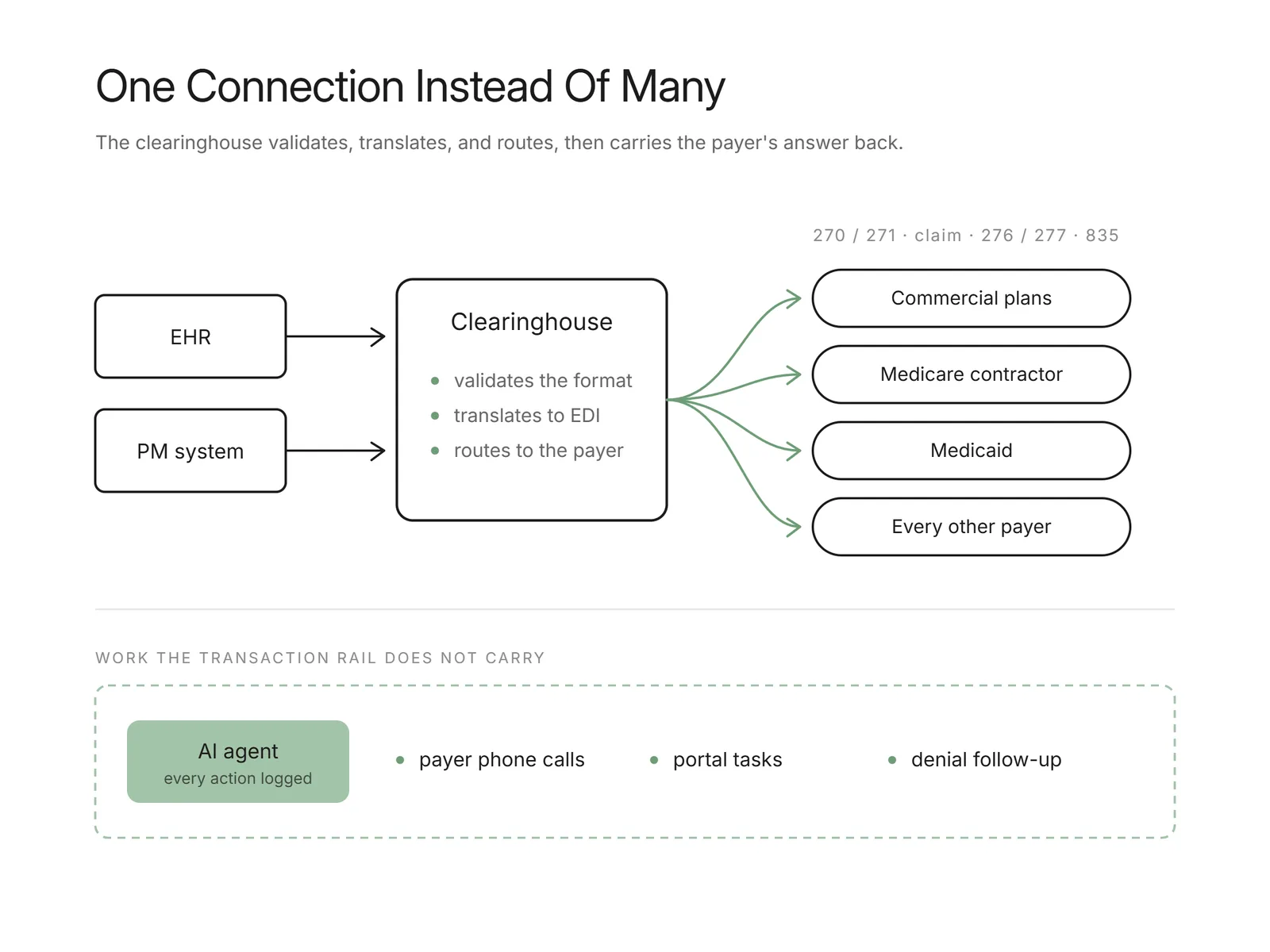
Yes, Waystar includes clearinghouse functionality, and it layers a broader revenue cycle platform on top of that core. A clearinghouse is an intermediary that validates outgoing claims and administrative transactions, translates them into the standard formats payers require, and routes each one to the correct plan, then carries the payer's response back to the provider. Waystar performs that role and adds reporting, denial management, and patient payment tools around it. So the clearinghouse is one part of what the platform does rather than the whole of it. If you want the mechanics of the intermediary role on its own, our guide to what a clearinghouse is in medical billing covers scrubbing, routing, and the standard transactions in more detail.
What is a clearinghouse in medical billing?
A clearinghouse in medical billing is the connection layer between a provider's billing system and the many payers it submits to. Rather than building a separate link to each health plan, the provider sends transactions to one clearinghouse, which checks them for format and data errors, translates them into the standard electronic data interchange (EDI) formats, and forwards them to the right payer. It also returns the payer's replies, such as eligibility and claim status responses. These transactions follow national standards adopted under HIPAA's Administrative Simplification rules. For eligibility specifically, the ASC X12N 270/271 inquiry and response is the adopted standard, per CMS. A clearinghouse does not decide coverage or adjudicate claims; it moves and translates the data so the payer can act on it.
See what AI can run at your facility. In a 30-minute audit we map the calls, eligibility, and follow-ups Flexbone can take off your team first.
Book an auditWho uses Waystar?
Waystar is used by a range of healthcare organizations that need to exchange claims and administrative transactions with payers, including hospitals, health systems, physician groups, and other provider organizations. Within those organizations, the day-to-day users are revenue cycle, billing, and patient access staff: the people who verify eligibility, submit and track claims, post remittance, work denials, and collect patient balances. Because the platform connects to payers and to the systems a provider already runs, the practical fit depends on an organization's payer mix, its transaction volume, and the practice management or EHR systems in place. Larger systems may use more of the back-end and analytics capabilities, while a smaller group might rely mainly on the clearinghouse and eligibility functions.
How does Waystar fit in the revenue cycle?
Waystar fits into the revenue cycle as the layer that carries standardized transactions between a provider's systems and its payers, at each stage where money and coverage information move. At registration and scheduling, it supports eligibility verification. When a claim is ready, it validates, translates, and submits it, then tracks claim status and returns remittance so staff can reconcile what was billed against what was paid. When a claim is denied, it supports the denial and appeal workflow, and it also handles the patient payment side. It works alongside the practice management system and EHR rather than replacing them: those systems produce the claim and hold the record, while the platform handles the payer connection and the responses. If you want the full picture of the stages involved, our overview of revenue cycle management walks through front, middle, and back-end steps.
How do AI agents work alongside a clearinghouse like Waystar?
A clearinghouse moves electronic transactions, but a meaningful share of revenue cycle work still happens off that rail, on payer phone lines and inside portals that the standard transactions do not fully cover. That is the gap Flexbone AI agents are built for. The clearinghouse routes the 270/271 and the claim, and the agents do the work around it: calling a payer to confirm a benefit or check on an authorization, completing a portal task the clearinghouse does not handle, and following up on a denial through to a resolution. For insurance eligibility verification, the agents run electronic checks where a path exists and fall back to a portal or a payer call when it does not, then write structured results back into the systems the billing team already uses. The same pattern supports AI denials management and the payer healthcare calls that otherwise sit in a staff queue. Every action an agent takes is logged so a person can review what was checked, where, and what came back, and the agents record and hand off rather than make coverage decisions on their own.
AI agents can sit alongside a clearinghouse and take on the phone calls, portal tasks, and denial follow-up that the transaction rail does not cover, so a revenue cycle team spends less time on hold and in browser tabs. If you want to see what that looks like against your own payer mix, book a call with Flexbone to run a quick audit of what AI can take off your revenue cycle.