Call center cost reduction works best when you attack unit economics, not headcount. Cost per contact is total operating cost divided by contacts handled, so you lower it either by spending less per interaction or by removing interactions entirely. The durable levers are: cut repeat contacts by raising first call resolution, shorten handle time by fixing after-call work and hold time, and remove predictable tier-one volume with self-service and AI. Balto groups the same strategies into reducing volume, improving agent efficiency, and automating routine work. The trap is cutting in ways that lower resolution, because every unresolved call comes back as a second, more expensive contact. This post walks the cost stack and shows where automation pays.
What drives call-center cost?
Labor is the dominant cost, which is why staffing decisions dwarf almost everything else. Strategic Contact puts agent-related labor at roughly two-thirds to three-quarters of total contact-center cost, with technology, facilities, and overhead splitting the rest. Customer service representatives are one of the largest occupations in the US economy, which the Bureau of Labor Statistics tracks in its Occupational Outlook Handbook, so agent wages set the floor under most contact-center budgets. That single fact sets the strategy: if you want a large cost change, you have to change how many agent-minutes each resolved issue consumes. Two numbers translate labor into unit cost. Handle time sets the minutes per contact. Volume sets the number of contacts. Multiply them by a fully loaded agent rate and you have most of your cost per contact. Everything else, from real estate to licensing, moves the number at the margins rather than the core.
Want this mapped against your own call and claim volume? Book a 30-minute audit
Where is the biggest waste?
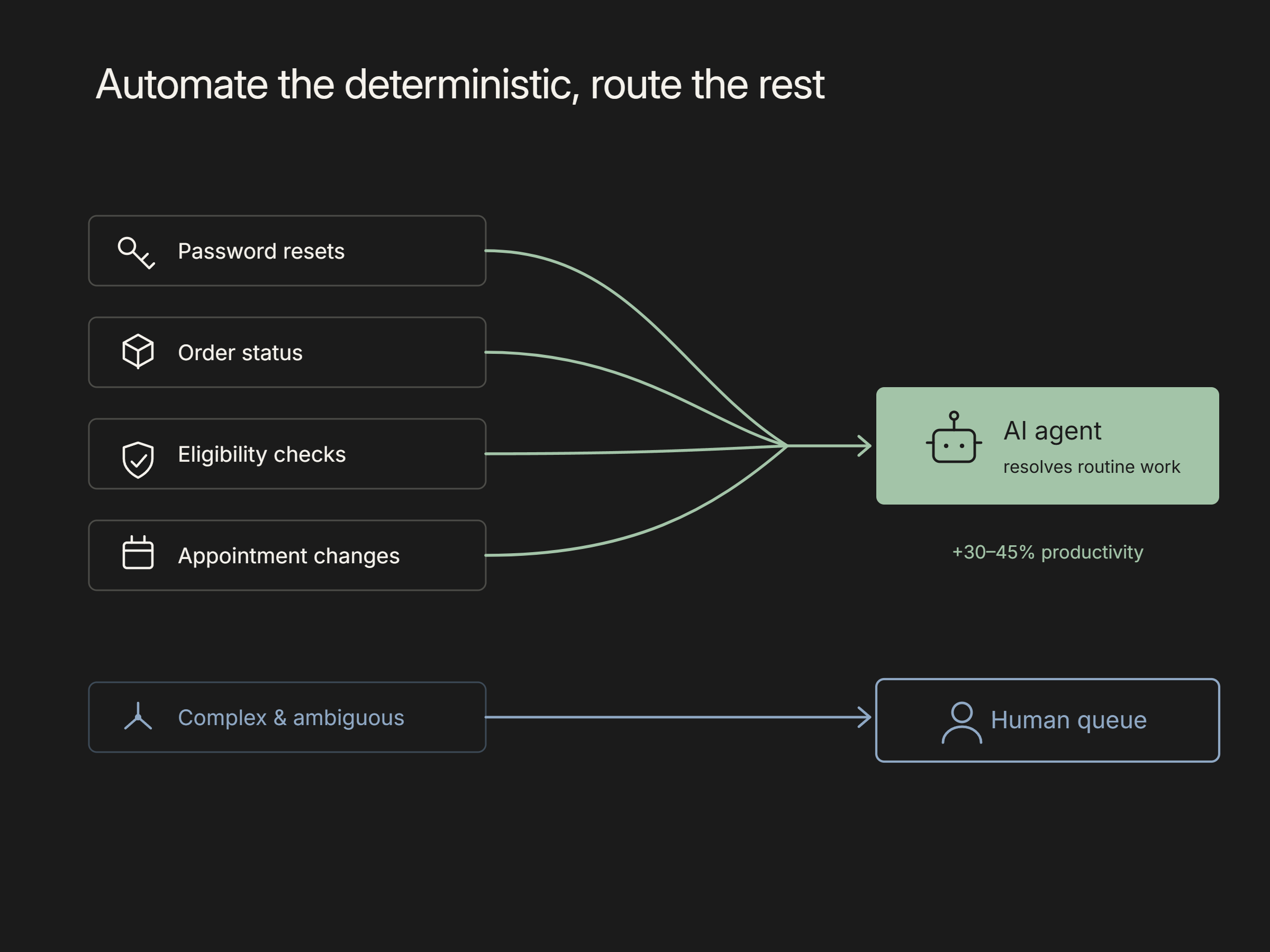
The biggest waste is work that should not reach a human at all, plus rework from calls that were not resolved the first time. Password resets, order status, eligibility checks (the 270/271 transaction against a payer portal like Availity), and appointment changes are predictable and repetitive, yet they often consume trained agents. McKinsey estimates that applying generative AI to customer care could lift productivity by 30 to 45 percent of the function's current cost, largely by handling routine contacts and assisting agents on the rest. The second source of waste is repeat contacts: a low first call resolution rate quietly doubles the cost of every issue that bounces back. Use our cost per contact calculator to size both leaks for your own operation before you decide where to cut.
Finding the waste requires listening to calls rather than reading reports, because a report shows how long calls took and not why. Flexbone begins with that step, transcribing and classifying a center's calls to locate the repetitive ones before building any agent. See contact center automation.
See what AI can run at your facility. In a 30-minute audit we map the calls, eligibility, and follow-ups Flexbone can take off your team first.
Book an auditHow do you cut cost without hurting CSAT?
Protect resolution and let cost follow. The safe cuts remove effort, not service: deflect only the contacts customers are happy to self-serve, and keep a clean path to a human for everything else. Document360 reports that around 67 percent of customers prefer self-service for simple issues, but the same research warns that a poor self-service flow that fails to resolve the issue makes the eventual agent call harder and less satisfying. So the rule is to automate the contacts with clean, deterministic answers and route ambiguity straight to a person. In the engagements we run, we hold CSAT and first call resolution as guardrails on any cost program, so a saving that lowers resolution gets caught before it ships. Cost cuts that raise repeat contacts are not savings.
What does automation actually save?
Automation saves on the two things that drive cost: minutes per contact and number of contacts reaching an agent. When an AI agent fully resolves a routine interaction, its marginal cost is a fraction of a staffed call, and the human queue keeps only the complex work. Gartner projected conversational AI would reduce contact-center agent labor costs by 80 billion dollars in 2026, noting that labor can reach up to 95 percent of some centers' costs, which is what makes even partial automation land hard. The honest caveat is that automation carries build and maintenance cost, and poorly scoped bots can raise cost by adding a failed step before the agent. The savings are real when you automate deterministic, high-volume contacts and measure resolution, not just deflection.
How Flexbone cuts your cost per contact
Flexbone builds audit-first AI agents (voice, browser, document, and desktop) that remove repetitive, deterministic contacts from the queue in secure, regulated environments. We lead with an audit because the savings live in specific contact types, not in a blanket deflection target. The platform is HIPAA compliant and SOC 2-aligned, so BPO, insurance, healthcare, and public-sector teams can automate without new compliance exposure, whether the contact is a Medicare or Medicaid coverage question or a scheduling change written back into Epic. We instrument cost per contact, first call resolution, and CSAT together, so you see the unit cost fall while resolution holds, which is the only cost reduction worth keeping.
Start a pilot: https://www.flexbone.ai/contact