Call center workforce management (WFM) is the practice of putting the right number of agents, with the right skills, in the right place at the right time to hit service targets without overpaying for labor. It runs as a repeating cycle: forecast demand, calculate the staff required, build schedules, manage the day in real time, then measure and adjust. WFM matters because labor is the largest line item in a contact center, so small errors in staffing show up quickly as either long queues or idle, expensive agents. Salesforce describes WFM as this continuous loop of forecasting, scheduling, and intraday adjustment rather than a one-time plan. This guide walks the cycle and shows where automation changes the math.
What is workforce management?
Workforce management is the set of processes that match agent supply to contact demand across voice, chat, and back-office work. It answers three questions: how many contacts will arrive, how many people are needed to handle them at target, and who works which shift. Five9 defines WFM as ensuring the right number of agents with the right skills are scheduled at the right times to meet service goals while controlling cost. The discipline sits between operations and finance: it turns a service-level promise into a headcount and a budget. In BPO, insurance, and public-sector centers alike, WFM is usually owned by a small planning team that works from historical volume and the service targets the business has committed to.
Want this mapped against your own call and claim volume? Book a 30-minute audit
What does the WFM cycle look like?
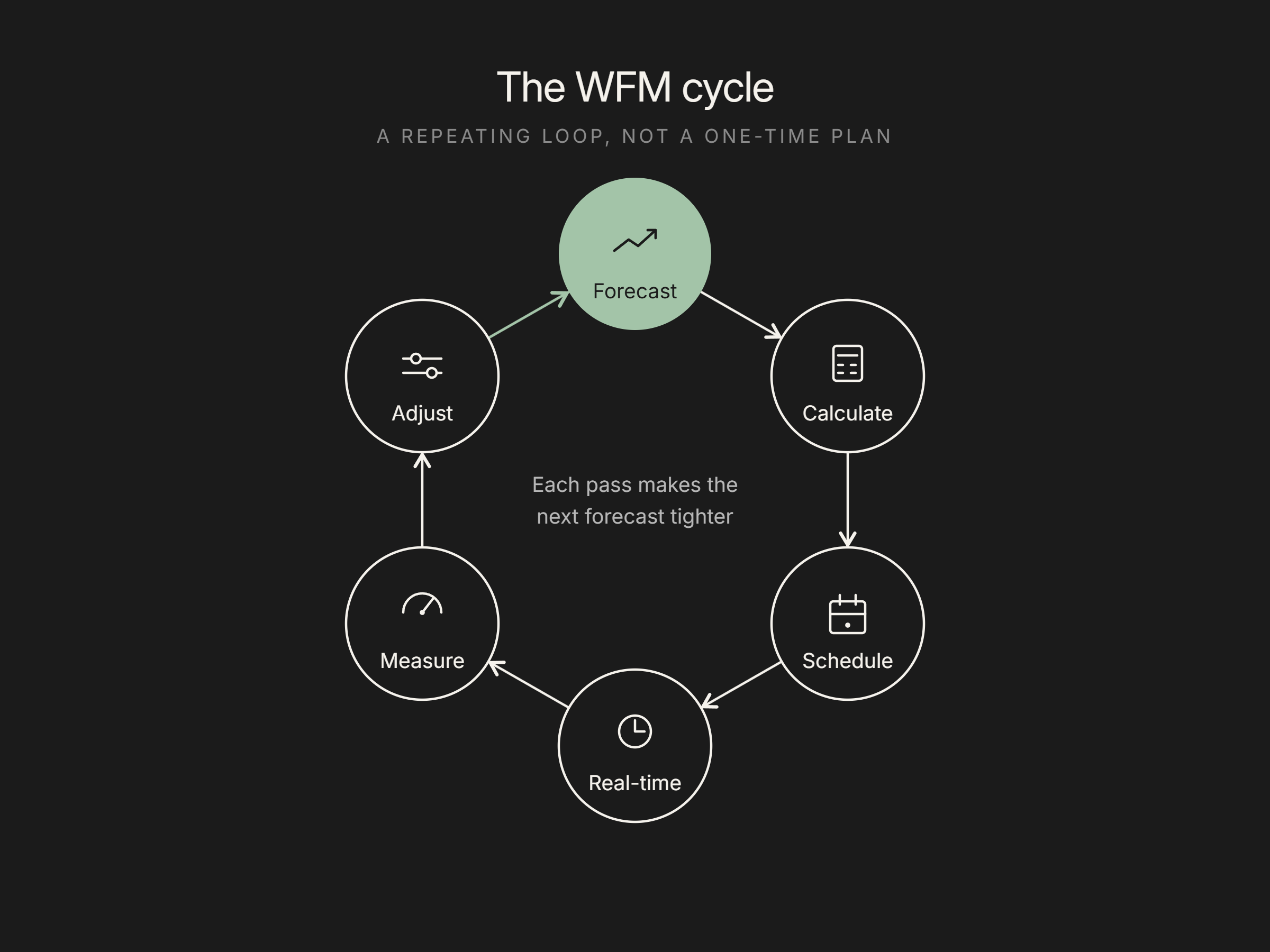
The cycle has six repeating steps rather than a single annual plan. NiCE lays it out as forecast, calculate, schedule, manage in real time, measure, and adjust. Forecasting predicts arrival patterns by interval, day, and season. Calculating converts that forecast into required agents at your service target. Scheduling assigns real people to shifts, skills, and breaks. Real-time management, sometimes called intraday, handles the surprises: a sick agent, a spike after an outage, a payer portal going down. Measuring compares planned to actual on adherence, occupancy, and service level. Adjusting feeds those lessons back into the next forecast. Each pass makes the next forecast tighter, which is why mature planning teams treat WFM as a habit, not a project.
Automation enters the cycle at the forecasting step, since calls an agent handles no longer need a staffed seat. Flexbone gives WFM teams volume by call type from recorded calls, so the forecast separates what people will answer from what agents will. See contact center automation.
See what AI can run at your facility. In a 30-minute audit we map the calls, eligibility, and follow-ups Flexbone can take off your team first.
Book an auditHow do you build a staffing model?
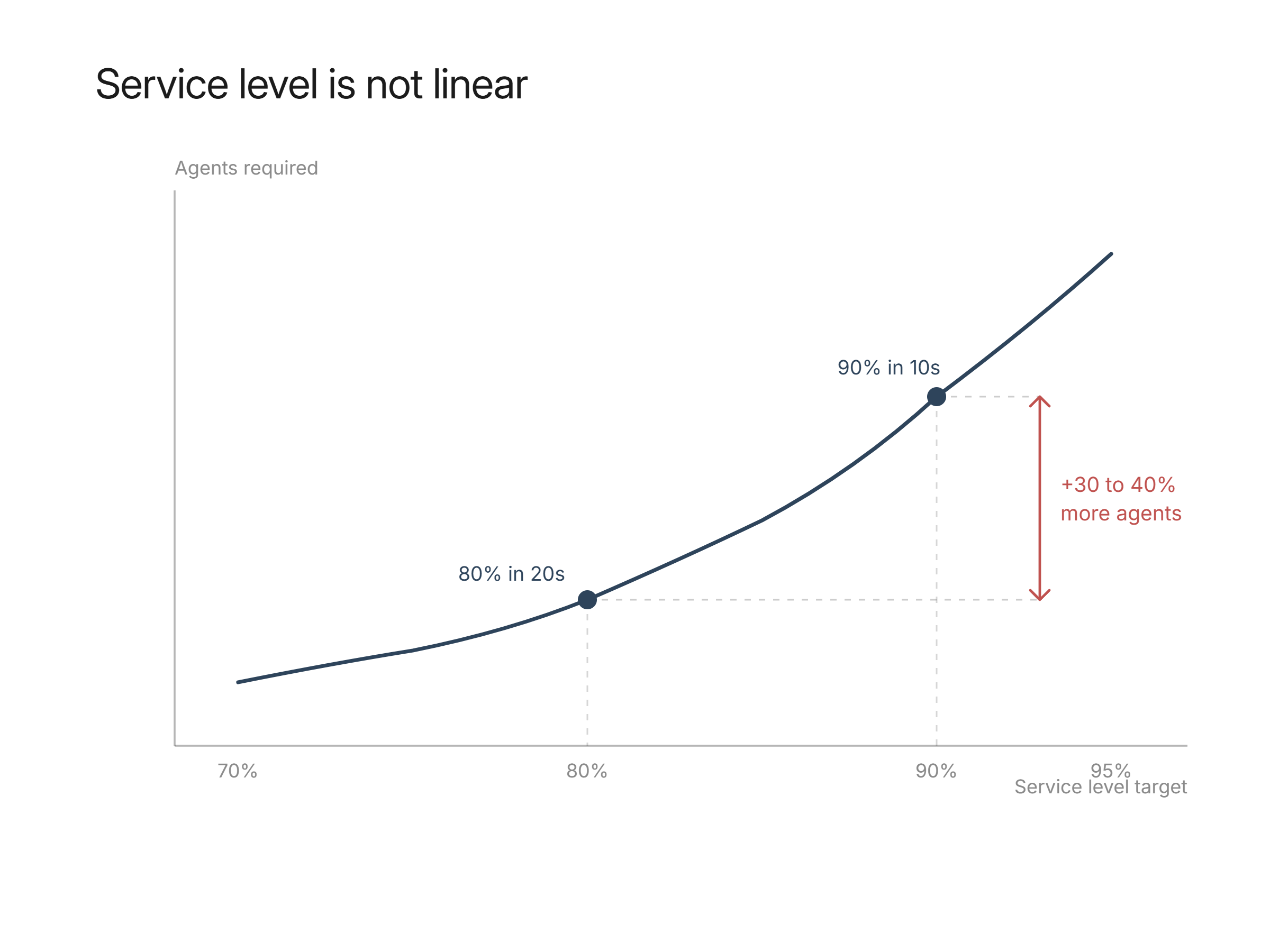
A staffing model turns forecast volume into a headcount using queueing math, then inflates it for lost time. The standard tool is Erlang C, which estimates the agents needed to answer a given call volume within a target wait. CallCentreHelper shows why the relationship is not linear: moving from 80 percent answered in 20 seconds to 90 percent in 10 seconds can require 30 to 40 percent more agents for the same volume. Two adjustments finish the model. Occupancy caps how busy agents can be before quality drops, usually around 85 percent. Shrinkage adds back the paid time agents are not on contacts, commonly 30 to 35 percent, covering breaks, training, and absence. See our Erlang C staffing calculator to run the numbers for your own volume.
Where does automation fit in WFM?
Automation is a lever inside the staffing model, not a replacement for it. When AI agents and self-service absorb a share of predictable tier-one contacts, the forecast that feeds Erlang C shrinks, and the residual demand skews toward complex work that needs experienced people. McKinsey frames the choice as finding the right mix of humans and AI, with automation handling a meaningful share of routine requests so human capacity goes to higher-value contacts. In planning terms, that means re-forecasting contained volume separately, re-baselining AHT for the harder mix, and reallocating freed hours to coaching and backlog rather than cutting blindly. In the engagements we run, automation makes the staffing model steadier because it flattens the tier-one spikes that used to force over-hiring.
How Flexbone fits your WFM plan
Flexbone builds audit-first AI agents (voice, browser, document, and desktop) that handle repetitive contacts and back-office tasks in secure, regulated environments. Inside a WFM program, that translates to lower and more predictable tier-one volume feeding your forecast, which makes Erlang C outputs smaller and less spiky. Because the platform is HIPAA compliant and SOC 2-aligned, it slots into BPO, insurance, healthcare, and public-sector planning without adding compliance risk. We start with an audit of your arrival patterns and contact mix, automate the segments the data supports, then hand your planning team a cleaner forecast to staff against.
Book a demo: https://www.flexbone.ai/contact