Dermatology billing works like most specialty billing, but three features make it distinct: high visit volume, a heavy mix of in-office procedures, and a split between medically necessary care and cosmetic self-pay work. A typical practice sees many short appointments and performs procedures at the same visit, so accurate procedure coding for biopsies, excisions, and destruction of lesions matters, along with careful use of modifiers and lesion measurements. Skin cancer work adds Mohs surgery coding and pathology on top of that. The biggest administrative load is biologic prior authorization: drugs for psoriasis, eczema, and related conditions are expensive, so payers require review and often step therapy. Billing goes wrong most often when cosmetic and medical work blur together, when modifiers are missing, and when biologic authorizations lapse or arrive incomplete.
What makes dermatology billing complex?
The complexity comes from volume meeting procedural detail. A dermatologist may see many patients in a day and perform a procedure at most of those visits, so each encounter can carry an office visit code plus one or more procedure codes. Procedures are coded by type and by anatomic detail: a shave or punch biopsy, an excision sized by the lesion plus margins, or destruction of a lesion by method. Getting the measurement and the method right changes the code, and the diagnosis has to support the service. Because the work happens quickly and the coding is granular, small errors in documentation or code selection scale into a large number of reworkable claims. Many practices run this on a dermatology-focused platform such as ModMed or Nextech, which helps standardize coding but does not remove the need for accurate clinical documentation behind each code.
Want this mapped against your own call and claim volume? Book a 30-minute audit
How does medical vs cosmetic billing work in dermatology?
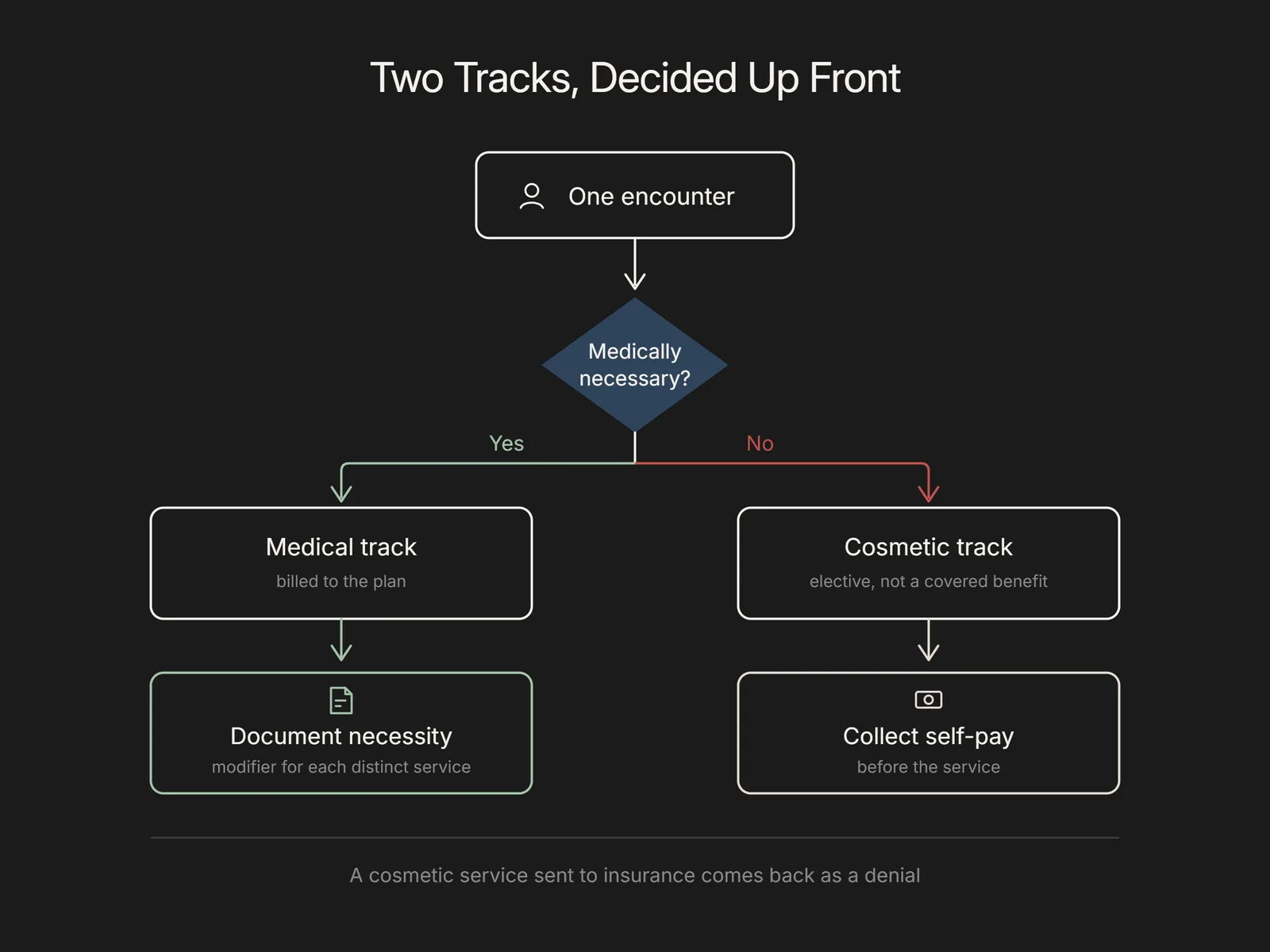
Medical and cosmetic dermatology are billed on two different tracks, and keeping them separate is one of the most important things a practice does. Medical dermatology treats a diagnosable condition, a suspicious lesion, a rash, an infection, and is billed to the patient's insurance under the usual coverage and prior authorization rules. Cosmetic dermatology is elective and performed for appearance, such as removing a benign, asymptomatic lesion a patient dislikes, and it is generally not a covered benefit, so it is billed to the patient as self-pay. Problems start when the two mix on one encounter: billing a cosmetic service to insurance produces a denial, and failing to document the medical necessity of a legitimate service invites one too. The practical rule is to decide the category before the service, document medical necessity when it applies, collect payment up front for cosmetic work, and never let a self-pay procedure ride on an insurance claim.
How do modifiers affect dermatology claims?
Modifiers are two-character codes attached to a procedure code that tell the payer something its edit logic needs to know, and dermatology relies on them heavily because so many procedures happen at one visit. When a biopsy and a separate treatment are both performed, or when a procedure is distinct from the office visit, a modifier signals that the services were separately identifiable rather than duplicate or bundled. Other common uses flag a staged procedure or a service on a specific site. The stakes are practical: payers run automated edits that bundle related codes, and without the right modifier the secondary service is denied or folded into the first at no extra payment. Because the exact modifier depends on the payer's rules and the clinical facts, coders should check the combination against the payer's edits before the claim goes out rather than assume a modifier that worked for one payer applies to another.
See what AI can run at your facility. In a 30-minute audit we map the calls, eligibility, and follow-ups Flexbone can take off your team first.
Book an auditHow does biologic prior authorization work in dermatology?
Biologics are the highest-friction part of dermatology billing. Drugs such as adalimumab, ustekinumab, and dupilumab treat conditions like psoriasis and atopic dermatitis, and because they are costly specialty products, nearly every plan requires prior authorization before it will cover them. Most plans also apply step therapy, which means the patient must have tried and failed, or have a documented reason not to try, one or more lower-cost therapies first. To get an approval, the practice submits the diagnosis, the record of prior treatments and outcomes, and the clinical rationale, and the request routes through a payer portal or a pharmacy benefit manager. This is a real workload: the American Medical Association reports physicians handle roughly 39 prior authorizations per week, about 13 hours of work, and biologic-heavy specialties feel that acutely. Incomplete step-therapy documentation is a leading reason these requests stall or get denied. For a deeper look at the derm-specific workflow, see dermatology and plastics prior authorization. For how the same work runs across a dermatology schedule, including Mohs and biologic authorization, see AI for dermatology practices.
Why do dermatology claims get denied?
Dermatology denials cluster around a few causes: a missing or incorrect modifier that triggers bundling, a diagnosis that does not support the procedure billed, thin documentation of medical necessity, a cosmetic service sent to insurance, or a biologic given without a current authorization. Denials are common across insurance generally, one analysis of HealthCare.gov plans found insurers denied about 20 percent of in-network claims in 2023, while fewer than 1 percent were appealed, a reminder that many correctable denials are simply written off. The fix is to read each denial by its reason and remark codes on the remittance advice, which tell you whether the claim needs a corrected resubmission or a formal appeal. Tracking denial patterns by payer and cause also surfaces the upstream problem, whether that is a coding habit, a documentation gap, or an authorization step being skipped. Our AI denials management work is built around reading and routing those codes.
How to prevent dermatology billing errors
Most dermatology billing loss is preventable with a few disciplined steps. Separate medical and cosmetic work explicitly at scheduling and at checkout, and collect self-pay amounts before the cosmetic service. Verify each patient's benefits before the visit through the electronic eligibility exchange (the 270 request and 271 response), so coverage and patient responsibility are known in advance; our insurance eligibility verification covers that mechanism. For biologics, secure authorization ahead of the treatment date and attach complete step-therapy documentation to the electronic request (the 278 transaction) rather than submitting a bare form. When a claim is denied, read the reason and remark codes on the electronic remittance advice (the 835) to decide the correct next action instead of blindly resubmitting. Keep modifier logic current against payer edits so distinct services are paid rather than bundled. Practices on ModMed or Nextech can encode much of this, but the accuracy still depends on the documentation and timing behind each claim.
Flexbone deploys AI voice and browser agents that handle the repetitive parts of this work: verifying benefits, chasing biologic authorizations with step-therapy documentation, and reading denials by their reason codes so staff act on the ones worth appealing. If you want to map which pieces of your dermatology billing an agent can take off your team, book a call with Flexbone and we will walk through your specific workflow.