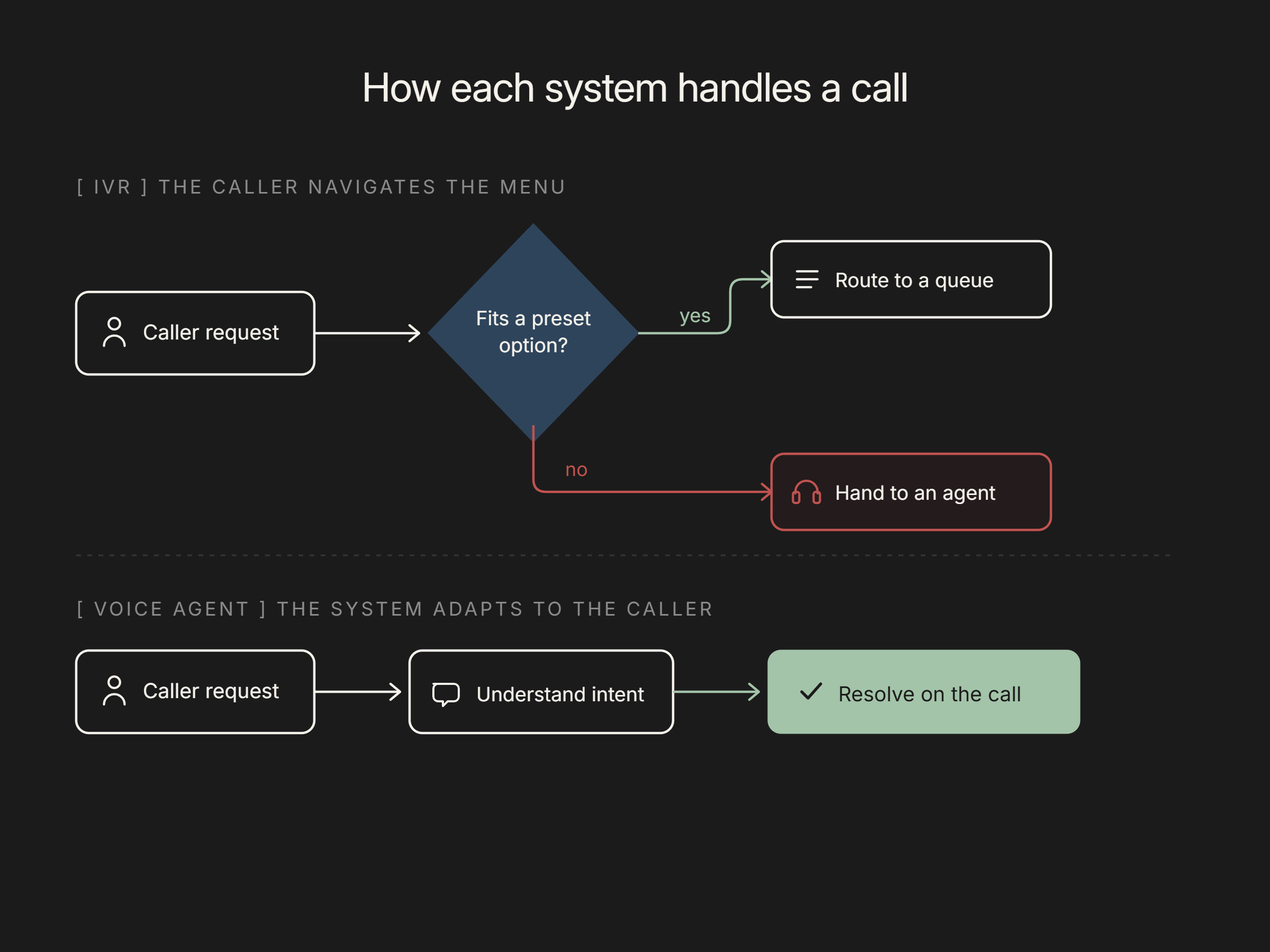
A voice agent and an IVR both answer phone calls, but they work in opposite ways. An IVR (interactive voice response) routes callers through a fixed menu using keypad presses or narrow speech recognition, so the caller has to fit their need into predefined options like "press 1 for billing." A voice agent uses natural language understanding to grasp what the caller actually wants, responds in conversational speech, and can complete the task instead of just routing it (3CLogic). The practical difference is who adapts to whom: an IVR makes the caller navigate the system, while a voice agent adapts to the caller. That is why conversational voice AI is replacing phone trees for many call types, resolving more requests without a live agent and reducing the frustration of pressing through menus to reach a person.
What is an IVR?
An IVR is an automated phone system that greets callers and directs them using menus, either through keypad tones or limited voice commands. It runs on pre-recorded audio, decision-tree logic, and database lookups, presenting fixed choices until the caller lands in the right queue or hears a recorded answer. IVRs have been the backbone of call routing for decades because they are predictable and cheap to run at scale (Twilio). Their limitation is rigidity: the system can only handle the paths it was explicitly built for, so anything unusual either dead-ends or gets routed to a person. Long menus, repeated prompts, and the inability to understand a plain-language request are the classic sources of caller frustration, and they push interactions to live agents that a smarter system could have contained.
Want this mapped against your own call and claim volume? Book a 30-minute audit
What is a voice agent?
A voice agent is an AI system that holds a real spoken conversation over the phone and acts on it. It is built from connected components: speech recognition transcribes what the caller says, a large language model interprets intent and decides the response, and speech synthesis replies in a natural voice, all coordinated in real time (AssemblyAI). Instead of offering a menu, the agent asks the caller what they need and understands the answer even when it is phrased unexpectedly. It also connects to back-end tools, so it can take the action the caller wants, such as booking an appointment or checking coverage, during the same call. A voice agent does not just route or read a script; it understands, reasons, and resolves.
Flexbone builds voice agents to finish the transaction, whether booking, confirming, or answering, and writes the result into the system of record, with call types chosen from the practice's recordings. See AI voice agents.
See what AI can run at your facility. In a 30-minute audit we map the calls, eligibility, and follow-ups Flexbone can take off your team first.
Book an auditHow do voice agents and IVR differ?
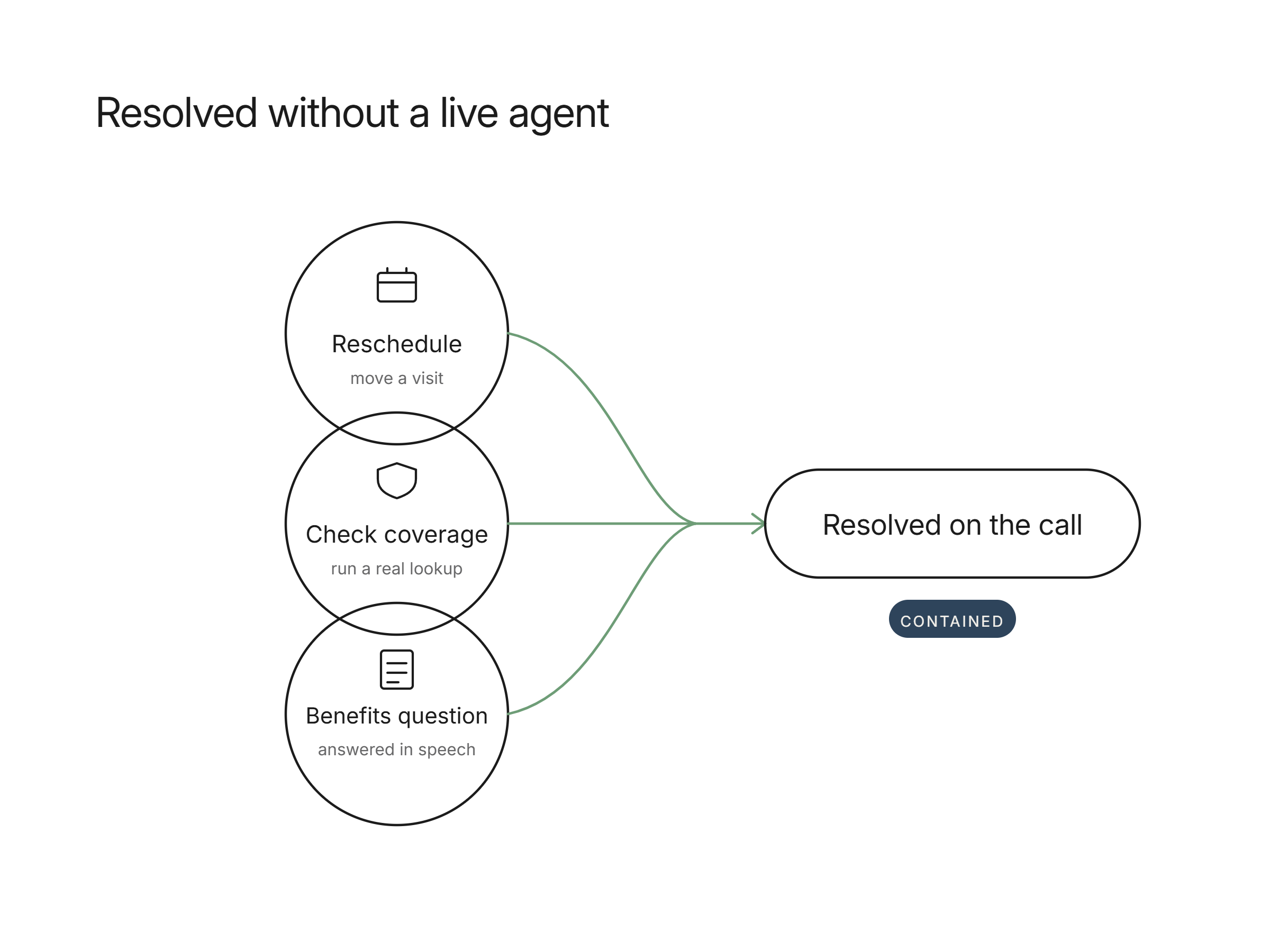
The difference is comprehension and action. An IVR matches a keypress or a narrow phrase to a fixed branch, so it can route and play recordings but cannot understand open-ended speech. A voice agent understands natural language, so a caller can say "I need to move my appointment to next week" and the agent handles it directly, rather than forcing the caller through a menu tree (CMSWire). An IVR is deterministic and limited to its script; a voice agent reasons over context and can handle variation. The other difference is outcome: an IVR usually hands off to a live agent when the request is anything but simple, while a voice agent can complete the task itself, connecting to systems to actually finish the work instead of passing the caller along.
What does switching from IVR cost and save?
The savings show up in containment, the share of calls resolved without a live agent. Containment rate measures the percentage of interactions fully handled by the automated system, and it is a direct lever on staffing cost: every contained call is one an agent did not have to take (Teneo). Because a voice agent understands and resolves more requests than a menu can, it typically contains more of them, which lowers cost per call and shortens wait times for the calls that do reach a person. The costs to weigh are integration and setup, connecting the agent to your systems, plus ongoing monitoring and per-minute usage. Our pricing page shows how those components are structured in practice. For a fuller picture of how to measure the payoff, see our guide to IVR containment rate, which explains how to calculate it and what drives it up.
How Flexbone replaces phone trees in healthcare
Flexbone builds voice agents for secure and regulated environments, with deep use in healthcare patient access. We are audit-first: before replacing any part of an IVR, we study the real call mix, the systems the agent must reach, and the failure modes, then design the flow with human handoff on sensitive calls. Our agents connect to the systems of record, so a scheduling call actually updates the calendar and a benefits question runs a real lookup instead of dead-ending in a menu. The platform is HIPAA compliant and SOC 2-aligned. See how this works for patient-facing calls on our healthcare calls page, then book a demo to hear a voice agent handle the calls your phone tree drops today.