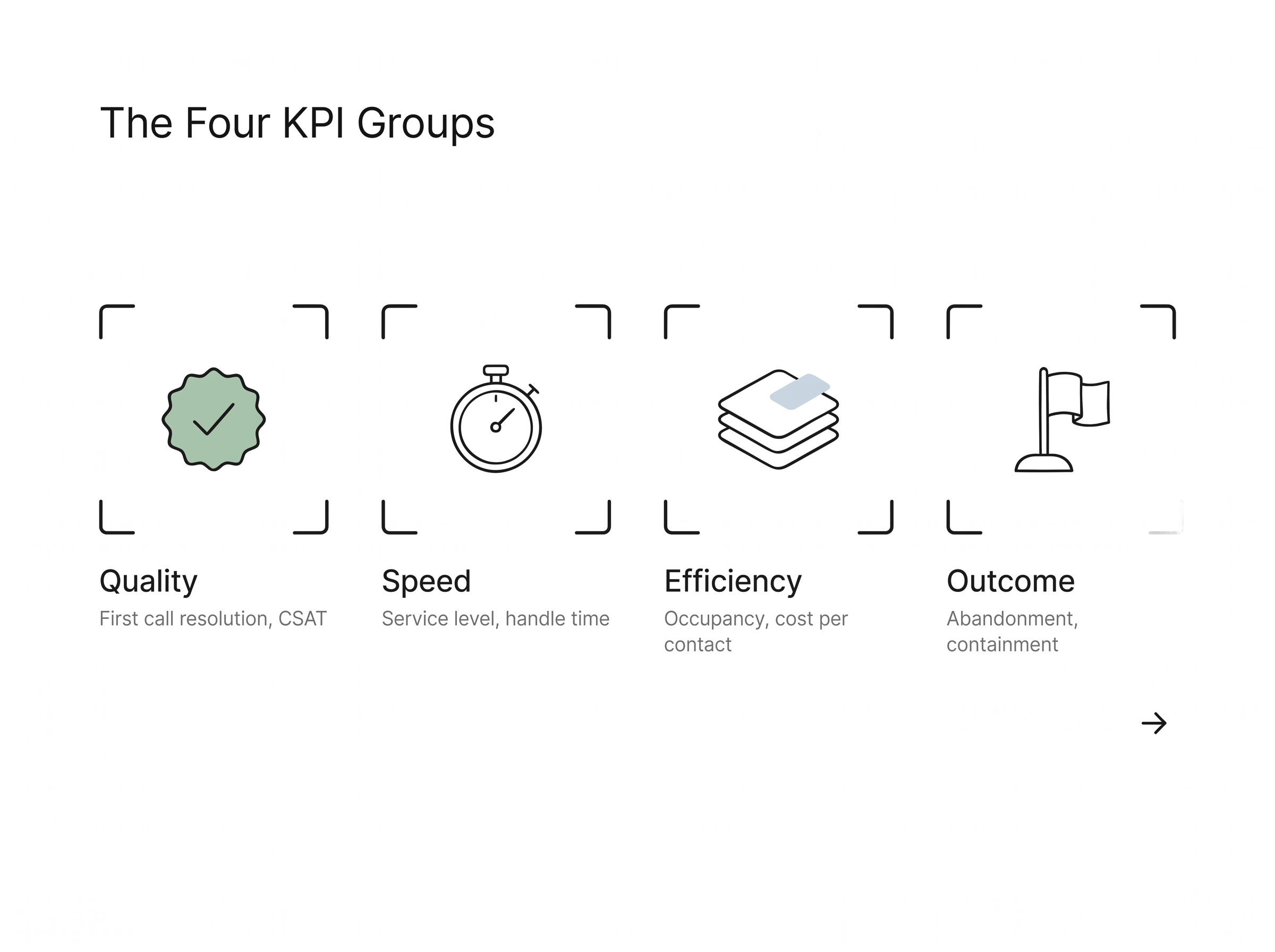
Call center KPIs fall into four groups: quality (first call resolution, CSAT, quality score), speed (average speed of answer, service level, average handle time), efficiency (occupancy, shrinkage, adherence, cost per contact), and outcome (abandonment, transfer rate, self-service containment, agent attrition). The most watched are first call resolution, CSAT, service level, average handle time, and cost per contact, because they connect customer experience to the money you spend on labor. A practical dashboard tracks one or two metrics per group rather than all twenty at once. Salesforce groups the core set the same way and recommends pairing a quality metric with a speed metric so agents are not pushed to rush. This post defines the twenty and links to the deep dives.
What are the most important call-center KPIs?
Start with five and add from there. First call resolution (FCR) measures how often an issue is solved on the first contact. CSAT captures how the customer felt. Service level is the share of contacts answered inside a target, often 80 percent within 20 seconds. Average handle time (AHT) is talk plus hold plus after-call work. Cost per contact ties it all to spend. These five appear on nearly every operations dashboard we build, across BPO, insurance, and healthcare queues. Zendesk makes the same point: a short, balanced set beats a long list nobody reads. The remaining fifteen (occupancy, shrinkage, adherence, abandonment, transfer rate, and so on) are diagnostics you consult when one of the core five moves.
Want this mapped against your own call and claim volume? Book a 30-minute audit
What are good benchmarks for each?
Benchmarks vary by industry, so treat these as starting points, not hard targets. SQM Group reports an industry-average first call resolution near 70 percent, with world-tier centers closer to 80 percent, and notes FCR has one of the strongest links to CSAT of any metric. CSAT commonly lands between 80 and 85 percent across sectors, lower in technical support and higher in relationship-driven B2B. Service level of 80/20 is the classic anchor, with healthcare often running 80/30. Occupancy is healthy between 75 and 85 percent. Abandonment under 5 percent is a common goal. Because a scheduling call and an eligibility call are different tasks, segment before you compare yourself to any published number.
Benchmarks describe the whole center; decisions come from the same metrics broken out by call type. Flexbone's Voice Room produces that breakdown from every recorded call rather than a sample, which is how a center sees which call types drag its averages.
See what AI can run at your facility. In a 30-minute audit we map the calls, eligibility, and follow-ups Flexbone can take off your team first.
Book an auditHow do these metrics relate to each other?
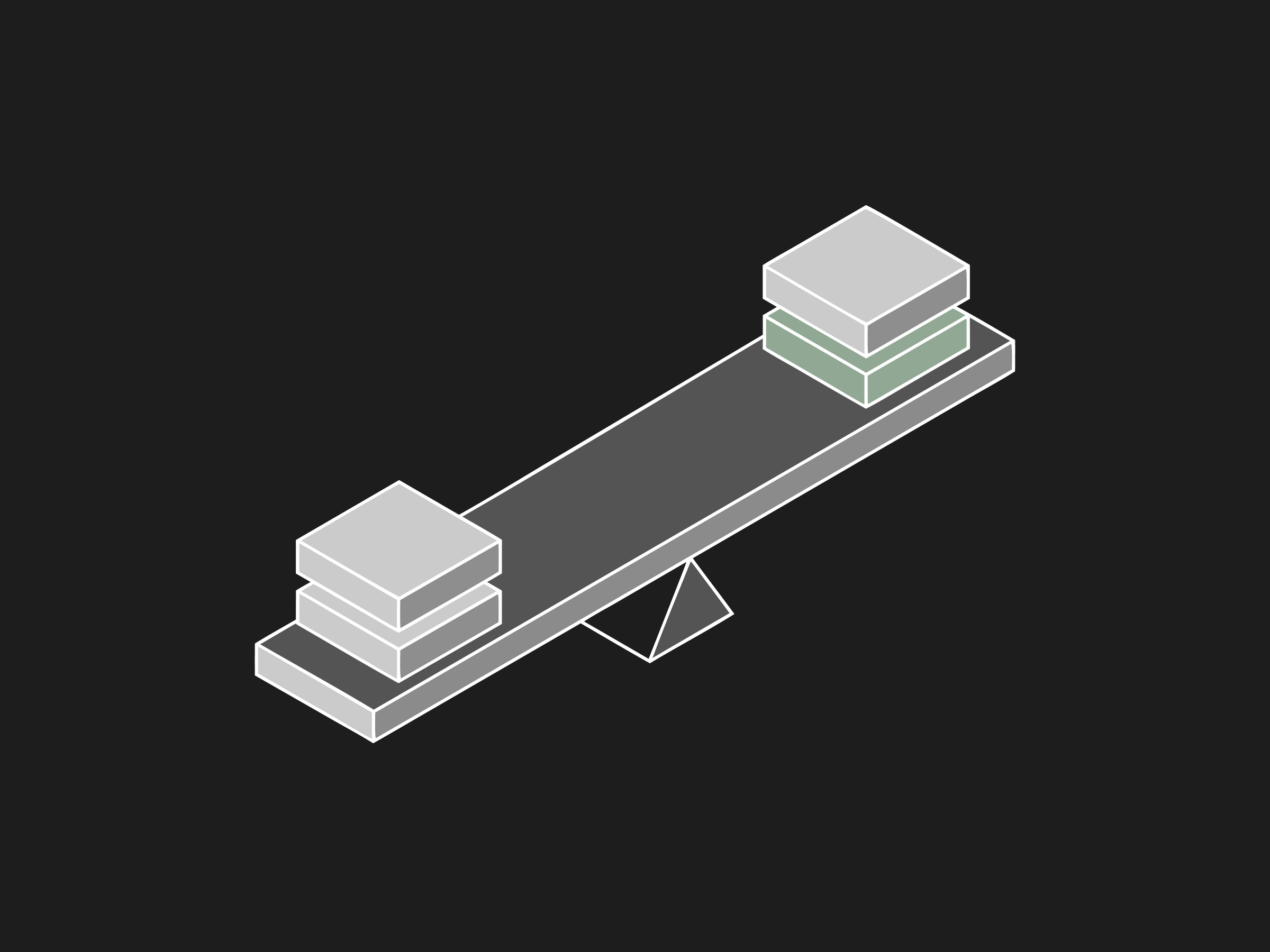
The KPIs move together, which is why you should never optimize one alone. Pushing AHT down by rushing calls tends to lower first call resolution, which creates repeat calls that raise total handle time and cost per contact. Raising occupancy improves efficiency until it crosses roughly 85 percent, where agent attrition climbs and quality falls. Nextiva frames these as a balanced scorecard for the same reason: speed, quality, and cost pull against each other. Two related levers worth their own metrics are IVR containment, which removes volume before it reaches an agent, and after-call work, which is often the hidden third of handle time. Read a KPI as a symptom, then trace it to its neighbors.
How does automation change the baselines?
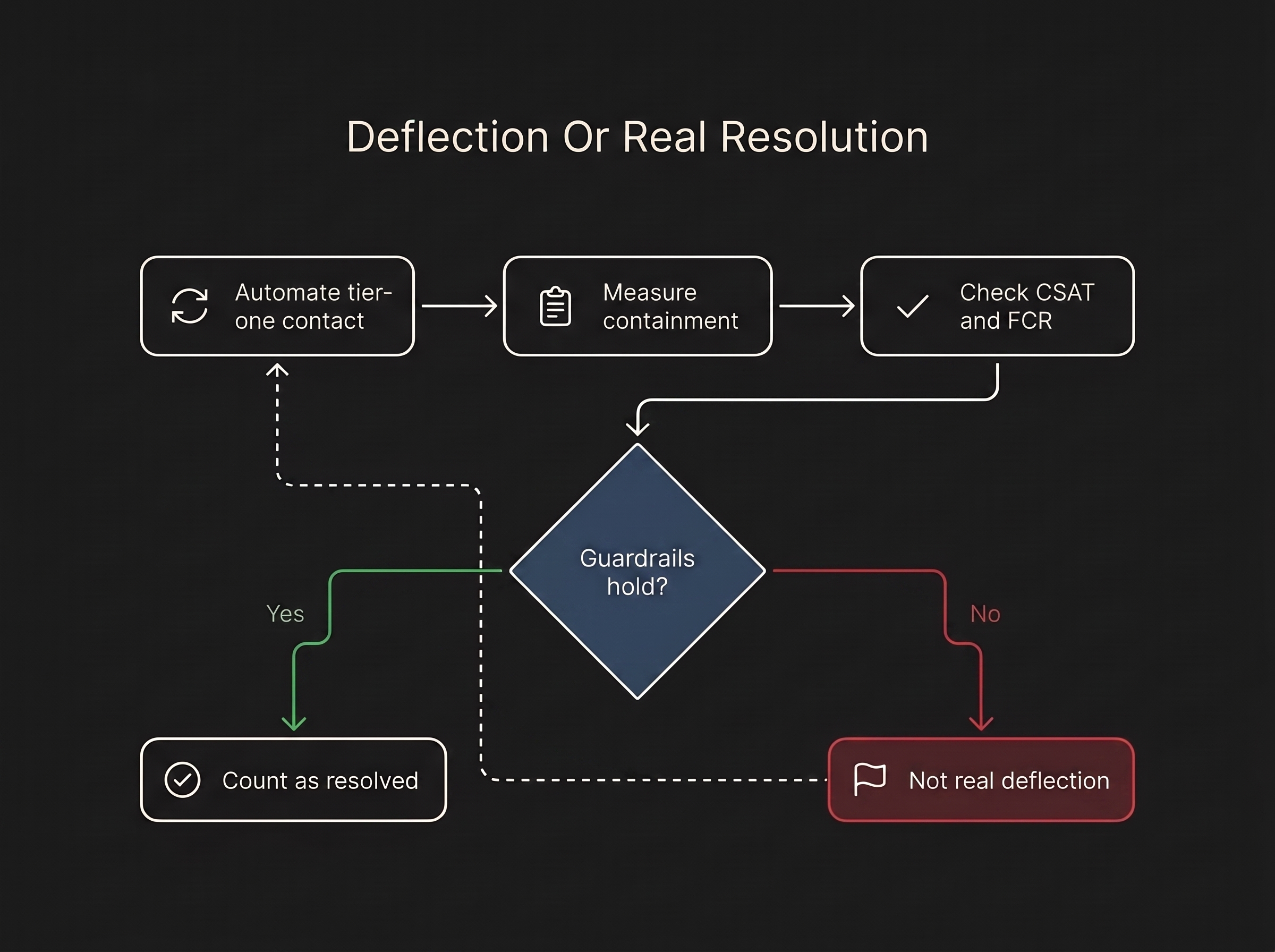
Automation shifts the denominators, so the same target now means something different. When self-service and AI agents resolve a share of tier-one contacts, the calls that reach a human are longer and more complex, so raw AHT can rise even as total cost falls. Gartner projected that conversational AI would cut contact-center agent labor costs by 80 billion dollars in 2026, with about one in ten interactions automated. That means your cost-per-contact and containment metrics become the headline numbers, while handle-time targets need re-baselining for the harder residual mix. In the engagements we run, we hold CSAT and FCR as guardrails so automation is measured on resolution quality, not just deflection. Re-baseline after any automation launch rather than judging new volume against old targets.
How Flexbone helps you hit these KPIs
Flexbone builds audit-first AI agents (voice, browser, document, and desktop) that take repetitive tier-one contacts off the queue in secure, regulated settings. The point is not deflection for its own sake. We instrument the same KPIs above, so you can see containment, cost per contact, FCR, and CSAT move together rather than trading one for another. Because the platform is HIPAA compliant and SOC 2-aligned, it fits BPO, insurance, healthcare, and public-sector queues without new compliance risk. We start by auditing your current numbers, then automate the contact types where the data says it pays.
Book a demo: https://www.flexbone.ai/contact